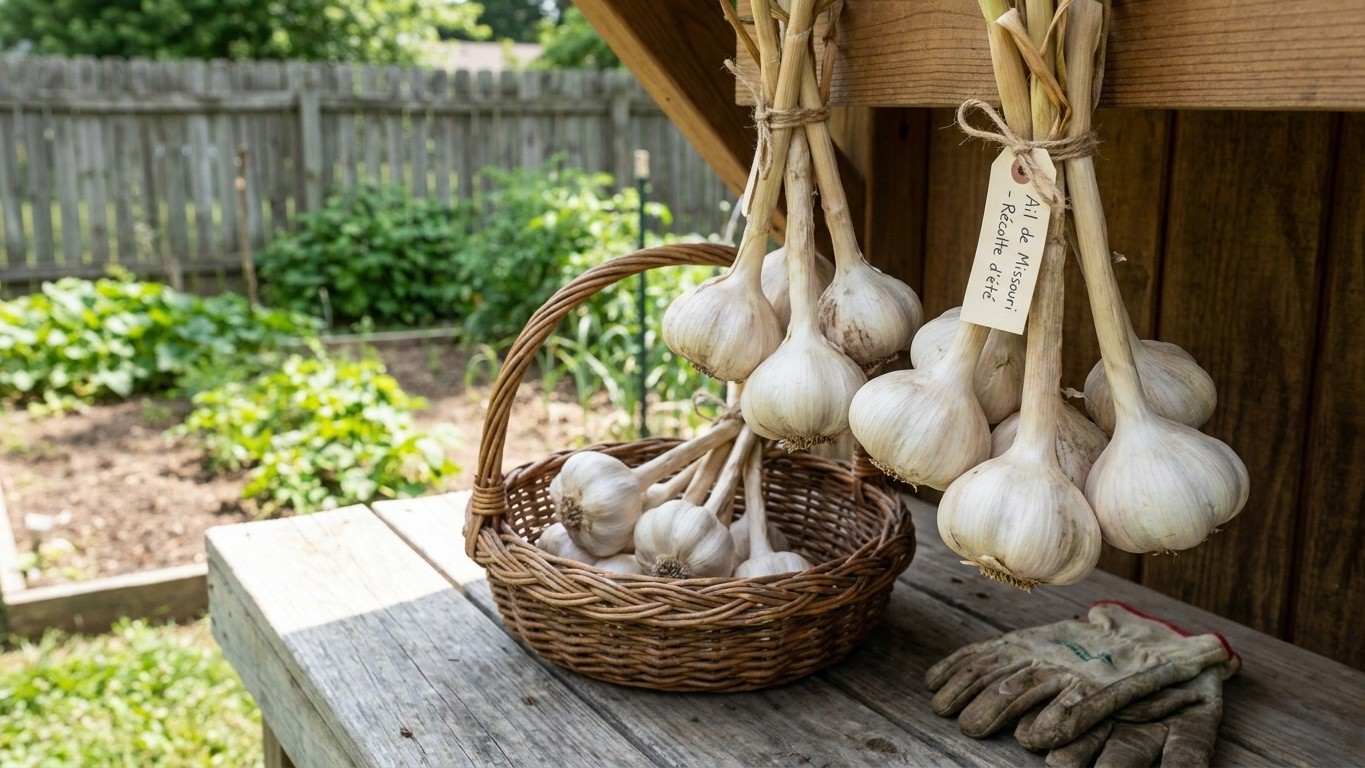

Six to eight weeks below 40°F — that’s what a garlic clove needs before it splits into a proper head instead of growing up into one fat, undivided round. Missouri doesn’t skimp on that. Frost shows up by late October in Kansas City, and cold holds through December, January, into February across most of the state, well past the minimum. Only down in the Bootheel and along the Arkansas line does that margin get thin enough to actually worry about.
Will garlic get the cold it needs in Missouri

Why the clove needs cold at all
A garlic clove planted in the fall has to go through a sustained cold period before it will split into a full head of cloves the next summer. Skip that step, or cut it short, and the plant grows into a single round, undivided bulb, essentially an overgrown clove with no papery segments inside it. University of Georgia Extension publication C854 sets the benchmark growers use nationwide: six to eight weeks of temperatures below 40°F to trigger that division reliably.
What Missouri’s winter actually delivers
Missouri’s winters are a real continental cold season, not a marginal one. With NOAA’s Kansas City data showing the first fall frost arriving by late October at the latest, the cold season that follows stretches on through December, January and into February in most years, far longer than the eight-week floor the University of Georgia sets. That holds for the bulk of the state. Southern Missouri, including the Bootheel and the areas near the Arkansas line, runs milder and closer to the minimum end of that six-to-eight-week window, though still generally enough to satisfy it in an average year.
If you garden in one of those warmer southern pockets, or you’re planting late and worried the clove won’t see enough cold before a warm spell sets in, you have two real options rather than one. The first is to refrigerate seed cloves for four to six weeks before planting, at a temperature similar to a home refrigerator, to front-load the chilling artificially. The second is to plant a softneck variety instead of a hardneck, since softnecks tolerate a shorter or less consistent cold period and still divide acceptably. Checking a guide to Garlic Varieties That Suit Missouri Winters can help you pick the right type for your particular region. Neither option is a downgrade. It’s a matter of matching the clove to the winter you actually have rather than the one a seed catalog assumes.
When to put the cloves in
Anchoring on the frost, not the calendar
Consulting a guide to When to Plant Garlic in Missouri confirms this: planting dates should never be pinned to a month on the wall. They’re pinned to the first fall frost, because the goal is a clove that has rooted into the soil but hasn’t pushed much leaf growth before the ground goes cold. Root first, grow later, is the order you want. NOAA’s 1991-2020 climate normals put that first frost at Kansas City between October 18 and October 29. Split the difference and you land on roughly October 23, the midpoint that window implies for the Kansas City area specifically.
Working back from that midpoint, most Missouri growers aim to get cloves into the ground three to six weeks ahead of the first frost, which puts the planting window at late September through early October, the same window the catalog dates for every variety on this page assume. That gives roots time to establish in still-warm soil without enough time left for the shoot to break the surface and get caught by a hard freeze.
What shifts the window around the state
Kansas City’s frost date is a Kansas City figure, not a Missouri figure. Elevation matters: the higher ground of the Ozark Plateau in the south-central part of the state cools off differently than the flat river bottoms along the Missouri and Mississippi. Northern Missouri, further from any moderating influence and more exposed to cold fronts moving in from the Plains, typically sees frost arrive earlier than the Kansas City normals suggest, while the southeastern Bootheel, at a lower and warmer position, tends to run later. None of that changes the underlying rule: plant by feel for the ground temperature dropping and the season turning, not by a date copied off a page written for a different county.
Which types suit Missouri
The hardneck-versus-softneck choice in Missouri comes down almost entirely to winter, not to taste. Hardneck garlic wants a real cold season to perform well, and produces a central flowering stalk (the scape, which gets cut and used but never pollinates anything on this crop) along with typically larger, easier-to-peel cloves. Softneck garlic tolerates a milder or less predictable winter and, as a bonus, stores for considerably longer in a pantry or root cellar than most hardnecks do.
Given how reliably cold most of Missouri gets, hardnecks are a sound default across the state, and gardeners further north or at higher elevation in the Ozarks will get the most consistent results from them. This is a similar calculation to a place with a genuinely hard winter like Montana, where hardneck is close to the only sensible choice, as covered in our guide to growing garlic in Montana. Softnecks still have a place here, especially for gardeners in the milder southern counties or anyone who wants a braid-worthy neck and a longer shelf life.
Varieties to consider
All of the following are set out on the same late September to early October schedule discussed above, calculated from the Kansas City frost window. Adjust a week or so earlier or later depending on where in the state you garden.
- Hardneck: Bavarian Purple, Blue Music, Chesnok Red, Duganski, Fall Festival, Georgian Crystal, Georgian Fire, German Red, German White, Ivan
- Softneck: Early Red Italian, Inchelium Red, Italian Late, Lorz Italian
Gardeners coming from a milder, wetter climate such as Washington’s, where softneck dominates for good reason, will find that logic reversed here. Our page on growing garlic in Washington lays out why softneck wins on that coast. In Missouri’s colder, drier winter, the calculation tips the other way for most of the state.
Soil and bed preparation
Garlic sits in the same bed for eight to nine months, through the wettest part of the Missouri year in many cases, so drainage is the first thing to solve, well before planting day. A clove sitting in saturated soil over a wet winter will rot long before any fungal disease gets a foothold. If your soil is heavy clay, which is common across much of the state, work in a couple of inches of finished compost across the bed and consider planting on a raised or mounded row rather than flat ground, so water has somewhere to go besides straight down into a clay pan.
Timing the work
Do the heavy digging and amending a few weeks before you actually plant, not the same day. Freshly turned soil needs time to settle, and cloves planted into loose, un-settled ground tend to sink too deep or shift as the soil compacts around them over the following weeks. Clear the bed of the previous crop’s residue, especially anything from the onion or allium family, since that residue is exactly where soilborne disease carries over from one season to the next.
Work a balanced, granular fertilizer or a generous layer of compost into the top several inches before planting, and skip a heavy nitrogen feeding at this stage. Garlic wants nitrogen in spring, when it’s putting on leaf growth, not in fall, when the priority is root establishment ahead of winter. A bed that’s too rich in nitrogen going into winter can push soft, lush top growth right before a hard freeze, which is the opposite of what you want a newly planted clove doing.
What the climate here favours, and what it does not
UC IPM’s Pest Management Guidelines for onion and garlic (UC ANR Publication 3453) publish soil-temperature ranges for the main garlic diseases, and Missouri’s monthly mean air temperatures can be checked against those ranges to see which months open a window for each one. The published thresholds are soil temperatures, while air temperatures run warmer and swing wider than soil does, and a monthly mean sitting inside a disease’s range does not mean every day that month was inside it. A month averaging 65°F has plenty of days above and below that number.
| Disease | Risk level | Months in range (growing season) | Pathogen |
|---|---|---|---|
| White rot | Critical | 5 (Sept, Oct, Apr, May, June) | Sclerotium cepivorum |
| Fusarium basal rot | Critical | 4 (Sept, May, June, July) | Fusarium oxysporum f. sp. cepae |
| Pink root | High | 1 (July) | Setophoma terrestris |
| Southern blight | High | 0 in its optimum range | Sclerotium rolfsii |
White rot’s published range of 50 to 75°F overlaps with Missouri’s air temperatures in five months of the growing season, including one month sitting right at the pathogen’s published optimum, which makes it the disease worth watching hardest here. Fusarium basal rot’s wider 59 to 90°F range overlaps in four months. Pink root’s tighter 75 to 85°F optimum only lines up with one month, July, right around harvest time. None of this means infection is guaranteed, and none of it means a disease is impossible where the count comes back low. Southern blight‘s 86 to 95°F optimum never lines up with a Missouri monthly mean, but that only means the pathogen runs less active here, not that it can’t show up. All four of these pathogens travel on infected seed cloves and in contaminated soil regardless of climate, so sourcing clean seed stock and rotating away from allium beds for a few years matters more than the temperature count ever will.
Getting it through the winter
Mulch is what separates a bed of garlic that sails through a Missouri winter from one that heaves itself half out of the ground by February. Once the soil has cooled and had a light frost or two, lay down three to six inches of straw or shredded leaves over the bed. Mulch too early, while the soil is still warm, and you trap heat that encourages exactly the leaf growth you were trying to avoid by waiting to plant.
The mulch does two jobs over winter. It insulates the soil against the sharpest temperature swings, and it slows the freeze-thaw cycling that causes heaving, where repeated freezing and thawing of wet soil physically pushes a shallow-planted clove up and out of the ground. A clove planted too shallow to begin with, less than about two inches deep, is the one most likely to end up heaved onto the surface by a late-winter thaw, exposed to cold and drying wind with no soil contact at all. Deep, even planting matters as much as the mulch does.
Leave the mulch in place through the cold months and pull it back gradually in spring once new green shoots start pushing up through it, rather than stripping it off all at once on the first mild day. A layer left too thick into spring can smother emerging shoots or keep the soil wetter and cooler than the plant wants once it’s actively growing again. Most growers rake the bulk of it off to the side once shoots are a few inches tall, leaving a thin layer behind to suppress weeds through the growing season.
Harvest and curing here
Garlic tells you when it’s ready far more reliably than any date on a calendar does. Watch the leaves: once roughly the bottom half of the plant’s leaves have browned and died back while some green remains up top, the bulb is mature and ready to lift. Pull too early, while too many leaves are still green, and the wrapper layers around each clove haven’t finished forming, leaving bulbs that don’t store well. Wait too long, past the point where most leaves have browned, and the wrapper starts to split and the individual cloves separate in the ground.
Lift bulbs by loosening the soil with a fork rather than pulling on the stalk, which tends to snap the neck away from the bulb. Brush off loose soil but don’t wash the bulbs, and don’t trim roots or tops yet.
Curing in Missouri’s summer
Curing is where a lot of an otherwise good crop gets lost, and Missouri’s summer humidity makes it a genuine risk rather than a formality. Bulbs need to dry somewhere out of direct sun, with good airflow, for several weeks, before they’re trimmed and stored. A garage or covered porch with a fan running works better here than it does in a drier climate, because still, humid air around freshly pulled bulbs is exactly what invites mold and soft rot to set in before the wrappers have finished drying down. Spread bulbs in a single layer, or hang them in loose bunches, rather than piling them, and check periodically for any bulb going soft so it doesn’t spread to its neighbors.
Local help
County-level frost dates, soil test results and current disease pressure all vary across a state as long as Missouri. For anything more local, University of Missouri Extension runs county offices that can pull frost data and soil testing for your exact location, which is worth doing before you commit a bed to a crop that’s in the ground for the better part of a year.
Common questions
Can I Plant Garlic in spring in Missouri instead of fall?
You can, but you’ll get much smaller bulbs. Garlic planted in spring misses the extended cold period that triggers clove division, and even a spring-planted clove that does divide has a shorter growing season ahead of it before summer heat shuts bulb growth down. Fall planting, timed to the frost window discussed above, is what gets you full-sized heads.
My garlic put up leaves before winter. Did I plant too early?
Probably, or the fall was unusually warm. Some top growth before a hard freeze isn’t fatal, since garlic is tough, but a lot of lush green growth going into winter leaves more tissue exposed to cold damage. A thick mulch layer helps protect what’s already up. Next season, aim for the later end of the planting window rather than the earlier end.
Do I need to break the bulb into cloves right before planting?
Yes, and do it as close to planting day as you can, ideally the same day or the day before. Cloves that sit broken apart for a week or more start to dry out at the base plate, which slows root formation once they’re finally in the ground.
Is it too late to plant if I missed the late September to early October window?
Not necessarily, but the margin shrinks fast. Cloves can still go in through much of October in most of the state, as long as the ground isn’t frozen and you get them in before the first hard freeze rather than after it. Planting right at or after that frost date leaves little time for root establishment before winter fully sets in.
Why did some of my bulbs come up as a single round clove with no divisions?
That’s the classic sign of insufficient cold before or during the growing season, sometimes called a “round” instead of a bulb. It happens most often with seed stock planted too late to get enough chilling, or with softneck varieties grown from cloves that never experienced a proper vernalization period. Replanting with fresh, properly chilled seed the following fall usually corrects it.