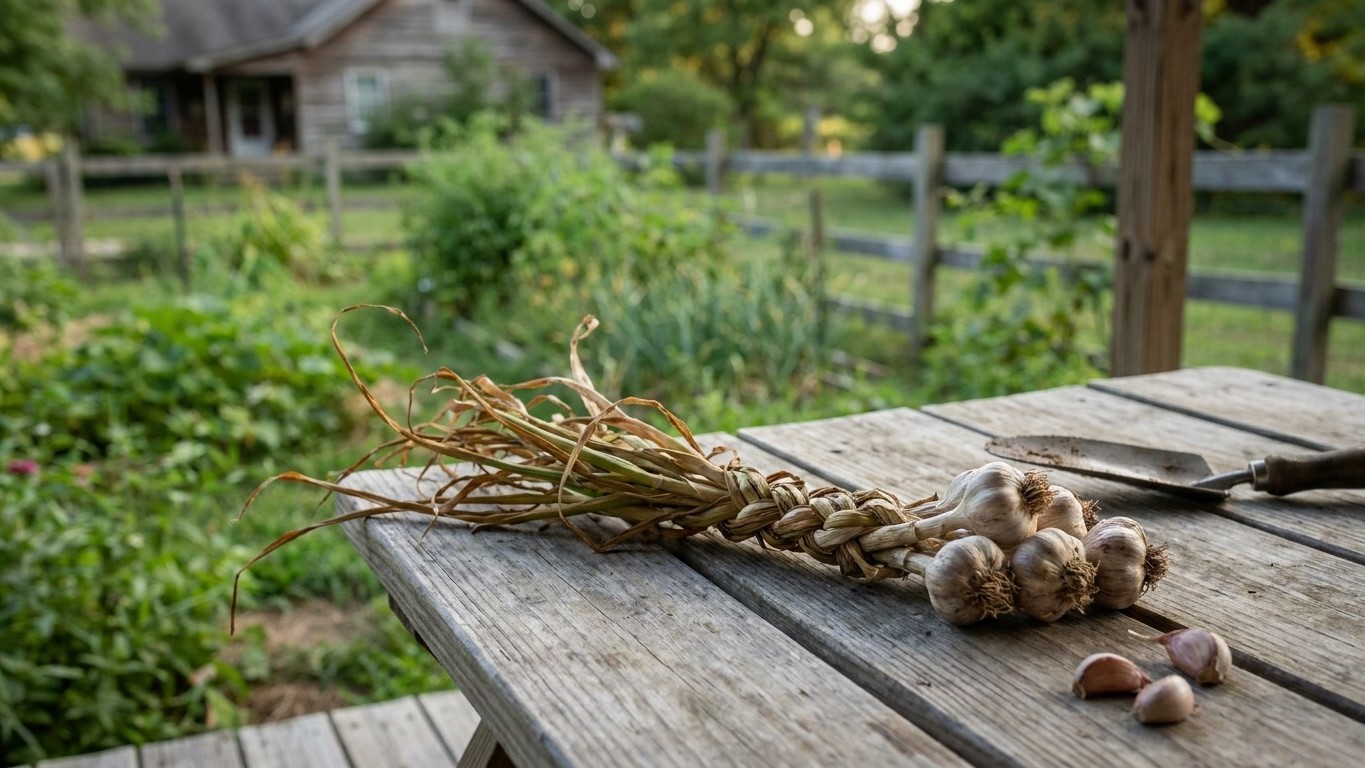

Every garlic variety on this list will make it through a Missouri winter just fine, so the question worth asking isn’t which one survives, it’s which one you’ll actually want to eat and when to get it in the ground. Plant three to five weeks before your area’s first fall frost, generally late September through early October, and let the variety come down to flavor and how long it keeps, not whether the cold will kill it. Start by marking that planting window on your calendar before you pick a cultivar.
The short answer for Missouri

Every variety on the list below will overwinter here without special protection. NOAA’s NCEI 1991-2020 normals put the Kansas City area’s first fall frost between October 18 and October 29, a light frost rather than a hard freeze, and garlic planted ahead of it has the whole winter to build roots before it needs real cold to trigger clove division. University of Georgia Extension (publication C854) puts that chilling requirement at six to eight weeks below 40°F, and a Missouri winter runs an average of 21.8 weeks below 40°F, more than double what any variety on this list needs. That gap is why the choice of variety here comes down to kitchen preference, not survival odds.
That October 18-29 window is a midpoint, not a guarantee. In one year out of two, the first fall frost near Kansas City arrives later than this range, sometimes well into November, and treating either end of the window as a hard deadline is a mistake. The safer read is to treat late September through early October, the planting window every cultivar on this list shares, as the target, and let a later frost be a bonus rather than something you planned around.
If you haven’t chosen a site or worked up the bed yet, the full walkthrough is in Growing Garlic in Missouri. Once the ground is ready, here’s what’s available:
- Softneck: Early Red Italian, Inchelium Red, Italian Late, Lorz Italian
- Hardneck: Bavarian Purple, Blue Music, Chesnok Red, Duganski, Fall Festival, Georgian Crystal, Georgian Fire, German Red, German White, Ivan
Working it out for your own garden
The six-to-eight week clove-splitting requirement from University of Georgia Extension is the number to work backward from, but it needs a start date, and that start date is a frost window, not a single calendar day. Missouri doesn’t have an ocean or a Great Lake to referee its temperature the way a coastal state does, but the state still runs wide enough, north to south, that a date drawn from one Kansas City weather station won’t fit every county evenly.
The count-back itself
Start with NOAA NCEI’s 1991-2020 window for the reference station near Kansas City, October 18 to October 29. Garlic wants three to five weeks of root growth in soil that’s cooling but not yet frozen, so counting back three to five weeks from that frost window lands you in late September to early October, which is exactly the planting window the catalog gives for every variety in this territory, hardneck or softneck. That’s not a coincidence. The catalog date and the frost-window arithmetic describe the same requirement two different ways. For the week-by-week version of this count-back, see When to Plant Garlic in Missouri: Counting Back From the First Frost.
Redoing the math for your county
If your county’s frost typically lands earlier or later than the Kansas City figure, shift the whole planting window by the same number of days. Don’t just move the frost date and leave the count-back period fixed, because the vernalization clock and the rooting period both run on the season’s temperature curve, not a fixed date on paper. Elevation changes across Missouri are modest compared with a mountain state, but they still matter at the margins. A low bottomland garden along a river holds cold air on a still night the way a hilltop garden never does, and that frost-pocket effect can beat or lag the regional average by more than a week even inside the same county. Shift the planting window, not just the frost date, and you’ll stay in step with your own ground rather than Kansas City’s.
What changes across Missouri
The October 18-29 window belongs to the reference station used in NOAA’s NCEI normals, which sits at Kansas City’s airport, north of the city center. The CAUTION attached to that data notes the downtown station runs about five days earlier in spring, meaning the airport reading already leans toward the cooler side for the metro area. Anyone gardening south or east of that station should expect the bias to run the other way in autumn, toward a later first frost, not an earlier one.
Southern Missouri, including the Ozark hill country and the Bootheel lowlands near the Mississippi, runs milder than the Kansas City figures in every season, first frost among them. St. Louis, sitting in the wide Mississippi floodplain and carrying a large city’s heat island, tends to hold warmth into autumn longer than open farmland nearby does. Higher ground in the Ozark plateau can run against that pattern, holding cold air in valleys even at a southern latitude.
| Region | Runs relative to the Kansas City reference | Main cause |
|---|---|---|
| Northern Missouri farmland | Frost arrives earlier | Open, unsheltered ground, no city or river moderation |
| Kansas City metro (downtown) | Runs slightly later than the airport figure | Urban heat island near the downtown station |
| St. Louis metro | Frost arrives later | River floodplain plus a large city’s heat island |
| Ozark plateau hill country | Can run earlier despite southern latitude | Higher elevation and cold air pooling in valleys |
| Bootheel lowlands | Frost arrives latest in the state | Lowest elevation and southernmost latitude |
The mistakes this climate punishes
Missouri’s cold season runs deep enough that under-chilling isn’t the risk here. The mistakes that actually cost a crop are about timing and disease pressure instead, and both start with planting too early while the soil is still warm from summer.
Disease pressure tied to timing
UC IPM’s guidelines for onion and garlic, UC ANR Publication 3453, put white rot‘s active range at 50 to 75°F soil temperature, and near Kansas City the average air temperature falls inside that band across September, October, April, May and June, five months of the growing season, with one of them at the pathogen’s published optimum. Soil lags air and swings less than a monthly average shows, so this is a count of months where the disease could be active, not a forecast that it will appear. The one move that matters regardless of the calendar: start with certified disease-free seed stock, because white rot travels into a garden on infected cloves and then persists in the soil for years once it’s established.
Fusarium basal rot‘s published range runs 59 to 90°F, overlapping four months here (September, May, June, July) with its optimum in one of them, and that stretch lines up with bulb sizing and the curing period after harvest. A hot, humid early summer right when bulbs are curing is exactly when stored garlic starts rotting from the base up. Skipping a proper cure with good airflow because the harvest looks finished is the mistake that turns a healthy-looking crop into a spoiled one in storage a few months later.
Planting too shallow
The other error specific to this climate is setting cloves shallow and skipping mulch. Missouri’s winter delivers plenty of cold overall, but it arrives as repeated freeze-thaw cycles rather than one steady deep freeze, and cloves set only an inch or two deep can heave right out of loosened soil during a January warm spell. A few inches of straw mulch put down after planting solves this, and it costs far less than replanting a heaved bed in spring.
Checking this against your county
Every figure above comes from one reference station near Kansas City, and Missouri stretches across enough latitude that a grower in the Bootheel or the northern border counties shouldn’t plant on Kansas City’s calendar without checking their own. Missouri Extension, at extension.missouri.edu, publishes county-level guidance and keeps local contacts who track frost records closer to your own ground than any single weather station can.
Common questions
Can I plant garlic in spring instead of fall in Missouri?
You can, but expect smaller bulbs. Garlic is planted in autumn and lifted the following summer because the cloves need a stretch of real cold to divide, and a spring-planted clove misses most of that chilling window, so it often grows as a single round bulb instead of a full head of cloves.
Should I grow hardneck or softneck garlic in Missouri?
Either does fine here, since the state’s winter cold clears what both types need with room to spare. The practical difference is in the kitchen and the pantry: softneck types generally hold up longer in storage, while hardneck types are the ones most growers reach for on flavor first.
What happens if I miss the late September to early October window?
You can still plant into November in most years, but the crop takes the hit, not the plant’s survival. Cloves need real time to root before the ground locks up hard, and a late-planted clove that hasn’t rooted well going into winter usually sizes up smaller the following summer.
Do I really need to mulch garlic over a Missouri winter?
Yes, and it has less to do with cold than with the freeze-thaw cycling that Missouri winters run through repeatedly. Mulch keeps soil temperature more even and stops cloves from heaving loose during a warm spell between hard freezes, which is a bigger risk here than the cold itself.