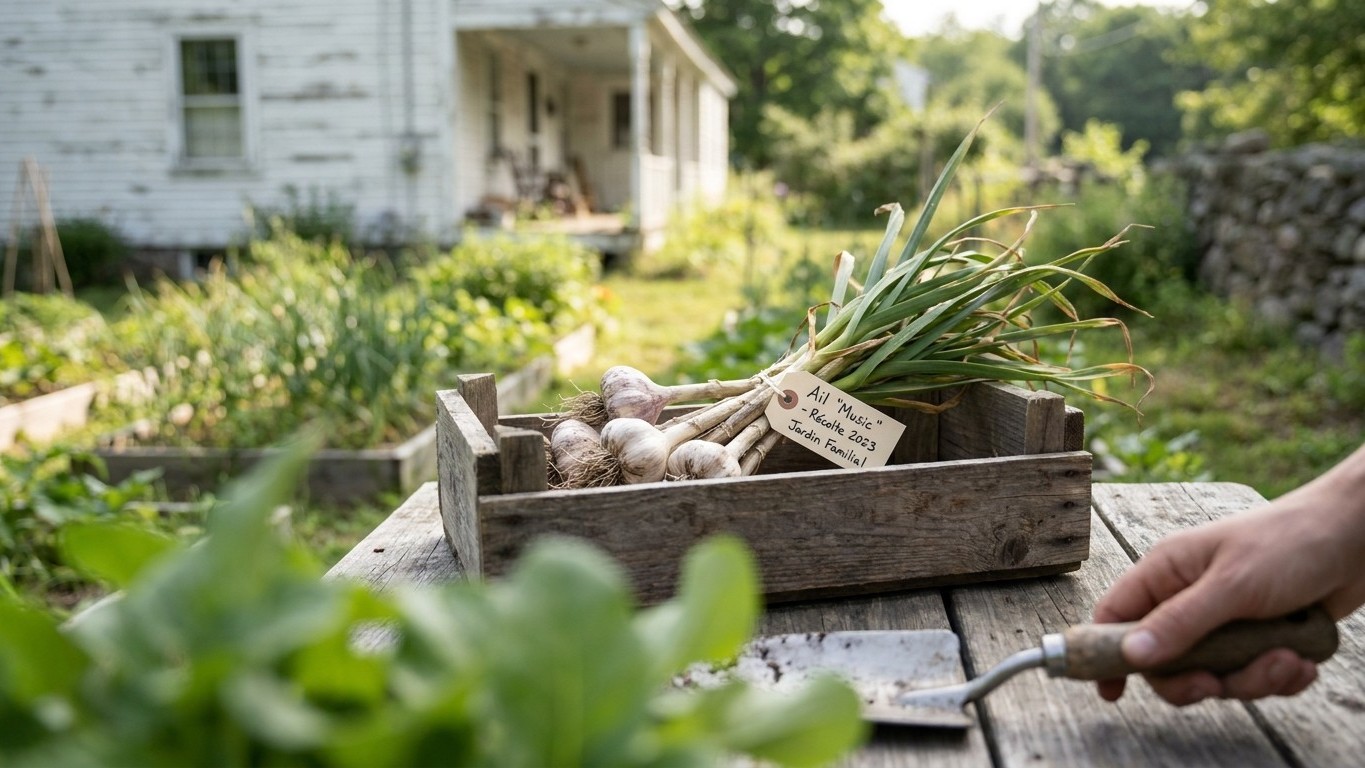

Mid October to late October is the window, full stop — hardneck or softneck, Chesnok Red or Inchelium Red, the clove doesn’t care which variety’s name is on the bag. Garlic isn’t a tomato you count forward from; it’s set by soil cooling and vernalization, which means every variety sold for New England planting shares the same few weeks in the ground. That window gets anchored to frost dates, but frost itself is the wrong thing to wait for, and the numbers behind it explain why.
The short answer for Massachusetts

Mid October to late October is the set-out window for every garlic variety sold for New England planting, hardneck or softneck alike. That includes softnecks such as Inchelium Red and Lorz Italian, and hardnecks such as Chesnok Red, Duganski and German Red. Garlic’s planting date does not shift by variety the way a tomato transplant date shifts with days-to-maturity, because the clock here is set by soil cooling and clove vernalization, not by counting forward to harvest.
That window is anchored on NOAA’s NCEI 1991-2020 climate normals, which put the Boston-area station’s first fall frost between November 3 and November 14. Treat that range as a midpoint, not a deadline: it comes from a 30 to 70 percent freeze-probability band, which means that in roughly half the years on record, frost at that station arrives before November 3 or after November 14. Planting to the calendar window rather than waiting for frost itself is what keeps a grower from getting caught out in an early year.
Once cloves are in, Massachusetts winters supply more cold than garlic strictly needs to split into cloves. NOAA’s station data show the region spending roughly 21.8 weeks a year with temperatures below 40°F, comfortably clearing the six to eight weeks of chilling the University of Georgia Extension (publication C854) says garlic requires. The limiting factor isn’t cold, it’s root establishment. That’s why the October window matters more than worrying about whether the winter ahead will be cold enough.
Working it out for your own garden
The arithmetic behind the October window is simple enough to redo for your own site, and worth doing rather than taking the catalogue range on faith.
Counting back from frost
Start with NOAA’s NCEI 1991-2020 normals for the Boston-area station: first fall frost between November 3 and November 14. Garlic wants somewhere two to four weeks of soil above freezing after planting to push roots down before top growth stops for winter. Subtract two weeks from the earliest date in that frost range and you land in the third week of October. Subtract four weeks from the latest date and you land in the third week of October from the other direction. That’s the arithmetic behind “mid to late October”: it’s the overlap of two ranges, not a single calculated day, and it should stay written as a range for the same reason the frost date does. If you haven’t yet worked out bed prep and soil amendments, the basics are covered in Growing Garlic in Massachusetts.
Adjusting for your site
The Boston-area station sits at Logan Airport, a waterfront urban site and the mildest spot in the state. NOAA’s own caution with this data is that inland suburbs and the Berkshires frost noticeably earlier in fall than that reading suggests, and later in spring. A garden twenty minutes inland from Boston, in a low frost pocket or at meaningfully higher elevation, should plan on the earlier days of the October window, not the later ones, because its own local frost date runs ahead of the Logan reading. A garden right on the water, sheltered from wind and buffered by the ocean’s stored summer heat, can lean toward the later end.
Cold air is heavier than warm air and drains downhill overnight, which is why valley bottoms and low fields frost earlier than a slope fifty feet above them even a short distance away. If your garlic bed sits in a natural low spot, in a hollow, or at the base of a hill where morning fog tends to collect, treat that spot as running a week or two ahead of the general district reading, not behind it.
What changes across Massachusetts
Massachusetts is not one climate, and the Boston-area frost figures shouldn’t be applied unchanged to the whole state.
Western Massachusetts and the Berkshires
The Berkshires and the higher ground of Franklin and Hampshire counties sit well above sea level and away from any ocean moderation, which pushes their frost season earlier in the fall and later into spring than the Boston-area reading implies. A grower in this part of the state should treat the October window as a target for the front end, not the back end, and check a station closer to home rather than relying on the Logan figure at all.
The Connecticut River Valley and the coast
The Connecticut River Valley, running through Hampden and Hampshire counties, tends to run slightly milder than the surrounding hills because the river moderates temperature swings and the valley floor holds some of that heat. Cape Cod, the Islands and the immediate South Coast get the strongest ocean buffering in the state, which is the same effect that keeps the Logan station’s own readings mild relative to inland Massachusetts. The Merrimack Valley and the hill towns of Worcester County fall somewhere between these extremes, closer to inland behavior than coastal.
None of this changes the length of the set-out window itself, mid to late October holds up as the target across the state. What it changes is which end of that window you should be planting toward, and how much slack you have if a fall planting weekend gets rained out.
The mistakes this climate punishes
Two kinds of mistakes show up every year in Massachusetts garlic beds, and both trace back to treating the planting window as flexible when it isn’t.
- Planting before mid-October, while soil still holds summer heat
- Setting cloves too shallow, so freeze-thaw cycles heave them out of the ground over winter
- Skipping mulch on an open, wind-exposed bed going into a cold winter
- Planting stock from a grocery bin instead of certified seed garlic
Timing and depth
Planting too early, into soil that’s still warm from summer, invites top growth before winter that then gets knocked back hard by the first real cold snap, weakening the plant going into the season that actually matters for bulb size. Planting too late runs the opposite risk: not enough of that two-to-four-week root-establishment window before the ground stops giving cloves anything to grow into. Shallow planting compounds a cold winter’s own freeze-thaw cycling. Massachusetts’s roughly 21.8 weeks below 40°F is plenty of cold for garlic’s needs, but it’s also plenty of freeze-thaw cycling at the surface to heave a shallow clove halfway out of the ground by February. A few inches of straw mulch after the ground begins to firm up solves this cheaply.
Disease that doesn’t wait for your calendar
Seed stock matters as much as timing. UC IPM’s Pest Management Guidelines for onion and garlic (UC ANR Publication 3453) list white rot, caused by the fungus Sclerotium cepivorum, as active across a 50 to 75°F range, a band that Massachusetts’s own air temperatures fall into during five months of the growing season, including September and October, the very months garlic goes into the ground. That’s an air-temperature reading, not the soil temperature the published threshold actually describes, and it comes from a single reference station, not a statewide survey, so treat it as context rather than a forecast. It doesn’t mean the disease is present in your soil. It means that if it is, autumn planting temperatures won’t be what keeps it in check. Buying certified disease-free seed garlic, rather than saving cloves from an unknown source or splitting a grocery-store bulb, is the actual defense, regardless of which week you plant.
Checking this against your county
Every figure above comes from one Boston-area station, and Massachusetts is long enough, north to south and coast to hills, that a county-level check is worth the five minutes it takes. The University of Massachusetts Amherst’s Extension service, the state’s federally recognized land-grant extension per the USDA NIFA directory, is the right first call for a frost date and planting recommendation specific to your own county. If you haven’t settled on a cultivar yet, Garlic Varieties That Suit Massachusetts Winters is the next thing to read before you order cloves.
Common questions
Can I still Plant Garlic in spring instead of fall?
You can, but expect smaller bulbs. Garlic planted in fall gets a long stretch of cold soil to develop roots and go through the chilling that triggers clove division before top growth even starts. A spring-planted clove skips most of that and tends to bulb up as a single round rather than dividing properly.
What do I do if it’s already November and I missed the window?
Plant anyway if the ground isn’t frozen solid. The frost date is a midpoint, not a deadline, so soil often stays workable well past it, especially near the coast. Go a little deeper than usual and mulch heavily right after planting, since the roots will have less time to establish before real cold sets in.
Should I use the Boston frost date if I don’t live near Boston?
Only as a starting point. The Boston-area station used for these normals sits at Logan Airport, a waterfront site and the mildest spot in the state, so inland and higher-elevation gardens should expect their own first frost earlier in the fall. Check with the University of Massachusetts Amherst’s Extension service for a figure closer to your own county.
Does it matter if I plant hardneck or softneck garlic in Massachusetts?
Not for winter survival. The state’s winter cold is well beyond what either type needs, so the choice comes down to flavor, scapes and storage life rather than cold-hardiness. Hardnecks like Georgian Crystal or Bavarian Purple produce scapes and tend toward bolder flavor, while softnecks like Early Red Italian or Italian Late store longer in a pantry.
If you follow the almanac, here is when to plant garlic by the moon. It is a tradition, not a proven method.