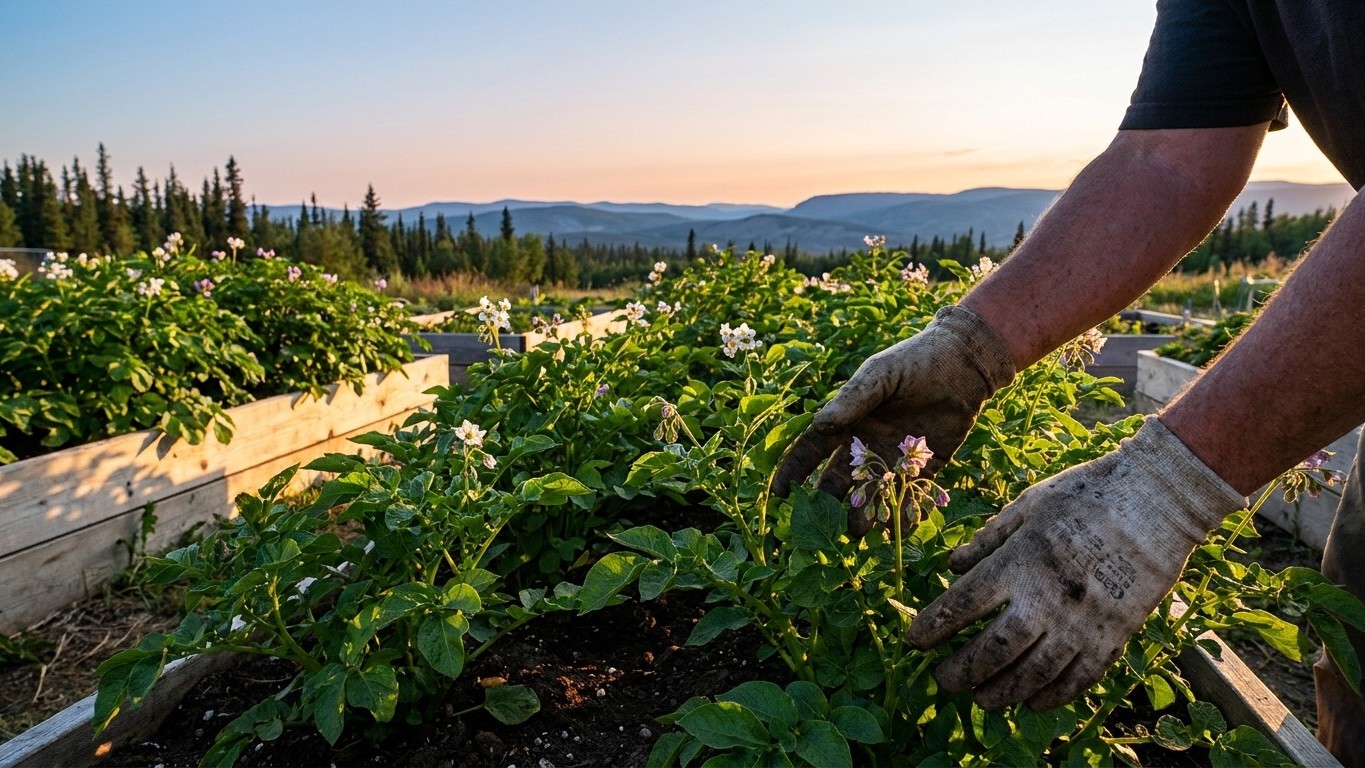

In Yukon, summer heat never gets in the way of a potato crop. Whitehorse averages 0.0 days a year at 90 F or above, so tuber set and fill run uninterrupted from planting to harvest. The limiting factor here isn’t heat, it’s the short, cool season itself and a frost window that closes late and reopens early.
The short answer
Two numbers set the whole calendar for a Yukon potato patch. The first is heat load: Utah State University Extension identifies 90 F soil temperature as the point where tuber set and fill stop, and at the Whitehorse reference station that threshold is crossed, on average, exactly zero days a year. The second is timing: the average last spring frost at Whitehorse A falls on June 5. Those two facts together mean something specific for this territory, and it’s the opposite of the problem most of the U.S. deals with.
Where summer routinely tips past 90 F, a gardener has to rush the crop into the ground early and dig it before the heat shuts tuber growth down. Yukon doesn’t have that problem. With essentially no days above the 90 F ceiling, potatoes here can run a full, unhurried season from planting straight through to a fall harvest, with no risk that a July or August hot spell will stall the tubers underground. The constraint flips: instead of racing the thermometer, a Yukon grower is racing the calendar in the other direction, working around a frost-free window that opens late and doesn’t leave much slack in either direction.
That changes what “variety” means for this climate. Neither Utah State University Extension nor the University of Maine Cooperative Extension publishes a days-to-maturity figure for any potato variety. What both sources do publish is season class, early, mid-season, or late, and what each type is suited for, baking or boiling. In a territory with a compressed season, an early or mid-season class gives the tubers the best chance of reaching a useful size before fall frost ends the growing period, while a late-season type is a harder bet unless the local microclimate runs mild. For a closer look at which season classes fit this territory best, see Potato Varieties That Suit Yukon.
None of this means the crop is easy. A short season with a late average frost date is its own kind of limit, just a different one than heat. The planting arithmetic, what happens underground when soil temperature climbs, and the mistakes this climate tends to punish all lead to Harvesting and Storing Potatoes in Yukon once that frost-free window closes.
When to plant here
For full planting details, see When to Plant Potatoes in Yukon. Potatoes go into the ground once soil temperature reaches 50 F, and that point falls 14 to 21 days before the last frost date, according to University of Maine Cooperative Extension guidance. Working backward from the Whitehorse average gives a Yukon gardener a starting figure to test against their own ground.
- Start from the frost date. Whitehorse A averages a last spring frost on June 5. That’s a mean, not a guarantee: in one year out of two, frost arrives later than that date, so treat June 5 as the middle of a window, not a line you can plant right up against.
- Count back 14 to 21 days. From June 5, that lands the target planting window in roughly the third week of May, give or take, depending on how the current season is running.
- Confirm with a soil thermometer, not the calendar. The 50 F threshold is a soil reading, not a date. A cold, wet spring can push the safe planting window later even if the calendar says it’s time; a mild one can pull it earlier.
- Hold back if the soil is still cold and wet. Seed potatoes set into cold, wet ground before it warms are vulnerable to rot before they ever sprout, regardless of what the date on the wall says.
The arithmetic itself travels anywhere: take the local last-frost average, subtract 14 to 21 days, then verify with a thermometer pushed a few inches into the soil rather than trusting the count alone. What doesn’t travel is the June 5 figure itself, which is specific to the Whitehorse A station and nowhere else in the territory.
What the heat does to the crop
The mechanism is straightforward and explains why Yukon’s growing conditions work the way they do. Once soil temperature climbs past 90 F, tuber set and fill are inhibited, according to Utah State University Extension. The plant doesn’t die, and the foliage can look fine, but the tubers underground stop sizing up. Watering more doesn’t reverse it, because the problem isn’t a lack of moisture, it’s the soil temperature itself acting directly on tuber development.
In states where 90 F days pile up through July and August, that mechanism forces a hard choice: plant as early as the frost date allows, and either dig a spring crop before the heat arrives or accept that a summer-planted crop will stall. Neither option is comfortable, and irrigation schedules don’t solve it.
Yukon sits on the opposite end of that spectrum. With 0.0 days a year reaching 90 F at the Whitehorse reference station, the soil essentially never crosses the threshold that shuts tuber growth down. A potato crop planted after the soil hits 50 F in spring can keep filling tubers straight through summer without hitting a heat ceiling at any point in the season. There’s no need to rush toward an early spring-only harvest to dodge a heat wave that, statistically, isn’t coming.
The tradeoff is that a short, cool season brings its own limits, just not this one. A grower here isn’t managing heat stress on the tubers; they’re managing a compressed window between a late spring frost date and the onset of fall frost, and choosing a season class that fits inside it.
What goes wrong here
- Planting uncertified seed potatoes. Seed that isn’t certified disease-free can carry viruses that stunt the plant and reduce the harvest before the season even gets underway. Buying certified seed potatoes each year is the single easiest way to avoid starting the crop already compromised.
- Planting into soil that’s still cold and wet. Setting seed potatoes into ground that hasn’t reached 50 F, especially if it’s also waterlogged from spring melt, invites rot before sprouting. Wait for the soil reading, not just the calendar date, before planting.
- Skipping the hilling and ending up with green tubers. Tubers that develop near the surface and get exposed to sunlight turn green and produce solanine, which makes them unfit to eat. Hilling soil up around the stems as the plant grows keeps developing tubers covered and out of the light.
- Digging too early. Pulling potatoes before the plant has finished its growth cycle means smaller tubers and thinner skins that don’t store well. Given how short the Yukon season already runs, it’s tempting to dig early out of anxiety about incoming fall frost, but that trade rarely pays off in yield or storage quality.
Checking this against your own county
The Whitehorse figures describe one station, not the whole territory. Elevation shifts frost dates by weeks in either direction, and a valley bottom holds cold air differently than a south-facing slope a few miles away. Northern Yukon communities can run well behind Whitehorse’s averages, while a sheltered, low-elevation garden might see frost lift earlier than the territory-wide figure suggests.
Treat the June 5 average and the 90 F count as a starting point for planning, then confirm the specifics locally. Agriculture and Agri-Food Canada, at agriculture.canada.ca, is the federal resource point for growers looking to check conditions and guidance closer to their own ground before committing seed potatoes to soil that may still be colder, or warmer, than the territorial average implies.
Common questions
Does Yukon ever get hot enough to stop potatoes from sizing up?
Essentially no. Whitehorse averages 0.0 days a year at 90 F or above, the threshold Utah State University Extension identifies as the point where tuber set and fill stop. That heat ceiling almost never applies here.
When is it safe to Plant Potatoes in Yukon?
Once soil temperature reaches 50 F, which typically falls 14 to 21 days before the last frost date. At Whitehorse A, the average last frost is June 5, putting the target window around mid-to-late May, confirmed with a soil thermometer rather than the calendar alone.
Which potato variety grows best in a short Yukon season?
Neither Utah State University Extension nor the University of Maine Cooperative Extension publishes days-to-maturity figures, so no specific number applies. What they do publish is season class: early and mid-season types are generally the safer fit for a compressed growing window, chosen by what they’re suited for, baking or boiling.
Why do some tubers turn green, and are they safe to eat?
Tubers exposed to sunlight near the soil surface turn green and develop solanine, which makes them unsafe to eat. Hilling soil around the stems as the plant grows keeps tubers covered and prevents this.