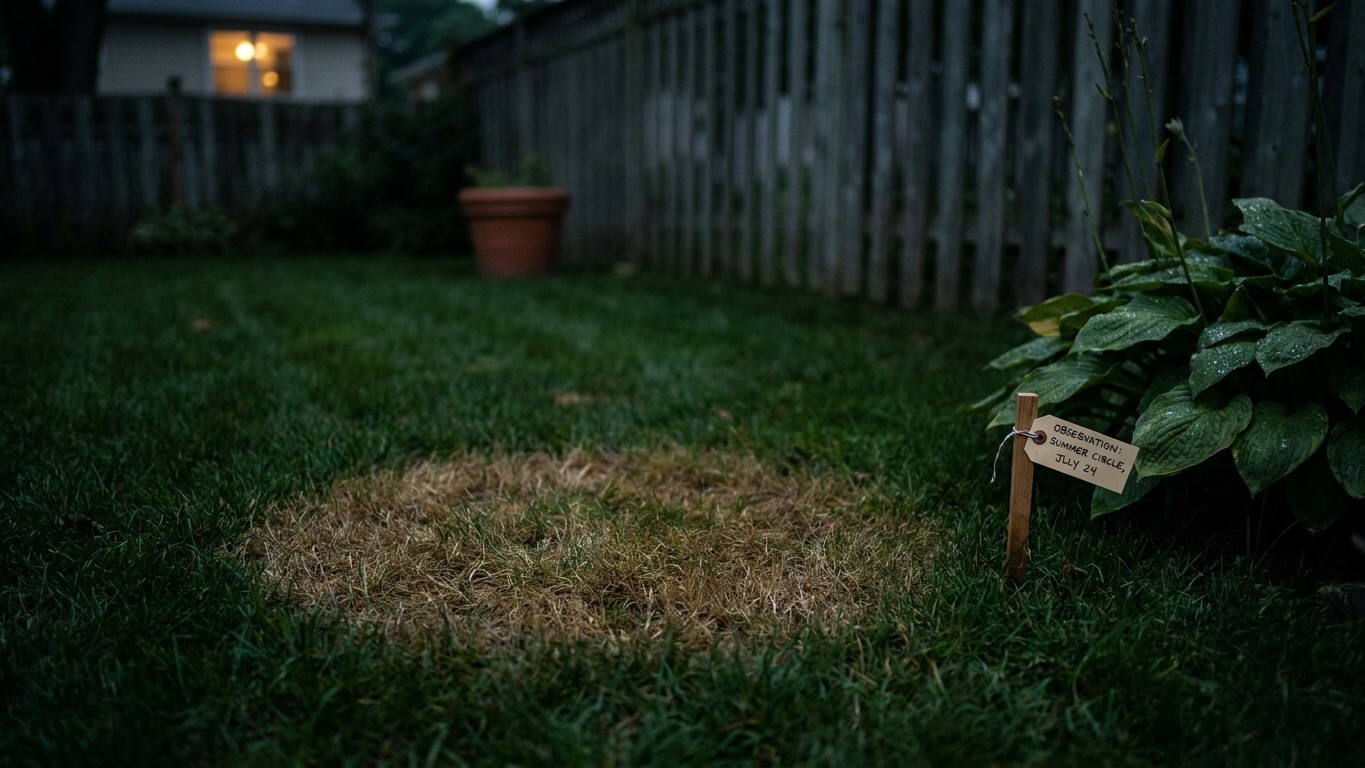

Brown patch is a fungal disease that shows up as roughly circular patches of tan or dead-looking grass, usually a few inches to a couple of feet across, appearing during stretches of warm, humid weather. It hits cool-season lawns hardest, especially tall fescue and perennial ryegrass. Check the individual blades at the edge of a patch for a tan lesion rimmed in dark brown: that lesion, not the tan color of the patch, is what separates brown patch from a watering or mowing problem.
What you are looking at

From a distance, brown patch looks like someone dropped a circle of dead grass into an otherwise green lawn. The patches are roughly round, though they merge into irregular shapes when several overlap, and the center sometimes greens back up while the ring around it stays brown, giving an almost donut-shaped mark. On a still, humid morning before the dew burns off, look for a thin grayish-purple ring of fungal growth at the patch edge, sometimes called a smoke ring. It disappears fast once the sun hits it, so early morning is the only time you will catch it.
The blade lesion that confirms it
Pull a few blades from the edge of a patch, not the dead center, and look at them in good light. A brown patch lesion starts as a small tan or straw-colored spot with a distinct dark brown or reddish-brown border, and on narrow-bladed grasses like tall fescue the lesion often pinches the blade into an hourglass shape where it crosses. The lesion has a clear edge between healthy green tissue and diseased tissue. That sharp border is the detail to look for. Diffuse yellowing with no defined edge is almost never brown patch.
Patches tend to reappear in the same low or shaded spots year after year, because those are the areas that hold moisture longest after watering or rain. If the same corner of the yard browns out every humid July, that pattern alone is a strong hint, though the blade lesion is still the detail that confirms it rather than the shape of the patch.
What it is not
Most brown lawn is not disease at all. Drought dormancy turns an entire lawn or large uniform sections tan, not neat circles, and the blades fold or roll rather than showing a lesion with a defined border. Press a footprint into dormant grass and it stays flattened; that is a watering issue, not a fungus.
A dull mower blade shreds the blade tip instead of cutting it clean, leaving a ragged, grayish-tan tip across the whole lawn rather than in patches, and there is no border-edged lesion when you look closely. Dog urine spots are usually small, roughly circular, and often ringed with a strip of dark green growth from the extra nitrogen, which brown patch does not produce. Grub damage pulls up loose like a rug because the roots are gone, while brown patch turf is still rooted, just diseased at the leaf.
If the marks are small and coin-sized rather than the size of a dinner plate or larger, look at Dollar Spot: Coin-Sized Bleached Marks on a Hungry Lawn instead, since that disease shows up as much smaller, bleached spots and tends to hit lawns running short on nitrogen rather than lawns that are wet and humid.
The conditions that bring it on
Brown patch is a warm-weather, high-humidity disease, and it needs the grass blade to stay wet for an extended stretch, which is why it shows up after a run of hot, sticky nights with heavy dew or after watering late in the day. It is a summer problem on cool-season grasses that are already stressed by heat they are not built for. Tall fescue and perennial ryegrass, both mowed at 2 to 3.5 inches per Penn State Extension’s Lawn Establishment guidance, are the two most commonly affected lawns in this category, with Kentucky bluegrass also susceptible though somewhat less so.
Warm-season lawns can get a related large-patch problem in humid climates, mainly in spring and fall when the grass is not actively growing fast, rather than in the heat of summer. St. Augustinegrass and centipedegrass, both mowed low relative to tall fescue according to Clemson Cooperative Extension’s HGIC 1214, are the warm-season species most often reported with this large-patch issue.
Mowing height and airflow matter as much as weather
Grass mowed shorter than its recommended range loses leaf area and root depth, which makes it slower to dry out and slower to recover once disease sets in. Grass left too long holds humidity down in the canopy overnight, extending the wet period the fungus needs. Clemson’s HGIC 1205 Mowing Lawns fact sheet sets out the mowing practices that keep a canopy drying fast; matching your grass to its own range, rather than mowing every lawn to one height, is the detail most home lawns get wrong.
| Grass | Season | Mowing height | Shade tolerance |
|---|---|---|---|
| Tall Fescue | Cool-season | 2.5 to 3.5 in | Good |
| Perennial Ryegrass | Cool-season | 2 to 3 in | Fair |
| Kentucky Bluegrass | Cool-season | 2 to 3 in | Fair |
| St. Augustinegrass | Warm-season | 2.5 to 4 in | Excellent |
| Centipedegrass | Warm-season | 1.5 to 2 in | Fair |
Source: Penn State Extension, Lawn Establishment; Clemson Cooperative Extension, HGIC 1214, Selecting a Lawn Grass.
What to do now
Most brown patch outbreaks run their course on their own. Once the weather breaks, cool-season grass sends up new leaf blades from the crown and the lawn fills back in over several weeks without any product applied. The lawn is not dead, it is diseased at the leaf, and the crown and roots underneath are usually still alive and pushing new growth as soon as conditions improve.
A fungicide is worth the money in a narrow set of cases: a lawn with a history of severe, repeated outbreaks, a newly seeded stand that cannot afford to lose leaf tissue while establishing, or a highly visible area like a front yard on a tight schedule for a sale or event. Outside those situations, treating brown patch is usually money spent on weather you cannot control, since the fungicide does not undo damage already present and the disease stops spreading on its own once humidity drops and nights cool.
If you do treat, this is a case where chemical control is a last resort, not a first response, and product choice and legal restrictions vary by state, so check with your state’s cooperative extension service or your state pesticide regulatory office before buying anything, rather than relying on what a garden center clerk hands you. In the meantime, stop watering in the evening, raise the mower back to the correct range for your species, and let the lawn dry out between waterings while you wait for the weather to turn.
Preventing it next season
Prevention here is mostly a schedule change, not a purchase. Water early in the morning, not in the evening, so the blades have the whole day to dry rather than sitting wet all night. If you use an automatic irrigation clock, check the actual start and finish time, not just the setting you remember choosing, since a run that starts too early can still leave grass wet at dawn.
- Mow at the correct height for your species rather than scalping it, using the ranges from Clemson’s HGIC 1214 and Penn State’s Lawn Establishment guidance as your reference
- Avoid a heavy dose of fast-release nitrogen right before a hot, humid stretch, since lush new growth is more susceptible; follow the seasonal timing in Clemson’s HGIC 1201 Fertilizing Lawns fact sheet instead of fertilizing on a whim
- Dethatch or aerate compacted, thatchy turf so air moves through the canopy and the blades dry faster after dew or rain
- Prune back overhanging branches or shrubs on the shaded, humid side of the lawn where airflow is already poor
None of these steps are difficult on their own, but they only work as a habit kept up through the whole season, not a one-time fix after an outbreak. A lawn watered on the same early-morning schedule and mowed at the right height all summer rarely needs to think about brown patch at all, disease or fungicide included. For the wider picture of what else can turn a lawn brown, the Lawn Diseases overview is worth reading before you settle on a diagnosis, since several problems share the tan-patch look from a distance.
One more seasonal note: brown patch is strictly a warm-weather disease, so if the same lawn shows matted, grayish-white patches right as the snow melts in late winter, that is an entirely different problem covered in Snow Mold: What the Grass Looks Like When the Snow Leaves, not a continuation of a summer brown patch outbreak.
Common questions
Will brown patch kill my lawn?
Rarely, on an established lawn. The fungus damages leaf tissue, not the crown or roots in most cases, so the grass typically regrows once humid weather breaks. A newly seeded or very young lawn is more vulnerable, since it has less root reserve to draw on while it recovers.
Can I mow over a brown patch outbreak?
Yes, but mow that section last and clean the mower deck afterward. The fungus spreads on wet leaf tissue, and a mower blade can carry it from an infected patch to healthy turf if you mow while the grass is still wet.
Does brown patch spread to my neighbor’s lawn?
It can move short distances through wind-blown spores, mower equipment, or foot traffic tracking wet clippings, though most outbreaks stay confined to the yard where the wet, humid microclimate exists. A shared irrigation schedule or a low, shaded strip along a property line is a more likely path than the disease jumping the whole yard on its own.
Is brown patch the same as large patch on my zoysia?
No, though they are caused by related fungi and both leave circular dead patches. Brown patch is a summer disease on cool-season grass under heat stress, while the large-patch problem on warm-season grasses like zoysiagrass and St. Augustinegrass shows up in spring and fall when the turf is not actively growing.