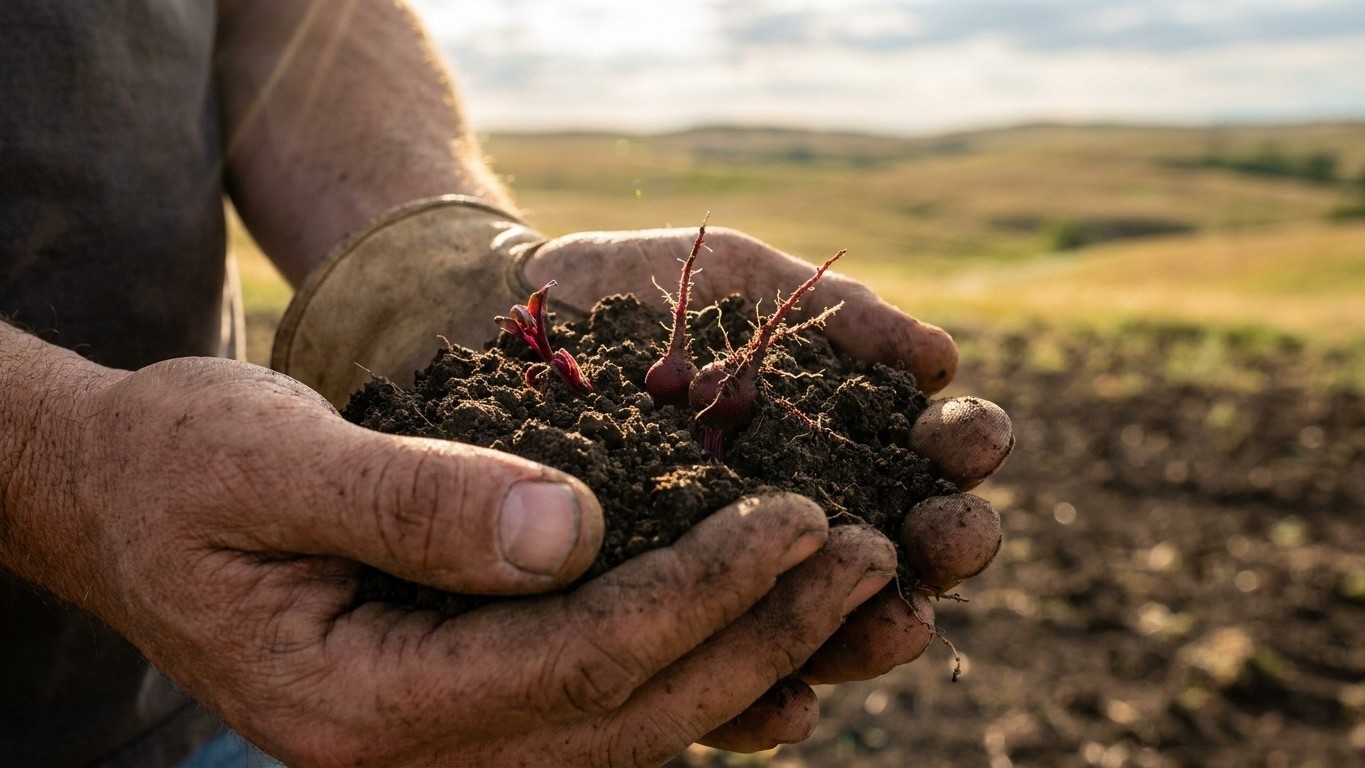

South Dakota gardeners get one straightforward truth about beets: this is a root vegetable that rewards steady moisture and even soil more than any fussy feeding schedule. Get the water right in the first six weeks and keep the roots cool enough later on, and the state’s prairie ground will grow you a solid beet with almost no extra effort.
The short answer
South Dakota’s official state soil is the Houdek series, a Mollisol, the deep, dark prairie soil that built the Corn Belt and that the state legislature named the official soil in 1990 under the USDA NRCS State Soils program. Its surface horizon runs close to neutral, about pH 6.7, with a texture of 38 percent sand, 22 percent clay and 40 percent silt, roughly 3.0 percent organic matter, and a well-drained classification. That combination, drawn from USDA NRCS Soil Data Access records of 90 mapped components of the series, describes a loam-to-silt loam that holds moisture without staying soggy, which is most of what Beet Soil in South Dakota asks for.
Utah State University Extension’s guidance on beets calls for deep, sandy, well-drained soil rich in organic matter, amended with no more than 1 inch of composted material per 100 square feet. Houdek is not sandy in the way that guidance means, but it is well drained and already carries a decent organic-matter base, so a gardener working genuinely Houdek-type ground starts closer to that ideal than a gardener on heavy clay or compacted fill would. Whether the same water-stress-plus-heat rule causes woodiness depends on temperature, and that is where the picture gets less complete: the specific count of days each year that the reference weather station in this dataset climbs past 90 F is not published in the records used for this page, so it will not be guessed at here. What is documented is the threshold that matters agronomically: heat above 85 F combined with water stress during root development is what turns a beet woody, according to Utah State’s guidance, regardless of how many days above 90 F a given summer racks up.
None of this should be read as a diagnosis of any one backyard. A state the size of South Dakota spans hundreds of distinct soil series, and the ground a few miles from a river, at the base of a hill, or on a lot that a builder graded and filled can behave nothing like the Houdek profile described above. Treat the state soil as a baseline for how the region’s ground tends to behave, not as a stand-in for a soil test.
The six weeks that decide it here
Beets are sown directly in place, never transplanted, and the standard advice is to get seed in the ground 2 to 3 weeks ahead of the last spring frost. For the reference station used in this dataset, station USW00014944, NOAA’s 1991-2020 Climate Normals put the last spring freeze, the 32 F threshold, somewhere between April 29 and May 9. Sowing 2 to 3 weeks ahead of that window means seed typically goes in during mid to late April; for a fuller breakdown of the timing, see When to Sow Beets in South Dakota, which puts the first six weeks of a beet’s life, the window Utah State University Extension identifies as the one that decides bolting, squarely inside a South Dakota April and May.
Suburban and rural gardens away from an airport weather station commonly see their own last frost land later, and their first fall frost land earlier, sometimes by one to two weeks, more at elevation. A gardener planning a mid-April sowing based on the station date alone should treat that date as a starting estimate, not a guarantee, and check it against their own county’s record.
April and May in South Dakota are not a single, predictable stretch. Some years bring a dry run of weeks with little rain and steady wind; other years swing the opposite way, with cold, wet soil that seems to never warm up, or with both extremes inside the same six weeks. That variability is exactly what makes the bolting risk here real rather than theoretical. Beets subjected to water stress in that early window respond by flowering prematurely, bolting, instead of building the root a gardener actually wants. On a Houdek-type surface, 40 percent silt and 38 percent sand, a dry spell paired with wind can dry the top inch of soil fast even while moisture sits just below, which is enough to stress a young beet seedling if nobody’s watching the surface. This is a separate failure from the heat-and-woodiness problem that shows up later in the season, and the two should never be treated as the same fix.
What goes wrong here
- Surface crusting after a dry, windy stretch. A silt-heavy surface like Houdek’s can dry and crust quickly once wind picks up, blocking even germination and stressing young roots before they’re established. Keep the top inch of soil consistently moist through the first six weeks after sowing, and consider a light mulch once seedlings are up to slow surface drying.
- A late cold snap right after an early sowing. Sowing 2 to 3 weeks ahead of the last frost is standard practice, but a sudden return to near-freezing temperatures after germination stresses young plants and adds to bolting risk. Watch the extended forecast after sowing and be ready to cover seedlings with a floating row cover if a cold snap is called.
- Mid-summer heat spikes hitting already-stressed roots. Once temperatures push past 85 F, any accompanying water stress makes roots woody rather than tender, a separate problem from early bolting. Keep watering consistent through the heat of the season and mulch to buffer soil temperature, rather than relying on rainfall alone.
- Over-amending soil that’s already reasonably organic. Houdek’s surface carries roughly 3.0 percent organic matter to start, and piling on more compost than the recommended 1 inch per 100 square feet can push growth toward leaves at the expense of the root. Stick to that 1-inch ceiling even on ground that looks like it could use richer soil.
- Clay pockets causing misshapen or forked roots. The 22 percent clay fraction in Houdek, or heavier still in a garden with more clay than that, can compact and deflect a taproot as it grows. Work the bed deeply before sowing and avoid walking on wet soil, or build a raised bed where the native ground runs heavier than loam.
Checking this against your own county
Everything above describes one named soil series and one weather station, not the ground under any particular South Dakota garden. Before committing a season’s beet crop to a sowing date or a watering plan based on this page, it’s worth confirming both the local soil type and the local frost window with South Dakota State University Extension, at extension.sdstate.edu. County-level extension staff can point to soil survey data specific to a property and to frost records closer to home than an airport station, which matters most in the exact six-week window this page identifies as the one that decides whether a beet bolts.
Common questions
How many days does it take beets to mature in South Dakota?
Beets typically reach maturity 60 to 80 days from seeding, not from transplanting, since beets are sown directly in place. Counting from a mid to late April sowing lines up harvest with mid-summer, which is exactly when heat above 85 F combined with water stress becomes a risk for woody roots.
Is Houdek soil good for growing beets?
Its well-drained classification and moderate organic matter are favorable, but its loam-to-silt texture (38 percent sand, 22 percent clay, 40 percent silt) is heavier than the sandy soil Utah State University Extension recommends for beets. It’s a reasonable starting point, not a perfect match, and any given garden may differ from the mapped series entirely.
What causes beets to bolt in South Dakota gardens?
Water stress during the first six weeks after sowing is the documented trigger, and that window typically falls in April and May here, a stretch that can run dry and windy or cold and wet depending on the year. Keeping the soil surface consistently moist through that period is the direct remedy.
Why are my beet roots woody even though they didn’t bolt?
Woodiness and bolting are two different failures. Woodiness comes from heat above 85 F paired with water stress later in the season, after the plant has already avoided bolting, so consistent watering needs to continue well past the first six weeks, not just during them.