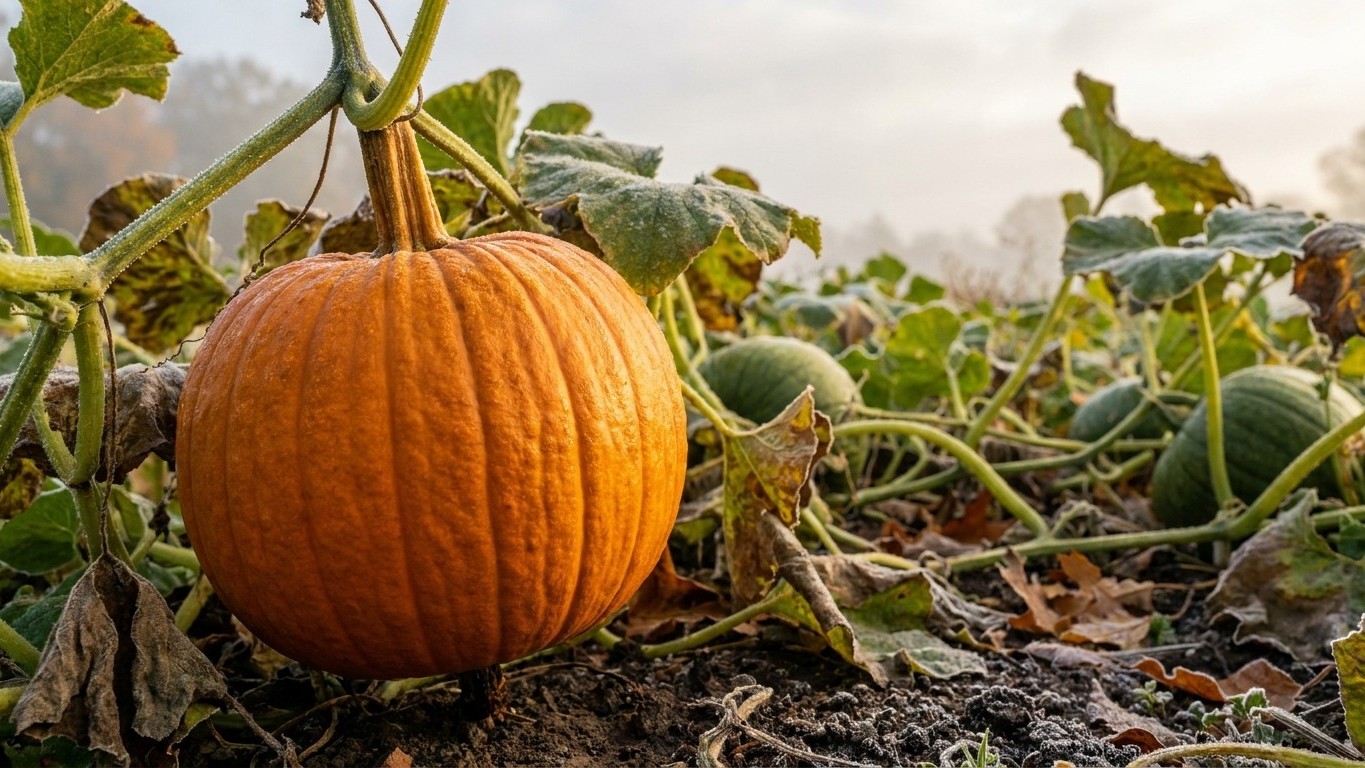

In coastal Virginia, a pumpkin flower needs to open somewhere between mid-September and early-to-mid October to have a real shot at turning orange before frost. Miss that window and the vine is still working on a green fruit when the first freeze hits. The math behind that window, and what actually pushes gardeners past it, is worth walking through before you drop a seed.
The short answer
Coastal Virginia’s first fall frost, based on NOAA NCEI 1991-2020 Climate Normals for station USW00013769 at NAS Oceana, lands somewhere between November 10 and November 24. That’s not a single date, it’s a range built from three decades of freeze probabilities, and it’s the number everything else in this article works backward from.
Pumpkins take 45 to 55 days to mature after flowering, according to Utah State University Extension. Not from the day you drop the seed, not from transplanting, from the day the flower opens. That distinction matters more than almost anything else in pumpkin timing, because a lot of gardeners count from planting and end up a month optimistic.
Run the arithmetic both ways and you get a window rather than a date. Take the earliest possible frost, November 10, and pair it with the longer 55-day maturation period, and the flower needs to open by around September 16 to stay safe. Take the latest possible frost, November 24, and pair it with the shorter 45-day window, and a flower opening as late as October 10 could still work out. That spread, roughly September 16 to October 10, is the real target. It’s wide because both ends of the calculation, the frost date and the maturation length, are themselves ranges, not fixed points.
Land toward the early side of that window and you’ve got margin. Land toward the late side and you’re betting on the mild end of the frost range showing up. Either way, this window is specific to the mild, coastal end of the state. The Blue Ridge and southwest Virginia run their frost dates weeks earlier in fall and weeks later in spring, which compresses this whole calculation and pushes the safe flowering window earlier too.
Nine or so pumpkin varieties commonly show up in seed catalogs and garden centers with names attached but no maturity data printed on the packet at all, sometimes not even a color or size range. That’s a packaging problem more than a growing problem. What matters for this calculation isn’t the variety name, it’s the 45-to-55-day flowering-to-harvest span that Utah State University Extension publishes as the general rule, and your own frost window layered on top of it.
When to sow here
When to Sow Pumpkins in Virginia is where most of the timing mistakes actually start, because gardeners tend to plant off the last frost date alone. That’s not enough information. Here’s the sequence that actually gets you to a safe flowering window.
- Let the last spring frost window close. For this coastal zone, that’s March 20 to April 3. Don’t sow at the tail end of that range hoping to get lucky; treat April 3 as the earliest the air is reliably clear, not a target date.
- Wait longer than that for the soil itself. Pumpkins need soil at 65 F to germinate well, and soil temperature lags air temperature by weeks, not days. The last frost date tells you when the air stopped threatening your seedlings. It tells you nothing about whether the ground six inches down has caught up. Check soil temperature directly with a thermometer at planting depth rather than counting days off a calendar.
- Use row covers to move that date up by about two weeks. A row cover traps solar heat over the bed and can get the soil to 65 F roughly two weeks sooner than bare ground would reach it on its own. That two-week head start is often the difference between a comfortable flowering window and a tight one.
- Count forward from your sowing date to your expected flowering date, then check it against the September 16 to October 10 target. If your projected bloom lands inside that window, you’re set. If it’s sliding past mid-October, you’re planting too late for this coastal frost timing and need to either move sowing earlier with covers or accept a narrower margin.
What goes wrong here
- A late flower that never colors. When the first bloom opens after early October, the fruit is still sizing and greening when frost arrives in the November 10 to 24 window. The remedy is upstream: get soil to 65 F earlier using row covers, and don’t let a slow spring push your effective planting date into May without compensating.
- A fruit caught by frost before harvest. Sometimes the pumpkin colors up fine but sits on the vine past the point where you should have cut it, and an early frost inside that November window damages the skin or the stem. The remedy is to harvest with the stem attached as soon as full color is reached, rather than waiting for a “perfect” moment that a frost date range makes unpredictable.
- A vine that dies back before the skin hardens. Disease and insect pressure can shut a vine down weeks before the fruit’s rind has toughened enough to store or display well. Squash bugs and cucumber beetles are common culprits in Virginia gardens; management specifics are covered on this site’s dedicated pages for squash bugs on pumpkins in Virginia and cucumber beetles on pumpkins in Virginia. Catching pressure early keeps the vine productive long enough for the skin to finish hardening.
- Fruit set too late in the season. A vine that keeps flowering into late summer, well past productive timing, puts energy into blooms that can’t mature before frost regardless of how healthy the vine looks. Pinching late flowers once you’re past the safe window redirects energy to fruit that already has a chance.
Checking this against your own county
Everything above is built on one weather station, NAS Oceana, which sits at the mild, coastal edge of Virginia. If you garden anywhere inland, in the Piedmont, the Blue Ridge, or southwest Virginia, your actual frost dates will differ from this window, sometimes by several weeks in either direction.
The reliable way to get county-level numbers is to contact Virginia Cooperative Extension directly. Their local offices track frost data and planting guidance specific to each region of the state, which matters a great deal here since a garden in the mountains is working with a meaningfully shorter season than one near the coast.
Common questions
Can I still plant pumpkins in July in coastal Virginia?
Working backward from the November 10 to 24 frost window and the 45-to-55-day flowering-to-harvest span, a July sowing can still work if the plant flowers by early-to-mid October, but there’s little margin left for a slow start or pest setbacks.
Does a green pumpkin ripen after picking?
The Utah State University Extension guidance behind this article’s maturity numbers doesn’t address post-harvest ripening; it addresses time from flowering to a mature fruit on the vine, so treat a green pumpkin picked ahead of frost as a fruit that didn’t reach the finish line rather than one that will finish indoors.
How long can I store a harvested pumpkin?
The source behind the maturity figures used here gives no storage temperature, humidity level, or keeping time, only that pumpkins should be kept where they won’t freeze. Don’t borrow a storage figure from another crop; if you need exact storage guidance, that’s a question for Virginia Cooperative Extension directly.
Why do seed packets list a variety name but no maturity date?
It’s common for pumpkin varieties to be sold by name alone, without days-to-maturity, size, or color data printed anywhere on the packet. When that happens, fall back on the general 45-to-55-day flowering-to-harvest rule from Utah State University Extension and your local frost window rather than assuming a specific number for that variety.