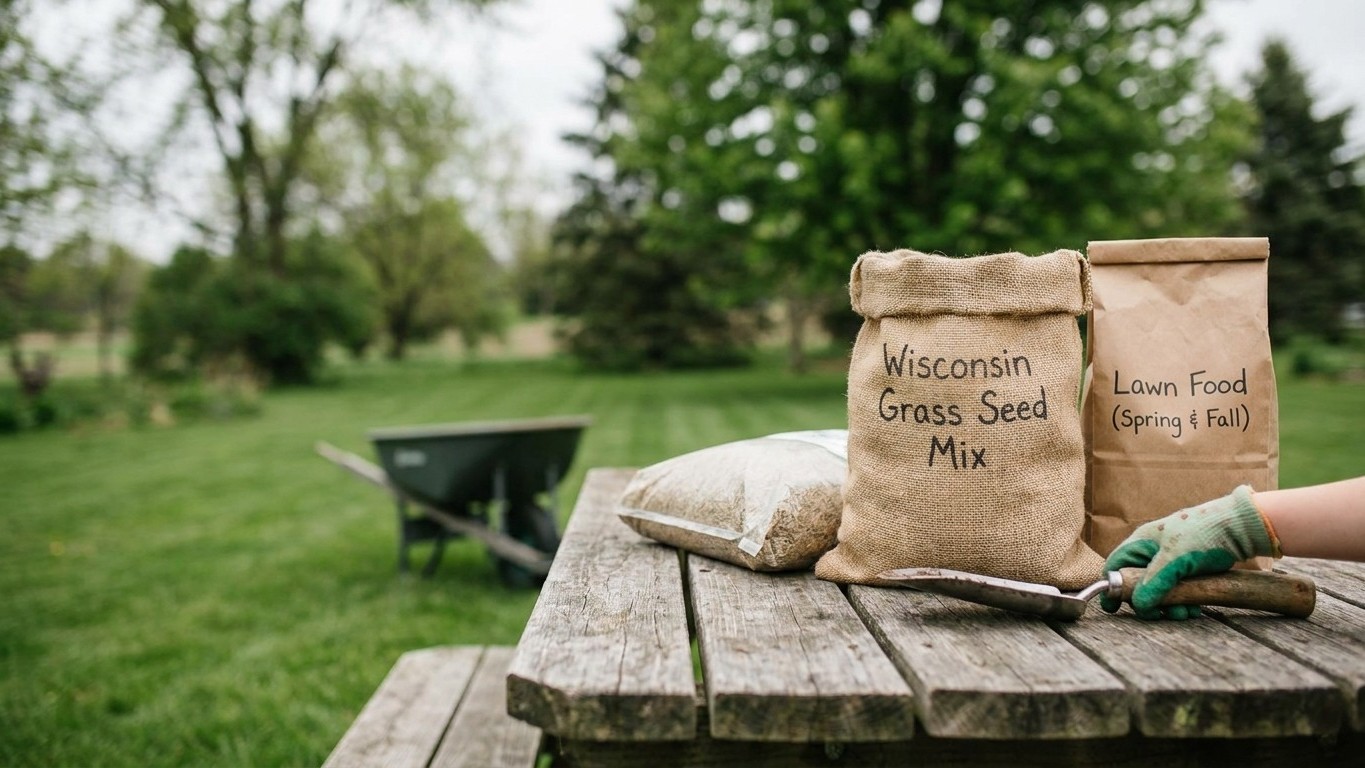

Seven days a year above 90°F, and winter lows that sink to 15.6°F on an average night — that’s the whole case against a warm-season lawn right there. Wisconsin doesn’t get enough heat to grow one, and the cold would finish off any crown that tried to survive it. So the choice narrows fast, down to a short list of cool-season grasses built for exactly this kind of winter, each suited to a different job in the yard.
Which grass belongs in Wisconsin

Start with the two numbers that settle this before any variety name comes up. At the Milwaukee reference station, NOAA’s NCEI 1991-2020 climate normals record only 7.0 days a year at or above 90°F, and a mean daily minimum of 15.6°F in the coldest month. That combination rules out a warm-season lawn outright. Warm-season grasses need long, reliable stretches of real heat to grow at all, and a winter low that cold would kill a warm-season turf’s crown before spring ever arrived. This is a cool-season climate, full stop, and the species list follows from that fact rather than from taste.
Clemson Cooperative Extension’s HGIC 1214 guide and Penn State Extension both name the same group of species for a climate like this one: Kentucky Bluegrass, Tall Fescue, Perennial Ryegrass, Fine Fescue, and Rough Bluegrass, the same lineup detailed in Wisconsin lawn Best grass. Each does a different job in a home lawn.
- Kentucky Bluegrass: spreads by rhizomes into a dense, self-repairing sod, the standard choice for a front lawn that takes foot traffic.
- Tall Fescue: deep-rooted and more drought-tolerant than the others on this list, a good pick for a lawn that won’t get watered every week.
- Perennial Ryegrass: germinates fast, often used mixed with bluegrass to hold soil while the slower species fills in.
- Fine Fescue: handles shade and thin, dry soil better than bluegrass, useful under mature trees.
- Rough Bluegrass: tolerates wet, shaded ground where almost nothing else in this list will grow.
None of this transfers south. A homeowner gardening in a warm-season state like Louisiana works from a completely different list, as covered in Louisiana Lawn Care: What to Plant and When to Feed It, because Bermudagrass and St. Augustine need the long heat that Wisconsin’s climate simply does not provide. Planting a warm-season species here, or a cool-season one there, wastes a season finding that out.
When to seed or sod here
Clemson Cooperative Extension’s HGIC 1203 guide gives the general split for the country: warm-season grasses go in around May, cool-season grasses go in mid to late September. Wisconsin’s exact timing, along with month-by-month care tasks, is laid out in the Wisconsin lawn Calendar. lawns are cool-season, so the fall window is the one that matters, and it should be set against this territory’s own frost pattern rather than a generic calendar month.
Working backward from the first fall frost
NOAA’s NCEI 1991-2020 normals put the first fall freeze, measured at the 30-70% probability band for 32°F, between October 17 and October 29 at the reference station near Milwaukee. Seeding in mid to late September, as the Clemson calendar recommends for cool-season species generally, puts new grass roughly three to six weeks ahead of that freeze window, enough time for a seedling to establish before the ground locks up. Wait past that and the seed germinates into cold soil with too little season left to root deeply before winter.
That frost date is not the same everywhere in the state. Lake Michigan holds heat into the shoreline counties and delays the first freeze there, while inland southern Wisconsin typically freezes earlier, and the far north earlier still. Nudge the seeding window earlier the farther you are from the lake and the farther north you sit, and treat the Milwaukee figure as a starting point, not a fixed date for the whole state.
A spring window exists too, but it comes with a built-in disadvantage: seedlings sown in spring compete directly with crabgrass and other summer annual weeds for light and water, while a fall-sown lawn gets a full season of cool, moist weather with far less weed pressure before it ever has to face a Wisconsin summer.
The feeding calendar that fits this climate
Nitrogen timing follows the grass’s growing season, not the wall calendar. A cool-season lawn does its real growing in spring and fall, slows or nearly stops in the heat of summer, and stores the bulk of that fall feeding in its roots and crown rather than pushing it into leaf growth you have to mow off. Feeding a cool-season lawn heavily in June, when a warm-season lawn would want it, forces soft growth right before the plant would rather be building roots.
Clemson’s HGIC 1219 Tall Fescue Maintenance Calendar, built around a cool-season species that many Wisconsin lawns already grow, calls for around one pound of actual nitrogen per 1,000 square feet in each of two fall applications, with the second and heavier feed timed as top growth slows but the roots are still active. That calendar’s calendar dates are set to South Carolina’s frost pattern, not Wisconsin’s, so use the rate and the two-application structure, and shift the actual dates earlier to sit ahead of this state’s own first fall frost instead of copying the page directly. Wisconsin’s own extension service can confirm the exact rate your lawn needs once a soil test comes back, since a nitrogen-rich soil needs less added than a depleted one.
A light spring feeding, well under the fall rate, can help a lawn coming out of winter looking thin, but it should never be the bigger of the two applications. Save the weight of the year’s nitrogen for fall, when the grass can actually use it.
Mowing height and watering here
Cool-season species like the ones on this list are generally mowed taller than warm-season turf, and height matters more here than most people think. Kentucky Bluegrass and Fine Fescue do best kept at roughly 2.5 to 3.5 inches, while Tall Fescue is often left a little taller still, around 3 to 4 inches, because the extra leaf area shades its own root zone and slows moisture loss. Cutting any of these too short in summer is one of the fastest ways to turn a lawn brown before a drought even gets the chance to.
The one-third rule and why it holds here
Never remove more than one third of the blade’s height in a single mowing pass. Scalping a lawn back hard after it gets away from you shocks the plant into using stored root energy just to regrow leaf, right when a cool-season lawn should be building roots instead. If growth has gotten ahead of the mower, take it down in two passes a few days apart rather than one drastic cut.
An inch of water a week, from rain and irrigation combined, is the common figure most extension guides give for an established cool-season lawn. Wisconsin’s summers rarely push that number much higher. NOAA’s Milwaukee normals show only 7.0 days a year reaching 90°F, so the kind of sustained heat that drives up watering demand in warmer states is uncommon here. What does change the figure locally is soil, not heat: a sandy lot drains fast and needs the same total water split into more frequent, lighter sessions, while a heavier clay soil holds moisture longer and can be watered less often but more deeply.
What goes wrong on lawns in Wisconsin

The failures that show up here are the ones this particular climate produces, not a generic list of lawn trouble. A humid stretch of summer, especially on Tall Fescue kept slightly too moist overnight, brings on brown patch, a fungal disease that shows up as roughly circular tan or brown patches with a darker, smoky-looking edge in the early morning. It spreads fastest when nights stay warm and the grass blades stay wet for hours, so watering early in the day rather than in the evening does more to prevent it than any product applied after the fact.
Dormancy is not death
A dry stretch in mid-summer can push a cool-season lawn into dormancy, where the grass browns off and stops growing to conserve itself. That is a survival response, not a dying lawn, and most cool-season species recover fully once rain returns or watering resumes. The mistake to avoid is dumping heavy water on a dormant lawn trying to “revive” it. A light watering every few weeks to keep the crown alive is enough; a lawn broken out of dormancy with a sudden soaking and then left dry again fares worse than one left alone.
Winter brings its own version of the same confusion. A season of snow sitting on unfrozen or slushy ground can leave patches of matted, gray or pink-tinged grass once it melts, a symptom of snow mold rather than a dead lawn. Raking out the matted area and letting spring growth resume usually fixes it without any product at all. Connecticut deals with a version of the same humid-summer fungus pressure on its own cool-season lawns, covered in Connecticut Lawn Care: What to Plant and When to Feed It, for largely the same reason: a cool-season species growing through a humid summer is always going to have some fungal risk baked in.
Local help
A soil test settles more arguments about a struggling lawn than any product on a shelf, and it’s the first thing a county office will ask about before offering advice specific to your ground. The University of Wisconsin’s extension service, at extension.wisc.edu, runs soil testing and county-level lawn advice that accounts for the differences a statewide guide like this one can’t, from lakeshore frost timing to the sandy soils common in parts of the state.
Common questions
Can I plant Bermudagrass or Zoysia in Wisconsin if I really want a warm-season lawn?
You can try, but it will not survive a normal Wisconsin winter. NOAA’s Milwaukee normals put the coldest month’s mean minimum at 15.6°F, well below what a warm-season grass’s crown can tolerate, so even a mild winter carries real risk and a typical one will kill it outright.
My lawn went brown in August but it wasn’t that hot. What happened?
Brown in a cool-season lawn during a dry stretch is almost always dormancy, not disease or death. Check the crown near the soil line: if it’s still white or pale green and firm rather than mushy or black, the grass is alive and will green up again once moisture returns.
Is it too late to seed if I missed the September window?
It gets riskier the closer you get to the first fall frost, which runs from October 17 to October 29 at the Milwaukee reference station and earlier inland and to the north. Seed sown too close to that window may germinate but won’t have time to root deeply before winter, so a spring seeding the following year is often the safer bet at that point.
Do I need to feed my lawn in summer if it’s not growing much?
No, and doing so usually does more harm than good. A cool-season lawn slows down in summer heat on purpose, and pushing nitrogen into it then forces soft top growth right when the plant would rather conserve energy, which can make heat and drought stress worse rather than better.
Why does my lawn have gray or pink matted patches right after the snow melts?
That’s almost certainly snow mold, a fungal issue that develops under snow cover sitting on unfrozen ground rather than a sign the lawn died over winter. Raking the matted patches to let air and light back in, and mowing the lawn a bit shorter than usual going into winter next year, both help reduce it.