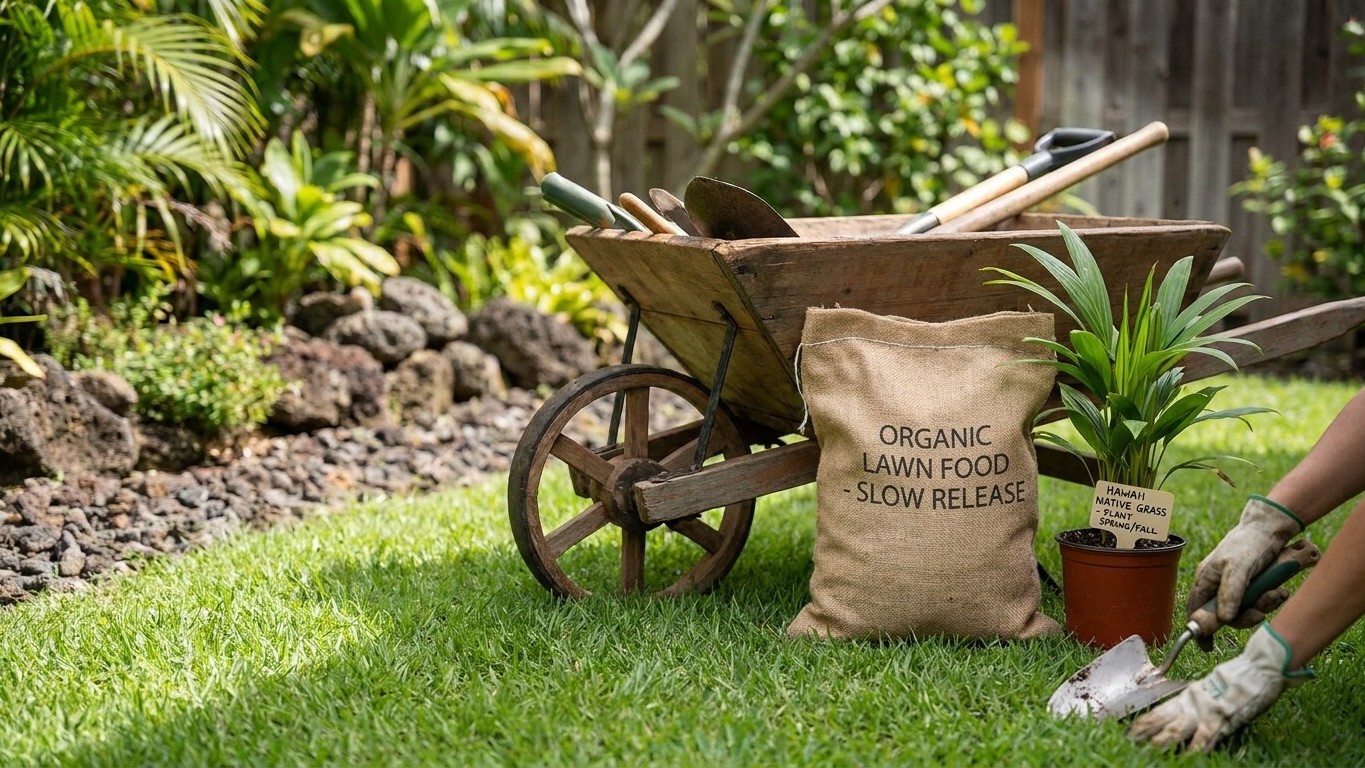

Your grass either survives Hawaii’s warmest and wettest months or it never really takes hold, and that’s the whole question worth asking before you plant anything. Cool-season grass won’t make it through even one lowland winter here, so the choice is really among warm-season types — Zoysiagrass, St. Augustinegrass, and a few others — each suited to a different mix of sun, shade, and traffic, as detailed in The Best Grass Seed for Hawaii Lawns. Start by walking your own yard and noting where the shade falls and where feet actually land, since that’s what should choose the grass, not what’s stacked at the garden center.
Which grass belongs in Hawaii
Most of what fails on a Hawaii lawn traces back to one of three climate features: constant humidity, a wet-dry split between windward and leeward sides, and a winter mild enough that nothing, pest or plant, ever really stops growing — which is why year-round upkeep matters more here than almost anywhere else, as laid out in The Hawaii Lawn Care Calendar, Month by Month.
Humidity-driven disease

A run of warm, wet weather, especially where air doesn’t move well, is exactly the setup that favors brown patch and large patch fungus on St. Augustinegrass and Zoysiagrass, showing up as roughly circular patches of collapsed, brown turf that spread outward day by day. Gray leaf spot follows the same humid pattern on St. Augustinegrass specifically. Treating this as a watering or fertilizer problem alone rarely fixes it. The trigger is moisture sitting on the leaf blade for too many hours at a stretch, so cutting back on evening irrigation and improving airflow does more than a fungicide alone.
Drought stress mistaken for death

On the drier leeward coasts, a warm-season lawn that goes weeks without rain or irrigation will bronze off and look dead. It almost never is. Warm-season turf goes dormant under drought stress the same way it goes dormant under cold on the mainland, and the crown and rhizomes below the brown leaf blades are usually still alive, ready to green back up within a couple of weeks once water returns. Ripping out a dormant lawn and resodding it is the single most common unnecessary expense homeowners here take on.
Weeds and pests with no off-season

Because there is no winter cold snap to knock back growth, weed pressure and insect populations here do not get the seasonal reset a colder-climate lawn gets. Compare that to a lawn in Manitoba, where a hard freeze shuts down both weed germination and most insect activity for months at a stretch: see Manitoba Lawn Care: What to Plant and When to Feed It for how a real winter changes that calendar. In Hawaii, a chinch bug or armyworm population can build all year, and broadleaf weeds keep germinating in every month, so a single spring cleanup is not enough. Scouting needs to be a routine, not a seasonal event.
Local help
For a soil test, a diagnosis of a patch disease, or advice specific to your island and elevation, the University of Hawaii’s College of Tropical Agriculture and Human Resources runs the state’s Cooperative Extension Service, with offices across the counties. Start with a soil test before you add a single pound of fertilizer, since volcanic soils vary widely in pH and nutrient availability from one island, and even one valley, to the next. Find your county office through the CTAHR Cooperative Extension Service.
Common questions
Can I grow a cool-season grass like fescue if I just water it enough?
No. Water is not the limiting factor. NOAA’s 1991-2020 climate normals show a coldest-month minimum of 66.1°F at the Honolulu station, which never gives a cool-season grass the winter chill it needs to reset, and it will decline no matter how well irrigated it is.
Does any part of Hawaii actually get frost?
Only the summits of Mauna Kea, Mauna Loa and Haleakala, well above where anyone gardens. NOAA’s climate normals flag freeze percentiles as not computable at the Honolulu station because it simply does not happen at inhabited elevations. Plan your lawn calendar around rainfall and elevation, not frost.
Is it better to seed or sod a new lawn here?
Sod, plugs or sprigs are the more common route for most of the species suited to Hawaii, since named hybrid types of Zoysiagrass and Bermudagrass don’t come true from seed, and common seed-grown turf establishes more slowly in a wet climate that also favors weeds. Seed is more workable for Bahiagrass and common Bermudagrass, where seed is widely sold.
Will Bermudagrass or Zoysiagrass take over my garden beds?
Both spread by runners, and Bermudagrass in particular will cross a shallow edge and root into loose garden soil within a season. A physical barrier sunk a few inches deep along bed edges, checked and trimmed back a few times a year, works more reliably than any chemical edge control.
How often should I mow during the wet season versus a dry stretch?
Follow growth, not a fixed weekly schedule. Warm-season turf actively growing during a wet, warm stretch may need mowing every four to five days to stay under the one-third rule, while the same lawn during a dry leeward summer can often stretch to every ten days or two weeks. Watch the blade height rather than the calendar.