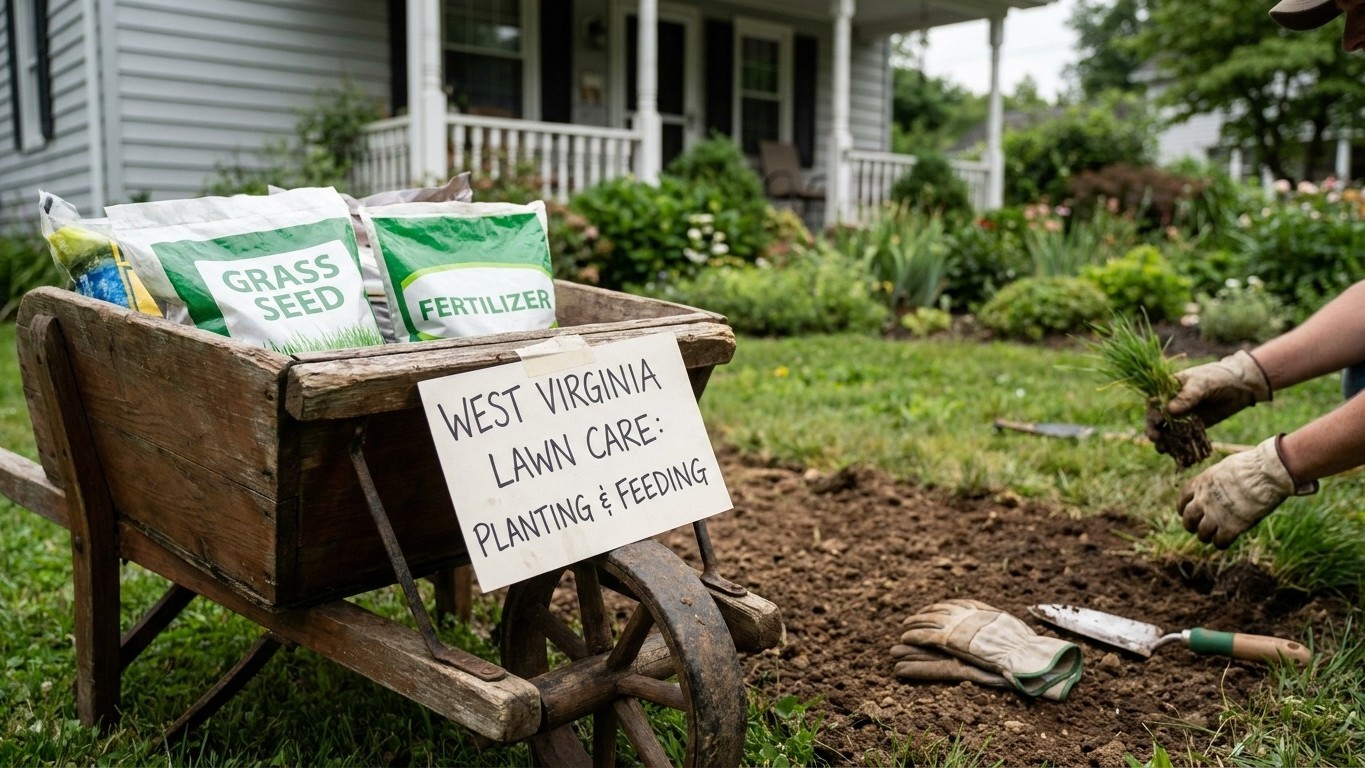

West Virginia grows cool-season lawns, not warm-season ones. At the Charleston reference station, NOAA’s 1991-2020 climate normals record just 16.0 days a year at or above 90°F and a coldest-month minimum of 26.3°F, a combination that rules out warm-season turf and points squarely at fescues and bluegrasses. Check which grass is already growing in your yard before buying seed or sod. A bag of warm-season turf grass bought from a big-box store display will not survive a West Virginia winter.
Which grass belongs in West Virginia

Your yard already told you the answer: West Virginia grows cool-season grass, not the warm-season stuff on the big-box display. That’s not a style choice, it’s a survival one — a place where the coldest winter nights average 26.3°F will kill bermudagrass and zoysia outright, no matter how good the bag looks in the store. So before you buy anything, walk out and check what’s already growing in the lawn now, because that grass has already passed the test the new bag hasn’t, consult our West Virginia lawn Best grass guide to confirm your choice, and pair that observation with a West Virginia lawn Calendar to know when to act on it.
The five cool-season options
Clemson Cooperative Extension’s HGIC 1214 fact sheet, along with Penn State Extension, names the cool-season species that fit this climate: Tall Fescue, Kentucky Bluegrass, Perennial Ryegrass, Fine Fescues, and Rough Bluegrass. None of them is a single perfect answer for every yard in the state, and each trades one strength for a weakness somewhere else.
| Species | Shade tolerance | Wear/traffic tolerance | Where it earns its place |
|---|---|---|---|
| Tall Fescue | Moderate | High, deep roots resist drought stress | Default choice for most West Virginia yards, sun or part shade |
| Kentucky Bluegrass | Low | High, spreads by rhizome and self-repairs | Open, sunny lawns where a dense uniform look matters most |
| Perennial Ryegrass | Low | Moderate, germinates fast | Overseeding and quick patch repair, rarely the whole lawn |
| Fine Fescues | High | Low | Dry shade under mature trees, low-input areas |
| Rough Bluegrass | High in moist shade | Low | Damp, shaded low spots where little else will grow |
Picking between fescue and bluegrass
Tall fescue is the grass on the most lawns statewide, and for a practical reason: it tolerates the swing between a wet spring and a dry August better than bluegrass does, and needs less nitrogen to stay green. Kentucky bluegrass looks better on a golf-magazine cover but demands more water and more feeding to match it. If your lot gets full sun and you’re willing to water through a dry stretch, bluegrass earns its keep. If it doesn’t, plant fescue and don’t look back.
Homeowners arriving from a warm-season state carry assumptions that don’t transfer. Someone used to growing bermudagrass in Arizona is used to a lawn that goes tan and dormant for winter and greens up fast in summer heat, a pattern covered in Arizona Lawn Care: What to Plant and When to Feed It. A West Virginia cool-season lawn runs the opposite calendar. It grows hardest in spring and fall and can look ragged in the hottest weeks of summer, which is normal rather than a sign of failure.
Elevation changes the answer
Charleston sits in a river valley, and the ridges and higher valleys across the state run colder in winter than the reference figures above suggest. If you garden well above the valley floor, treat 26.3°F as a floor rather than a promise, and lean toward tall fescue and fine fescues, the two most cold-hardy choices on the list, rather than perennial ryegrass.
When to seed or sod here
Cool-season lawns go in during the shoulder seasons, not high summer. Clemson Cooperative Extension’s HGIC 1203 fact sheet gives the general cool-season seeding window as mid to late September, with warm-season species, which don’t apply here, going in around May instead. For West Virginia, work backward from the local frost date rather than repeating that calendar month on its own.
Anchoring the window to frost
NOAA’s NCEI 1991-2020 normals put the first fall freeze at the Charleston-area station somewhere between October 18 and November 1, a wide band because freeze timing shifts with elevation and terrain even within one county. Seed six to eight weeks ahead of that freeze window so young grass has time to root before the ground goes cold. Counted back from October 18 to November 1, that lands the earliest planting in early September and the latest into mid to late September, which lines up with Clemson’s general guidance.
Why fall beats spring
Fall beats spring for a reason that has nothing to do with tradition. Cool nights and warm soil in September let seedlings establish roots without fighting crabgrass and other summer weeds, and without the disease pressure that comes with a hot, humid August. A spring-seeded lawn spends its first summer fighting weeds and heat stress before it has built any root reserve to draw on.
Sod, elevation, and a colder comparison
Sodding is more forgiving because you aren’t waiting on germination, but the same frost logic applies. Get sod down early enough that roots knit into the soil before a hard freeze locks everything up. Waiting until the week before a likely freeze risks sod that lifts and dries out over winter.
Gardeners moving in from New York will recognize this fall-first rhythm. New York’s own cool-season lawns run on a similar seeding calendar, though frost timing differs by region there too, as laid out in New York Lawn Care: What to Plant and When to Feed It. Seed in fall and let it root before cold weather, a rule that holds across most of the cool-season zone.
Above the valley floor, where frost regularly arrives earlier than the Charleston normals suggest, shift the seeding date earlier within that six-to-eight-week rule rather than pushing it later. Waiting for a warm September afternoon at higher elevation can mean seeding after the first freeze has already happened.
The feeding calendar that fits this climate
Nitrogen timing follows the grass’s growing season, not the calendar on the wall. A cool-season lawn like the fescues and bluegrasses recommended for West Virginia does most of its root growth in fall and spring, and that’s when nitrogen does the most good. A warm-season lawn, which doesn’t apply to most of this state, would instead be fed in late spring as it comes out of dormancy.
What Clemson’s fescue calendar says
Clemson Cooperative Extension’s Tall Fescue Maintenance Calendar (HGIC 1219) lays out the year application by application, and it’s worth reading end to end if tall fescue is what you’re growing, which covers most West Virginia lawns. The short version: the heaviest feeding goes down in fall, split into two or three applications rather than one big dose, at roughly 1 pound of actual nitrogen per 1,000 square feet per application.
Skip the spring push
A single light application in early spring can help green-up after winter, but skip a heavy spring feeding. Pushing a cool-season lawn hard with nitrogen right before summer heat arrives builds soft top growth with no root reserve behind it, which is exactly the growth that struggles when a hot, dry stretch hits in July or August. Save the bulk of the bag for September, when the lawn is actively rebuilding roots ahead of winter, following the same calendar Clemson publishes.
Nitrogen form matters too
Choose a slow-release nitrogen source for the early fall application and a faster-release form for the last feeding before dormancy, so the lawn gets an immediate boost heading into cold weather without pushing tender growth that a hard freeze would only kill back. A soil test is the only way to know whether the lawn also needs phosphorus or potassium alongside that nitrogen. Guessing at a complete fertilizer blend when the soil already has enough phosphorus just adds runoff with no benefit to the grass.
Mowing height and watering here
Mowing height
Tall fescue, the grass most West Virginia lawns are built on, holds up best mowed at 3 to 4 inches. Kentucky bluegrass can run slightly shorter, closer to 2.5 to 3.5 inches, and fine fescues in shade do well left a little taller still to make up for lower light. Never cut more than one-third of the blade length in a single mowing, the rule that governs every cool-season lawn regardless of species. Scalping a lawn that’s grown tall after a rainy stretch stresses the roots and opens the door to the disease problems covered below.
A taller mowing height also shades the soil surface, which keeps crabgrass and other summer annual weeds from getting the light they need to germinate. That’s one more reason to resist the urge to cut a cool-season lawn short for a neater summer look. Leave the clippings on the lawn when you mow at the right height. They break down quickly and return nitrogen to the soil, cutting the fertilizer bill without feeding disease the way a heavy clipping pile left sitting on top of the grass would.
Watering
An inch of water a week, delivered in one or two deep sessions rather than a handful of light sprinklings, is the common baseline for a cool-season lawn. Light daily watering trains roots to stay near the surface, which is the opposite of what gets a lawn through a dry August.
What moves that baseline in West Virginia is the same humidity that drives disease pressure: a humid stretch cuts evaporation, and the lawn may need less than the inch-a-week figure, while a dry, breezy week on a sandy or south-facing slope pushes it higher. Water in the early morning, not the evening, so blades dry out during the day rather than sitting wet overnight, which is exactly the condition brown patch disease needs to spread.
What goes wrong on lawns in West Virginia

Brown patch in humid summers

A humid summer stretch, especially one with warm nights, is when brown patch shows up on tall fescue and other cool-season lawns. It appears as roughly circular patches of blighted grass, sometimes with a darker smoke-ring edge visible in early morning dew. It’s a fungal disease that thrives on wet grass blades that don’t dry out overnight, which ties directly back to watering in the morning instead of the evening.
Dormancy mistaken for death

A hot, dry stretch in July or August can turn a cool-season lawn brown and crisp-looking almost overnight, and the reflex is to assume it’s dead and needs replanting. It usually isn’t. Cool-season grass goes dormant to survive drought stress, the same way it would after a hard freeze, and a deep watering or a return of cooler, wetter weather typically brings it back green within a couple of weeks. Digging up a “dead” lawn in August and reseeding it is one of the most common wastes of money and effort in West Virginia yards.
Weeds that never stop in a mild winter

A mild winter, without enough hard freezes to knock back cool-season weeds like chickweed and henbit, lets them keep growing right through what should be the lawn’s dormant stretch. By the time spring green-up arrives, the weeds already have a head start on the grass. A fall pre-emergent application, timed ahead of that weed germination window rather than after the weeds are already up, is a more effective fix than trying to spray them out once they’ve taken hold.
All three of these failures trace back to the same climate pattern: warm, humid summers that stress cool-season grass, followed by winters too mild to fully shut weeds down. Building a feeding and mowing routine around that pattern, rather than fighting each symptom as it appears, is what keeps a West Virginia lawn from cycling through the same three problems every year.
Local help
A soil test through WVU Extension is the cheapest fix available for a struggling lawn, and it tells you whether the problem is nitrogen, pH, or something a fertilizer bag can’t solve at all. County offices also carry the local calendar adjustments that a single statewide figure like the Charleston frost date can’t capture, from earlier freezes at elevation to soil types that hold water differently across the state. Call before spending another season guessing.
Common questions
Can I plant Kentucky bluegrass under my shade trees?
Not successfully. Kentucky bluegrass has low shade tolerance and thins out fast under a canopy. Fine fescues are the better fit for dry shade, and rough bluegrass suits damp shaded low spots better than a standard bluegrass blend.
Is it too late to seed if it’s already mid-October?
Probably, in most of the state. NOAA’s 1991-2020 normals put the first fall freeze at the Charleston station between October 18 and November 1, and seed needs six to eight weeks to root before that freeze arrives. Seed sown in mid-October at higher elevation is likely racing a freeze it will lose. Wait for the next window in early fall rather than pushing seed into ground that’s about to go cold.
Why does my new lawn look thin its first winter?
A fall-seeded lawn is still building its root system through its first winter and won’t reach full density until its second growing season. Thin, uneven coverage in December is normal for a lawn seeded that September, not a sign the seeding failed.
Can I grow zoysia or bermudagrass anywhere in West Virginia?
Not reliably. The coldest-month minimum NOAA records for the Charleston station, 26.3°F, is well below what those warm-season grasses need to survive winter without dying back hard. Even in the warmest low valleys of the state, a cool-season species is the safer long-term bet.
How often should I feed a newly seeded lawn versus an older one?
A new seeding benefits from a starter application at planting to push root development, then follows the same fall-weighted schedule as an established lawn once it’s through its first growing season. Don’t add extra nitrogen on top of that starter feeding just because the lawn looks sparse. Patience and time do more than a second bag of fertilizer will.