
Every fruit tree or small fruit in this collection lives or dies by three numbers most buyers never check: the coldest zone it survives, the space it needs at full size, and the week it opens its first flower. Get those three right and the rest, soil texture, light, pruning, sorts itself out. Get them wrong and no amount of care fixes it.
The limit that decides everything
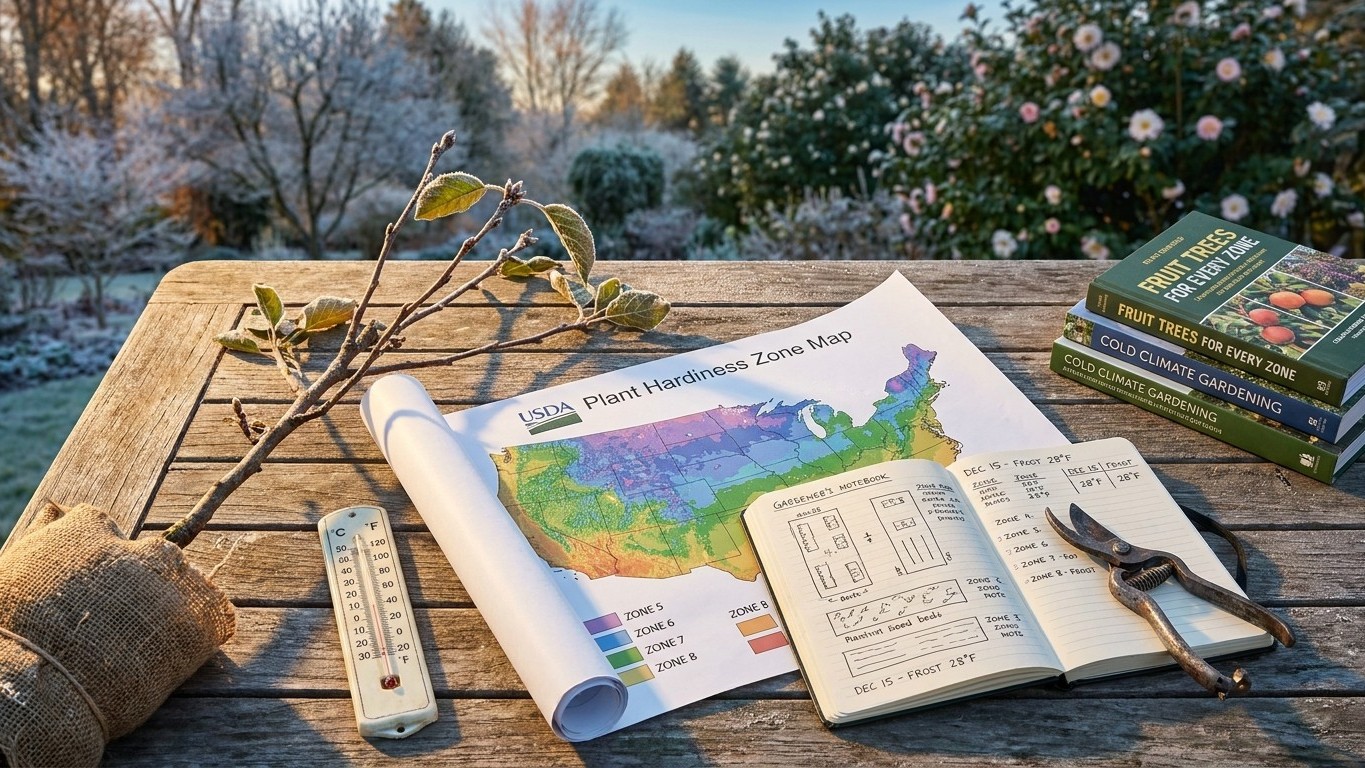
Hardiness ratings get sold as a promise of success. They are not. A hardiness rating, whether it comes from the USDA Plant Hardiness Zone Map or from a state extension office, describes the coldest winter a plant is known to survive, nothing more. It says nothing about whether that plant will thrive, crop heavily, or even look decent in a given yard. A fruit tree rated to survive at the cold edge of its range is often a fruit tree that limps through most winters, loses buds to late freezes, and never quite settles into a productive rhythm. Comfort and survival are two different questions, and a hardiness number only answers the second one.
Across the fruit trees and small fruits profiled in this collection, you will see two different formats for that number. Some carry a continuous range, expressed as one zone through another. Others are listed as a set of separate zones, joined by commas rather than a dash. That second format is not a stylistic choice. When a source lists zones individually instead of giving a span, it usually means there is a gap in the record, a zone in the middle that has not been tested or documented, not a guarantee that the plant fails there. Read those enumerations as they are written. Turning a comma-separated list into a smooth range invents data that does not exist.
Why the bottom and top both matter
The more useful way to read any hardiness figure is negative: it tells you where a plant will not make it through winter, and separately, where summer heat and lack of chill hours start working against it. Below the bottom of a plant’s range, cold kills wood outright, sometimes over one bad winter, sometimes gradually over several. Above the top of the range, the problem is usually the opposite: not enough cold accumulation for the plant to break dormancy properly, weak flowering, and fruit that never fills out.
None of that can be judged from a national map alone. Zone lines run through counties, not states, and microclimates inside a single property (a slope, a low spot that collects cold air, a south-facing wall) can shift the effective zone by a full number or more. Before assuming where any tree in this collection will or will not survive, check your own zone on this site’s hardiness zone guide rather than working from a state name or a general impression of your region.
And the one people discover too late
Fruit plants collect common names the way old houses collect layers of paint, and most of those names arrived long before anyone standardized them, take Aronia melanocarpa, sold under a handful of different labels depending on the region, th[e botanical designation, as with the pawpaw, known scientifically as Asimina triloba]em. Extension publications, including guidance from North Carolina State University’s cooperative extension, typically list every common name they can document, in alphabetical order, and none of them is marked as the correct one. That is the honest state of things: common names are folk names, regional and inconsistent, and no single one outranks the others. It is also why every plant profile in this collection is titled by its botanical name first. A botanical name does not change from one county to the next.
The confusion is real and worth naming plainly rather than papering over. The same common word sometimes refers to two different plants entirely, one a genuine fruiting species and the other an ornamental relative that never produces anything worth eating. In other cases a common name properly belongs to a related species and gets borrowed, loosely, for a plant that only resembles it. A shopper going by memory of a name heard from a neighbor or seen on a roadside stand can walk away with the wrong plant and not find out until years later, when it flowers like an ornamental and never sets fruit.
The fix is not to declare one name right and the rest wrong. Extension sources do not do that, and this page will not either. The fix is to treat the botanical name as the anchor and the common names as a starting point for conversation, not a purchase order. When buying, describing, or looking up any plant in this collection, cross-check the botanical name against whatever common name was used, especially if that name is shared with a different plant in casual use nearby.
Choosing, in the order that works
Light, soil texture, pH and drainage decide different outcomes, and mixing them up is where a lot of frustration starts. Light and drainage tend to be survival issues: a fruit tree planted in poor light or waterlogged soil can hang on for years, gradually weakening, without ever dying outright. Soil texture and pH are more often about performance: a plant can survive in the wrong texture or pH range and still produce little to no usable crop, even while looking outwardly healthy. That distinction, survival versus yield, is the one worth keeping in mind while reading any site requirement.
| Condition | What tolerance usually means | Mostly affects |
|---|---|---|
| Full sun vs. partial shade | Some fruiting plants hold on in partial shade but flower and fruit far less | Yield |
| Soil texture (sandy, loam, clay) | Roots establish faster in loam; sandy and clay soils change how often watering or drainage correction is needed | Survival and yield |
| Soil pH | Most fruiting plants have a narrow comfortable band; outside it, nutrient uptake drops even in otherwise good soil | Yield |
| Drainage | Standing water around roots is one of the more common outright killers of fruit trees and many small fruits | Survival |
Where a given plant’s tolerance for shade, or its exact preferred pH band, is not documented in the source material, the honest answer is that the facts do not settle it, not a guess dressed up as certainty. That gap matters more than it might seem, because a plant sold as tolerant of a wide pH range is not the same as a plant proven to fruit well across that range.
The mistake that costs the most
Spacing at maturity is the detail buyers skip past fastest, and it is the costliest one to get wrong. A fruit tree or bramble planted too close to a fence, a structure, or another plant does not simply look crowded; it stops being harvestable. Branches that cannot spread outward push upward and inward instead, moving the fruiting wood out of reach or into shade cast by a neighboring plant. Pruning can manage a spacing mistake for a few seasons, not correct it permanently. Whatever mature spread is listed for a given plant in this collection, that number describes the space needed to actually reach and pick the crop, not just the space needed to keep the plant alive.
What is on this site
Bloom time is a season, not a date, and reading it as a season tells you something practical: the earlier a plant flowers in spring, the more exposed it is to a late frost. A tree or shrub that opens its blossoms early is gambling every year on the last frost date arriving before, not after, that bloom. In a year when the gamble fails, an entire season’s crop can be lost to a single cold night, even though the plant itself survives undamaged. That risk is worth weighing against the appeal of an early-blooming variety, especially in a spot known for late frosts.
Two questions matter more than bloom timing for actually getting fruit, and this collection does not carry the answers on a plant-by-plant basis, so they should not be guessed at. The first is pollination: many fruiting trees and shrubs need a second, genetically different but compatible plant nearby to set fruit at all, while others are self-fertile and manage alone. Being in the same genus does not settle the question either way; self-fertility varies within families and even within groups of closely related varieties. The second is time to first bearing: some fruiting plants produce within a couple of seasons, others take considerably longer to mature into cropping age, and that timeline is specific to the plant, not something to estimate from its type.
Before buying anything profiled in this collection, ask a nursery or supplier directly whether it requires a pollinator and, if so, which varieties are compatible, and ask how many years to expect before the first meaningful harvest. Those two questions, asked before the plant goes in the ground, prevent the single most common disappointment in fruit growing: a healthy, well-sited plant that simply never fruits because it was planted alone, or a gardener who gives up waiting one season too early.
Common questions
Does a hardiness zone rating guarantee a fruit tree will produce well?
No. It only describes the coldest winter conditions the plant is known to survive. A plant at the cold edge of its rated range often survives but performs poorly, with reduced flowering and fruiting compared to a plant grown well within its comfortable range.
Why do some fruit plants list several separate hardiness zones instead of one range?
That format usually signals a gap in testing or documentation for the zones in between, not a confirmed failure in that middle zone. Read the list exactly as given rather than smoothing it into a continuous range.
Is “drought tolerant” the same as needing no water after planting?
No. Drought tolerance ratings generally apply to an established plant with a developed root system, not a newly planted one. Young fruit trees and small fruits typically need consistent watering during their first one to two growing seasons regardless of how drought tolerant the mature plant is described as being.
How do I find out if a fruit tree needs a second plant to pollinate it?
Ask the nursery or supplier directly at the time of purchase, since pollination requirements vary even among closely related varieties and are not something this general framework can determine on its own.
Guides by state
- Aronia melanocarpa
- Asimina triloba
- Diospyros virginiana
- Ficus carica
- Fragaria virginiana
- Fragaria x ananassa
- Morus rubra
- Prunus avium
- Prunus domestica
- Prunus persica
- Pyrus communis
- Rubus idaeus
- Rubus occidentalis
- Sambucus canadensis
- Vaccinium angustifolium
- Vaccinium corymbosum
- Aronia melanocarpa: Hardiness, Site and What It Needs to Crop
- Asimina triloba: Hardiness, Site and What It Needs to Crop
- Diospyros virginiana: Hardiness, Site and What It Needs to Crop
- Ficus carica: Hardiness, Site and What It Needs to Crop
- Fragaria virginiana: Hardiness, Site and What It Needs to Crop
- Fragaria x ananassa: Hardiness, Site and What It Needs to Crop
- Morus rubra: Hardiness, Site and What It Needs to Crop
- Prunus avium: Hardiness, Site and What It Needs to Crop
- Prunus domestica: Hardiness, Site and What It Needs to Crop
- Prunus persica: Hardiness, Site and What It Needs to Crop
- Pyrus communis: Hardiness, Site and What It Needs to Crop
- Rubus idaeus: Hardiness, Site and What It Needs to Crop
- Rubus occidentalis: Hardiness, Site and What It Needs to Crop
- Sambucus canadensis: Hardiness, Site and What It Needs to Crop
- Vaccinium angustifolium: Hardiness, Site and What It Needs to Crop
- Vaccinium corymbosum: Hardiness, Site and What It Needs to Crop