
A tree or shrub that fails almost never fails for a mysterious reason. It fails because the root flare got buried, mulch piled against the bark, or water came too often and too shallow. Get those three things right and most plants shrug off bad luck. Get them wrong and no amount of fertilizer or luck saves the plant.
The three rules that decide whether it lives

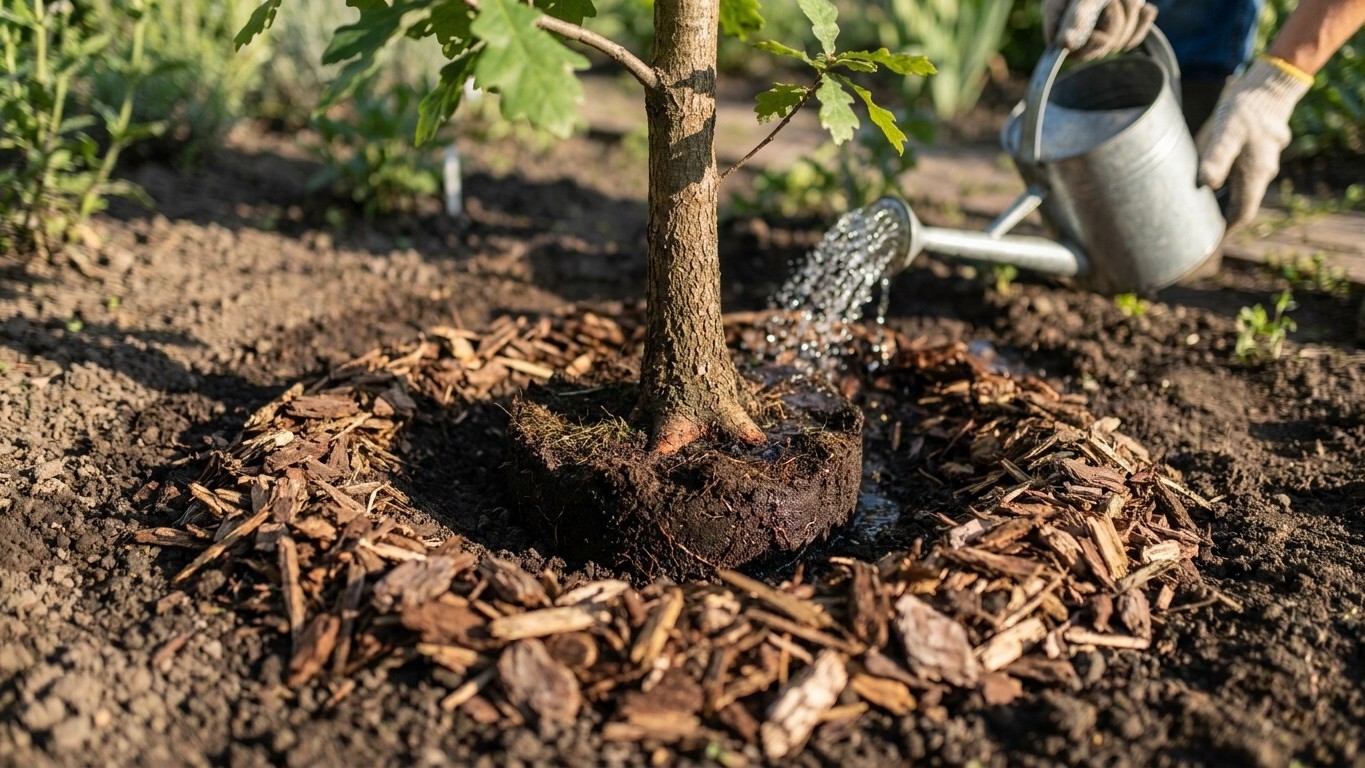
Before any zone map, any variety name, any calendar, there are three things that matter more than everything else combined. The root flare, the place where the trunk widens into roots, has to stay visible above the soil line. Mulch has to stay off the trunk and off the stems, forming a ring instead of a pile against the bark. And water has to go on deeply and rarely, not in frequent light splashes that never reach the roots that need it.
These three rules earn their place at the top of this hub because each one is checkable by eye, without a tool, without a soil test, without knowing the species. You can look at a trunk and see whether the flare disappears into a mound of dirt or mulch. You can look at the base of a shrub and see whether bark is visible or buried under a cone of wood chips. You cannot always tell whether a plant got the “right” amount of water on any given week, but you can tell whether the soil around the root zone is soaked several inches down or just damp on the surface.
Each rule also applies everywhere, regardless of what is being planted. A dogwood, a boxwood hedge, a hosta bed and a fruit tree all die the same way when planted too deep: the buried bark stays wet, oxygen exchange at the root collar drops, and rot sets in slowly enough that the cause gets blamed on something else entirely, usually months or years later. A rose and an oak both suffer the same trunk decay when mulch is stacked against the stem like a small volcano. And shallow, frequent watering keeps roots near the surface, chasing the only moisture they ever see, instead of growing down where they would be more stable and more drought tolerant later.
What makes these three rules worth stating this plainly is also how often they get broken, by people who are trying hard to do the right thing. Planting too deep usually comes from wanting the tree to “stand up straight” in a loose hole. Mulch volcanoes usually come from a genuine effort to protect the trunk from mowers and string trimmers. Frequent light watering usually comes from a hose left on for a few minutes every evening out of good intentions. None of these mistakes come from neglect. They come from reasonable instincts applied without knowing what the plant actually needs at the root zone.
What goes wrong, and where to read about it
Most planting and care questions boil down to a small number of patterns. The table below is a starting point for figuring out which one applies, and which guide in this collection covers the fix in more depth.
| Symptom | What it usually means | Where to read more |
|---|---|---|
| A tree or shrub declined or died two to five years after planting, well past its first season | Root flare likely buried at planting, or mulch built up against the trunk over successive years, causing slow bark decay that only shows above ground once the damage is advanced | See the guide on diagnosing delayed decline in established trees and shrubs |
| A new planting never took hold: leaves stayed small, growth stalled, or the plant died within its first year | Root ball never made contact with surrounding soil (common with a hole dug too narrow), or watering was too shallow and frequent to reach the root zone | See the guide on transplant shock and first-year establishment |
| Bark stripped, stems snapped, or new growth chewed back overnight | Browsing or rubbing damage from deer, rabbits, voles, or rodents, often worse in winter when other food is scarce and mulch piled against stems gives cover | See the guide on identifying and managing browsing and animal damage |
| A shrub has outgrown its space, blocks a window, or has become woody and bare at the base | Years without structural pruning, or a shrub planted without checking its mature size against the space available | See the guide on renovating and pruning overgrown shrubs |
| A tree has outgrown its spot near a house, driveway, or power line | A species chosen without checking mature height and spread against the site, now creating a structural or safety problem rather than a cosmetic one | See the guide on trees that have outgrown their location, and never attempt canopy work near overhead power lines yourself |
Two of these patterns deserve a second look, because they get diagnosed backward more often than not. Delayed decline gets blamed on pests or disease when the real cause was a planting depth mistake made years earlier, one that a quick check of the root flare would have confirmed in seconds. And failure to establish often gets blamed on “bad luck with the weather” when the actual problem was a root ball that never had contact with native soil.
The order of the work
Planting is not a single action. It is a sequence, and doing the steps out of order is how otherwise careful gardeners end up with a plant that struggles despite their best effort.
- Choose for the site and the zone first. Sun exposure, soil drainage, mature size, and the hardiness range for the local climate should all be checked before anything is purchased. The plant’s own page on this site carries its hardiness range, its size at maturity, and what it resists, and the state page carries the local zone and frost dates. None of that belongs here, because it changes as data gets updated.
- Choose the form being bought. Container-grown, balled-and-burlapped, and bare-root plants each need slightly different handling at the root check and the planting step that follows, so knowing which form is in hand shapes everything downstream.
- Check the roots before digging anything. Circling, matted, or girdling roots need to be identified and corrected now, because burying that problem inside a hole only hides it until it strangles the plant later.
- Dig for the flare, not for the container. The hole’s job is to expose where the flare will sit once backfilled, not simply to match the size of the pot the plant came in.
- Plant with the flare visible. This is the moment the first rule on this page gets applied, and it is the single easiest mistake to fix before backfilling, and the hardest to fix after.
- Mulch as a ring, never a mound. The mulch protects soil moisture and temperature without ever touching bark, which is the second rule from above put into practice.
- Water deeply right away. The first deep watering settles soil around the roots and closes air pockets that would otherwise dry out fine root hairs within days.
- Leave it alone. No fertilizer push, no repeated tugging to check if it is “taking,” no impatience. Establishment takes time the plant sets, not the gardener.
The order matters because each step protects the one after it. Checking roots before digging prevents a hole sized around a problem that should have been corrected first. Digging for the flare before planting prevents the single most common cause of long-term decline. Mulching before watering means the ring is already in place to hold moisture rather than being added as an afterthought once the soil has already dried. Skip a step or reorder it, and the next one has to compensate for a mistake instead of building on solid work.
Which numbers exist, and which do not
Some parts of this process have a published figure worth quoting exactly, because being wrong about them costs the plant something real. According to the NC State Extension Gardener Handbook, “An ideal planting hole is only as deep as the root ball and at least two to three times wider, with roughened sides sloping in toward the bottom.” The depth is a limit, not a target to exceed, and the width is a minimum, not an average. The roughened, sloping sides matter as much as the number: smooth sides in heavy clay behave like the wall of a pot, and roots that hit that wall simply circle instead of spreading outward.
On mulch, the same source gives two figures for two different jobs. “A 2-inch to 3-inch layer of mulch suppresses most annual weed seeds and makes it easy to hand-pull any that do germinate,” and for trees specifically, “Provide a 3-inch layer of mulch to reduce water loss and maintain uniform soil moisture and temperature around roots.” More is not better here. A thicker layer than what is written is how a mulch ring turns into a mulch volcano, the exact problem the first section of this page warns against. Clearance from the trunk has its own figure too: “Pull mulch 6 inches away from the base of plants to prevent bark decay and vole damage.” Both reasons matter, not just one. The decay risk is obvious in summer; the vole risk shows up in winter, when rodents use mulch piled against bark as cover to gnaw at the stem unseen. The visual check travels with the plant everywhere the tape measure does not: if the trunk is not visible at its base, the mulch is too close, regardless of what the ruler would say.
Staking has a published deadline rather than a fixed duration. “Remove all staking within one year after planting or growth may be reduced.” That one year is a ceiling, not a schedule to aim for, and the same source adds that “it may be possible to remove stakes for fall-planted trees by midspring,” which shows the extension service itself expects removal earlier whenever the season allows it.
What does not have a published figure is watering frequency, and that gap is deliberate rather than an oversight. Soil texture, rainfall, plant species, and season swing the right interval too widely for a single number to be honest. A number here would mislead rather than simplify, telling a gardener with sandy soil in a dry spell the same thing it tells a gardener with clay soil after a wet week. What the sources give instead is a shape: water deeply enough to reach the full root zone, then let the soil dry out somewhat before watering again, checking moisture at depth rather than trusting the surface or the calendar. A figure earns its place on this page when someone measured it and being wrong about it costs the plant something concrete. The rest is a rule checked by eye.
Common questions
Should the root flare ever be covered with soil or mulch? No. The flare needs to stay visible for air exchange at the base of the trunk. Covering it, even shallowly, is the single most common cause of decline that shows up years after planting rather than right away.
Is deer or rabbit repellent worth using instead of a physical barrier? There is no solid evidence backing repellent products as a reliable defense against browsing damage, and this page will not recommend one for that reason. A physical barrier, covered in the browsing damage guide linked above, is the approach with actual evidence behind it.
Why does mulch depth matter if a little more seems safer? A thicker layer than what has been tested holds excess moisture against the base of the plant and encourages the kind of rot and vole activity the clearance rule is meant to prevent. The published range works because it balances weed suppression against those risks, and going past it tips that balance the wrong way.
Can pruning near power lines be done as a DIY project? No. Any canopy work near overhead power lines should be left to a qualified utility or tree service, and a saw should never be used from a ladder under any circumstances. The risk is not worth the cost saved.
Guides by state
- Planting Too Deep: The Commonest Way to Kill a New Tree
- Mulching Without Killing the Plant: The Ring, Not the Volcano
- Watering a New Tree or Shrub: Deep and Rare Beats Little and Often
- Staking a New Tree: Usually Not, and Never for Long
- When to Prune: The Rule That Comes From When It Flowers
- Where to Cut: The Branch Collar and the Cuts That Do Not Heal
- Circling Roots: The Damage That Arrives Ten Years Late
- Moving an Established Tree or Shrub, and When Not To
- Protecting New Plantings Through Their First Winter
- Deer and Rabbit Damage: What « Resistant » Actually Means
- Dividing a Perennial: The Signs, and the Method
- Bare Root, Container or Balled: What the Difference Costs You
- Tree Roots and Foundations: What Is Real and What Is Not
- Renewal Pruning: Fixing an Overgrown Shrub Without Shearing It
- Planting Too Deep: The Commonest Way to Kill a New Tree
- Mulching Without Killing the Plant: The Ring, Not the Volcano
- Watering a New Tree or Shrub: Deep and Rare Beats Little and Often
- Staking a New Tree: Usually Not, and Never for Long
- When to Prune: The Rule That Comes From When It Flowers
- Where to Cut: The Branch Collar and the Cuts That Do Not Heal
- Circling Roots: The Damage That Arrives Ten Years Late
- Moving an Established Tree or Shrub, and When Not To
- Protecting New Plantings Through Their First Winter
- Deer and Rabbit Damage: What « Resistant » Actually Means
- Dividing a Perennial: The Signs, and the Method
- Bare Root, Container or Balled: What the Difference Costs You
- Tree Roots and Foundations: What Is Real and What Is Not
- Renewal Pruning: Fixing an Overgrown Shrub Without Shearing It