
Hawaii’s frost-free climate means pest populations never really get knocked back the way they do on the mainland. The University of Hawaii CTAHR Extension’s IP-13 guide to home garden insect identification names fruit flies, Chinese rose beetle, diamondback moth and other caterpillars, aphids, thrips, whiteflies, leafminers, bean fly, slugs and snails, fire ants, southern green stinkbug and mites as the pests that actually turn up in home gardens across the islands. Before you spray anything, check the plant at night with a flashlight, since more than half of this list feeds after dark and daytime inspection misses it entirely.
What Hawaii gardens actually deal with

Something is already chewing on your plants, and here in Hawaii it never really stops, because there’s no winter to knock the population back and give you a break. The usual suspects are fruit flies, Chinese rose beetle, caterpillars, Aphids in Hawaii, thrips, whiteflies, leafminers, bean fly, slugs, snails, fire ants, stinkbugs, and mites, and most of them keep breeding through every month of the year. Before you reach for anything, grab a flashlight and check the plant after dark, since more than half of these pests feed at night and hide completely during the day.
Slugs and snails

Soft gray-brown slugs and the much larger giant African snail, which carries a brown conical shell that can reach several inches, both feed at night on seedlings and low leaves, leaving ragged holes and silvery slime trails behind. Transplants and germinating seed take the worst of it, since a slug can flatten a whole tray of seedlings in one night. Hand removal after dark, copper tape around raised beds, and baits containing iron phosphate work. Beer traps catch some, but not enough to matter on a bad night.
Leafminers and bean fly

Leafminer larvae tunnel between the leaf surfaces, leaving pale winding trails you can see held up to the light. Bean fly maggots do the real damage: they tunnel down inside the stem of young bean plants and can kill the seedling before it ever sets a leaf. There is no rescuing a plant once the stem is hollowed out, so the fix is prevention, floating row cover over the bed from the day seed goes in the ground until plants are established.
Aphids

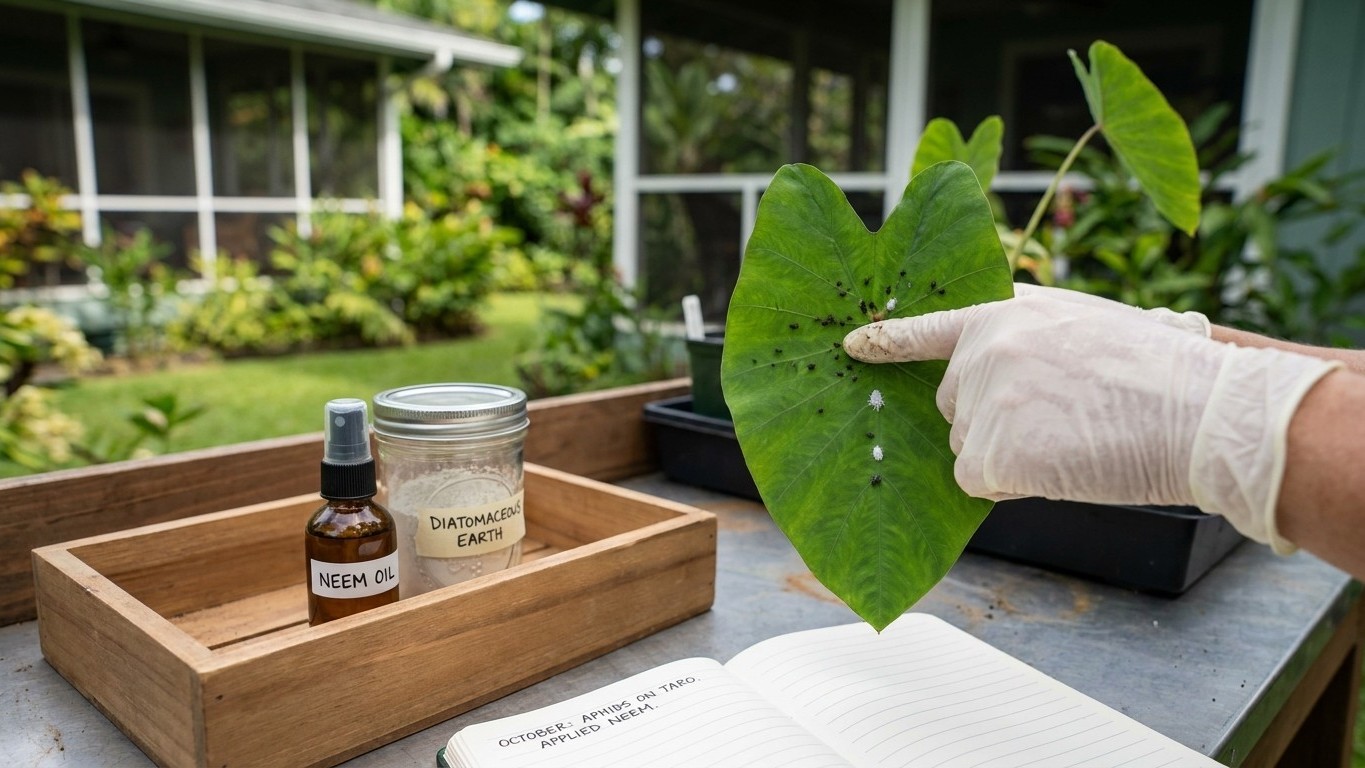
Aphids are soft-bodied insects the size of a pinhead, green, yellow or black, that cluster on new growth and the undersides of leaves. They damage plants directly by sucking sap, curling and yellowing leaves, and matter more as major virus vectors, moving disease from plant to plant as they feed. A strong water spray knocks down light infestations. Ladybird beetle larvae and lacewings will clean up an outbreak given time.
Thrips

Thrips, including melon thrips and western flower thrips, are slender insects under a tenth of an inch, pale yellow to dark brown, easiest to spot by shaking a flower over white paper. Their feeding leaves silvery stippling and black flecks of frass on leaves, and heavy populations distort new growth. Blue or yellow sticky cards catch adults and show you when numbers are climbing before the damage becomes obvious.
Whiteflies

Silverleaf, greenhouse, spiraling and anthurium whiteflies are all tiny moth-like insects, about a tenth of an inch, with powdery white wings that lift off in a small cloud when a plant is brushed. Nymphs sit flat and pale on leaf undersides and excrete sticky honeydew that grows sooty mold. Yellow sticky traps and a horticultural oil spray on the leaf undersides both help. A heavy infestation is easier to prevent with row cover than to clear once it takes hold.
Mites

Mites are barely visible without a hand lens, tiny red, yellow or green specks that cluster on leaf undersides and spin fine webbing between leaves and stems when populations build. Feeding shows up as a dry, stippled bronzing across the leaf, distinct from the shinier silvering thrips leave behind. Mites thrive in dry, dusty conditions, so a regular hose-down of foliage holds them back better than most sprays do.
Diamondback moth and other caterpillars
Diamondback moth larvae are small pale green caterpillars that chew ragged holes and skeletonize cabbage-family leaves. Imported cabbageworm, cabbage webworm, beet armyworm and corn earworm cause similar chewing damage across a wider range of crops. All of them do their damage as larvae, before pupating. Bacillus thuringiensis (Bt) sprays kill young caterpillars without harming bees or other garden visitors, and are the standard first response.
Chinese rose beetle
This small metallic brown beetle, under half an inch long, feeds at night on rose, grapes, beans, eggplant, corn, cucumber and ginger, chewing distinctive round or ragged holes at leaf margins, then drops into soil litter by day where it is hard to find. Because it only feeds after dark, daytime inspection almost always misses it. A porch light trap or handpicking after dusk with a flashlight catches it in the act.
Southern green stinkbug
An oval, shield-shaped bug about three-quarters of an inch long and bright green as an adult, the southern green stinkbug pierces developing pods and fruit to feed, leaving discolored, pitted spots and deformed seeds behind. Damage shows up mainly as fruit and pods approach maturity. Handpicking adults and destroying egg clusters on the undersides of leaves keeps small gardens ahead of it.
Fruit flies
Oriental fruit fly, melon fly, Mediterranean fruit fly and solanaceous fruit fly are all tan to yellowish-brown flies close to housefly size, with clear or patterned wings, that lay eggs inside ripening fruit. The white maggot larvae feed inside the fruit, causing it to rot and drop before it can be picked. Bagging fruit while it is still small and picking up dropped fruit daily to break the life cycle are the two most effective home garden steps. Protein bait traps help track when populations are building.
Fire ants
Little fire ant is pale orange-yellow and barely a tenth of an inch long, slow enough to pick up on a leaf without seeming to move. Red imported fire ant is larger, reddish-brown, and builds visible soil mounds. Both sting, and little fire ant in particular causes painful welts on skin brushed against infested leaves or soil. Report a suspected find to the state extension service rather than treating on guesswork, since the right control differs by species and by site.
Telling damage apart

Chewed edges with irregular holes point to a caterpillar or beetle feeding directly on tissue, usually at night or dawn when you never see the culprit. Stippling, a fine dry speckling that turns leaves bronze or silver, comes from sucking insects like thrips or mites rasping cell contents out from the surface rather than biting through it. Sticky residue on leaves, especially with a black sooty film underneath, is honeydew left by aphids or whiteflies, not a disease on its own, though the mold that grows in it can be.
Sorting symptoms fast
Wilting fools people more than any other symptom, because it can mean three unrelated things: a chewed or tunneled stem cutting off water flow, root rot from overwatering, or plain drought stress in a plant that was never watered deeply enough to begin with. Check the stem base and the roots before treating anything for wilting, because a fungicide does nothing for bean fly damage and an insecticide does nothing for root rot.
| What you see | Likely cause | What to check next |
|---|---|---|
| Ragged holes, chewed leaf margins | Caterpillar, beetle, or slug and snail | Check at night with a flashlight for slime trails or frass |
| Fine speckling, bronzed or silvered leaf surface | Thrips or mites | Shake a leaf or flower over white paper and look for tiny moving specks |
| Sticky film, black sooty mold | Aphids or whiteflies | Check leaf undersides and new growth for clusters of small insects |
| Wilting despite normal watering | Stem-tunneling pest, root disease, or root damage | Dig at the stem base and check the roots for rot, tunnels, or grubs |
| Yellow leaves, no visible insects | Nutrient deficiency, virus, or overwatering | Rule out watering and feeding schedule before assuming a pest |
Disease and watering faults get blamed on insects more often than the reverse happens. A fungal spot usually has a defined ring or margin, often a different color at the center than at the edge, where insect feeding is more irregular and tends to follow the leaf’s vein pattern instead. If you can’t find the insect itself, or its frass, eggs or feeding stage on the plant, treat for disease or a cultural fault first rather than reaching for an insecticide on suspicion alone.
What actually works
Prevention beats intervention for nearly everything on CTAHR’s IP-13 list, mostly because Hawaii’s climate gives pests so many generations a year that a garden which starts clean stays ahead longer than one that starts by fighting an established population. Row cover and physical barriers installed before pests arrive do more work for less effort than any spray applied afterward, especially against bean fly, leafminers and the tephritid fruit flies, none of which can reach a plant they can’t land on or lay eggs in.
Before pests show up
- Rotate cole crops, beans and cucurbits to a different bed each planting rather than repeating the same family in the same soil
- Use floating row cover over seedbeds and young transplants until plants are established enough to tolerate some feeding
- Bag developing fruit on papaya, mango and other susceptible crops before fruit flies can reach it
- Clear fallen and overripe fruit daily, since it is both a fruit fly nursery and a slug food source
- Leave flowering herbs and weeds at field edges to keep ladybird beetles, lacewings and parasitic wasps established nearby
Once something is established, match the response to the pest rather than reaching for a general-purpose spray. Bacillus thuringiensis (Bt) kills caterpillars including diamondback moth without harming bees, ladybird beetles or the parasitic wasps that would otherwise help you for free. Horticultural oil and insecticidal soap smother aphids, whiteflies and mites on contact, but only where the spray actually lands, so undersides of leaves matter more than tops. Iron phosphate bait handles slugs and snails without the pet and wildlife risk of older metaldehyde products.
Some popular home remedies do close to nothing. Beer traps drown a handful of slugs a night out of a population that can number in the hundreds. Garlic and hot pepper sprays repel briefly at best and wash off in the next watering or rain. Diatomaceous earth works only while bone dry, a short window in humid conditions, and does nothing once it gets wet. None of these replace a barrier installed before the pest arrives, which is the one step that consistently pays off across every pest on this list.
What control costs
Comparing methods
Hand picking costs nothing but time, and for slugs, Chinese rose beetle and stinkbug it is genuinely effective if done consistently, a few minutes each evening rather than an hour once a week. Physical barriers like row cover and fruit bags cost more upfront, material plus the time to install and reinstall as plants grow, but they need almost no repeat attention once in place for the season. Biological controls, meaning the ladybird beetles, lacewings and parasitic wasps that build up on their own once broad spraying stops, cost nothing directly but take longer to reach a population that keeps pace with an outbreak.
Sprays, whether Bt, horticultural oil, insecticidal soap or a bait, cost the most in repeat labor over a season because most break down in sun and rain within days and have to go back on every week or two through an active infestation. For a home garden, barriers and hand picking are the cheapest options over a full season, since they are one-time or low-frequency actions rather than a recurring purchase and application.
| Method | Upfront cost | Ongoing time | Repeat frequency |
|---|---|---|---|
| Hand picking | None | A few minutes daily or every evening | Ongoing through the season |
| Row cover and barriers | Moderate, material cost | One installation, occasional adjustment | Once per planting |
| Biological control | Low to none | Low once established | Builds over weeks, then self-sustaining |
| Sprays (Bt, oil, soap, bait) | Recurring purchase | Application every one to two weeks | Repeated through active infestation |
Combining a barrier with hand picking covers most home garden situations without ever reaching for a spray, and it is the low-cost approach that fits the pests most likely to show up in a backyard planting.
Local help
The University of Hawaii CTAHR Extension identifies specimens, tracks outbreaks and publishes the pest and disease bulletins that home gardeners across the islands rely on. If you can’t identify what’s damaging a plant, take a sample or a clear photo to your county extension office rather than guessing at a spray. Find your nearest office through the CTAHR Extension directory. For other island-specific tasks, the Hawaii guides cover planting windows and soil prep beyond pest control.
Common questions
Why does my garden already have pests even though I just started it this year?
New gardens pick up pressure fast because pests move in from neighboring plants, wild host plants and fallen fruit nearby, not because of anything you did wrong. Hawaii’s mild climate keeps populations breeding continuously, so a garden’s age has almost nothing to do with how quickly pests find it.
Can I buy ladybugs to fix an aphid outbreak fast?
Purchased ladybird beetles often fly off within a few days looking for more food once the aphids they were released for are gone, so the effect is usually short-lived. Encouraging the predators already established in your yard, by leaving some flowering weeds and cutting back on broad-spectrum sprays, tends to hold populations down longer than a one-time release.
How do I tell a little fire ant from a regular ant?
By sight alone it’s hard. Little fire ant is pale orange-yellow, barely a tenth of an inch, and moves slowly compared with most common ants, but confirming it takes a close look under magnification. Take a sample or a clear photo to your county extension office rather than guessing, since misidentifying it delays the right response.
Should I spray preventively even if I don’t see any pests yet?
No. Spraying without an identified pest kills off the ladybird beetles, lacewings and parasitic wasps that would otherwise keep populations in check for free, and it speeds up resistance in whatever pest eventually shows up. Monitor with sticky cards and regular hand inspection instead, and treat only once you’ve confirmed what you’re dealing with.