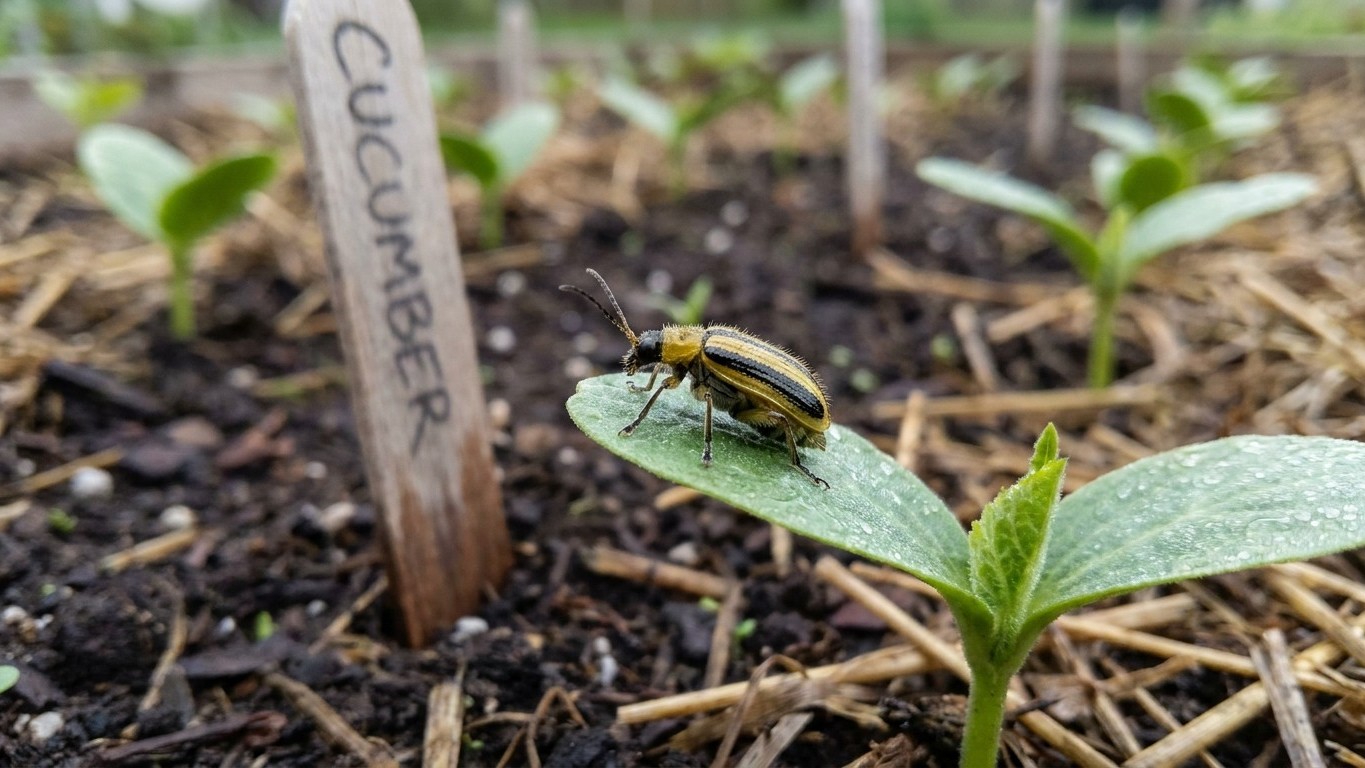

Striped cucumber beetles start turning up in New Brunswick gardens in late May to early June, right when cucumber, squash, and melon seedlings push their first true leaves through the soil. The beetles don’t wait for warm, settled weather the way many gardeners assume. They track soil temperature, and once it hits roughly 50 to 55°F a few inches down, adults crawl out of leaf litter and hedgerows looking for the nearest cucurbit patch. Row covers installed before that window, combined with a short planting delay and a few sticky traps for scouting, stop the majority of early damage before it starts.
When Striped Cucumber Beetles Actually Show Up in New Brunswick

New Brunswick’s growing season runs shorter and cooler than most of the pest’s range south of the border, which shifts the beetle’s calendar without changing its habits. In the Saint John River Valley, where soils warm faster, adults can appear by the last week of May. Along the Fundy coast and in northern counties like Restigouche, that first wave often waits until mid-June, sometimes later in a cold spring.
The beetles spend winter as adults, tucked under fallen leaves, mulch, or dense grass at the edge of a garden bed. They’re not flying in from somewhere else. They’re already on the property, waiting out the cold within a few hundred feet of last year’s cucurbit patch. That’s a detail worth sitting with, because it means the beetle population you see in June is largely a product of what was left standing in that same spot the previous fall.
New Brunswick’s climate typically supports one full generation per season, with a partial second generation showing up in warmer years by late July or August. Compare that to warmer regions of eastern Canada and the northern US, where two full generations is standard. Fewer generations sounds like good news, and it is, but the tradeoff is that the single generation New Brunswick does get tends to concentrate its damage in a tight window right when seedlings are most vulnerable.
What the Damage Looks Like, and Why It’s Worse Than a Few Chewed Leaves
Adult beetles are easy to identify: about a quarter-inch long, yellow-and-black striped wing covers, quick to drop off a leaf and scurry into the soil when disturbed. They feed on cotyledons, stems, and leaf tissue of young cucurbit plants, and a heavy cluster of beetles can strip a seedling down to nothing in a day or two. Established, mature plants generally tolerate feeding damage without much yield loss.
The real threat isn’t the chewing. It’s what the beetles carry in their gut. Striped cucumber beetles vector Erwinia tracheiphila, the bacterium responsible for cucurbit bacterial wilt, and the disease moves from beetle mouthparts into plant wounds during feeding. A plant infected early can look perfectly healthy for a week or two, then collapse almost overnight, wilting from the crown outward even with adequate soil moisture. Cucumbers and muskmelons are highly susceptible; squash and pumpkins vary by variety, with some winter squash types showing more tolerance.
Cucumber mosaic virus is a second concern the beetles can spread, though less efficiently than bacterial wilt. Symptoms show up as mottled, distorted new growth and stunted fruit. Between the two, bacterial wilt is the one that causes the most heartbreak in a home garden, because by the time the wilting is obvious, there’s nothing left to save on that plant.
What Actually Stops the Beetle Before It Gets Established
Timing and Row Covers
The single most reliable defense is physical exclusion at the right moment. Floating row covers laid over cucurbit beds at transplant or seeding, sealed at the edges with soil or landscape staples, block adult beetles from reaching the plants during that critical early feeding window. Covers need to come off once flowers open, since cucurbits depend on bees and other pollinators for fruit set, and the timing usually lands two to three weeks after transplant in a typical New Brunswick season.
Delaying planting by even a week or two, when the schedule allows it, can help transplants miss the earliest and often heaviest beetle emergence. This works best paired with covers rather than as a standalone strategy, since a late planting still gets hit once beetles are active.
Trap Crops and Crop Rotation
Blue Hubbard squash is disproportionately attractive to striped cucumber beetles compared to cucumbers or most summer squash varieties. Planting a small border or perimeter row of it, seeded slightly ahead of the main crop, pulls beetles away from the plants a gardener actually wants to harvest. The trap crop still needs monitoring and, in heavier infestations, targeted treatment, but it concentrates the problem in a spot that’s easier to manage.
Rotating cucurbits to a different part of the garden each year, ideally at least 200 feet from the previous season’s planting site, cuts down on how many overwintering adults find the new crop right away. In a typical suburban or rural New Brunswick lot, that full distance isn’t always realistic, but even shifting beds to the opposite corner of the yard reduces the immediate beetle load.
Fall Cleanup
Since adults overwinter in garden debris, clearing spent cucurbit vines, fallen leaves, and dense mulch from the bed footprint each fall removes a chunk of the local overwintering population before it has a chance to settle in. This is a low-effort, high-payoff step that gets skipped more often than it should, mostly because gardeners are wrapping up the season and moving on to other chores.
Treating an Active Infestation
Once beetles are already feeding, monitoring with yellow sticky traps or simple visual counts (checking five to ten plants every few days) tells you whether the population is climbing fast enough to justify treatment. A general threshold used by extension programs across eastern Canada and the northeastern US is one beetle per plant on seedlings, since young plants have so little leaf tissue to spare.
Kaolin clay, applied as a spray coating on leaves and stems, works as a physical deterrent that makes plants less appealing to feed on and doesn’t harm pollinators once it dries. Spinosad, derived from a soil bacterium, controls beetles effectively but should be applied in early morning or evening when bees aren’t actively foraging, since it carries some risk to pollinators on wet application. Pyrethrin-based products offer a faster knockdown but break down quickly in sunlight, which means repeat applications are often needed during a heavy beetle week.
Diatomaceous earth, dusted on and around the base of plants, damages the beetle’s exoskeleton on contact and works as a lower-toxicity option for gardeners trying to avoid stronger insecticides. It needs reapplication after rain, which in a wetter New Brunswick summer can mean fairly frequent touch-ups.
Natural predators help more than most home gardeners realize. Soldier beetles, tachinid flies, and certain braconid wasps prey on cucumber beetle eggs and larvae, and a garden that avoids broad-spectrum insecticide use tends to build up these populations over a few seasons. Planting flowering herbs like dill, fennel, or yarrow near cucurbit beds gives these predators a reason to stick around.
Resistant and Tolerant Varieties Worth Considering
No cucurbit variety is fully immune to striped cucumber beetle feeding, but some show better tolerance to the bacterial wilt the beetles spread. Certain butternut and other winter squash varieties handle infection with less collapse than cucumbers or muskmelons, which remain the most vulnerable across the board. Seed catalogs and provincial extension bulletins occasionally note wilt tolerance for specific cultivars, and checking that detail before ordering seed is worth the extra five minutes for anyone who’s lost a cucumber patch to wilt before.
Gardeners in New Brunswick’s cooler pockets, particularly along the Bay of Fundy where fog delays soil warming, sometimes see lighter beetle pressure simply because the insects emerge later and get less time to build numbers before fall. That’s not a strategy so much as a regional quirk worth knowing if you’re deciding where on the property to tuck this year’s squash bed.
Related guides
- Striped cucumber beetle in Quebec: When It Shows Up and What Stops It
- Striped cucumber beetle in Nova Scotia: When It Shows Up and What Stops It
- Striped cucumber beetle in Newfoundland and Labrador: When It Shows Up and What Stops It
- Striped cucumber beetle in New Hampshire: When It Shows Up and What Stops It
- Browntail moth in New Brunswick
- Colorado potato beetle in New Brunswick
- Spotted wing drosophila in New Brunswick
- Striped cucumber beetle in Prince Edward Island: When It Shows Up and What Stops It