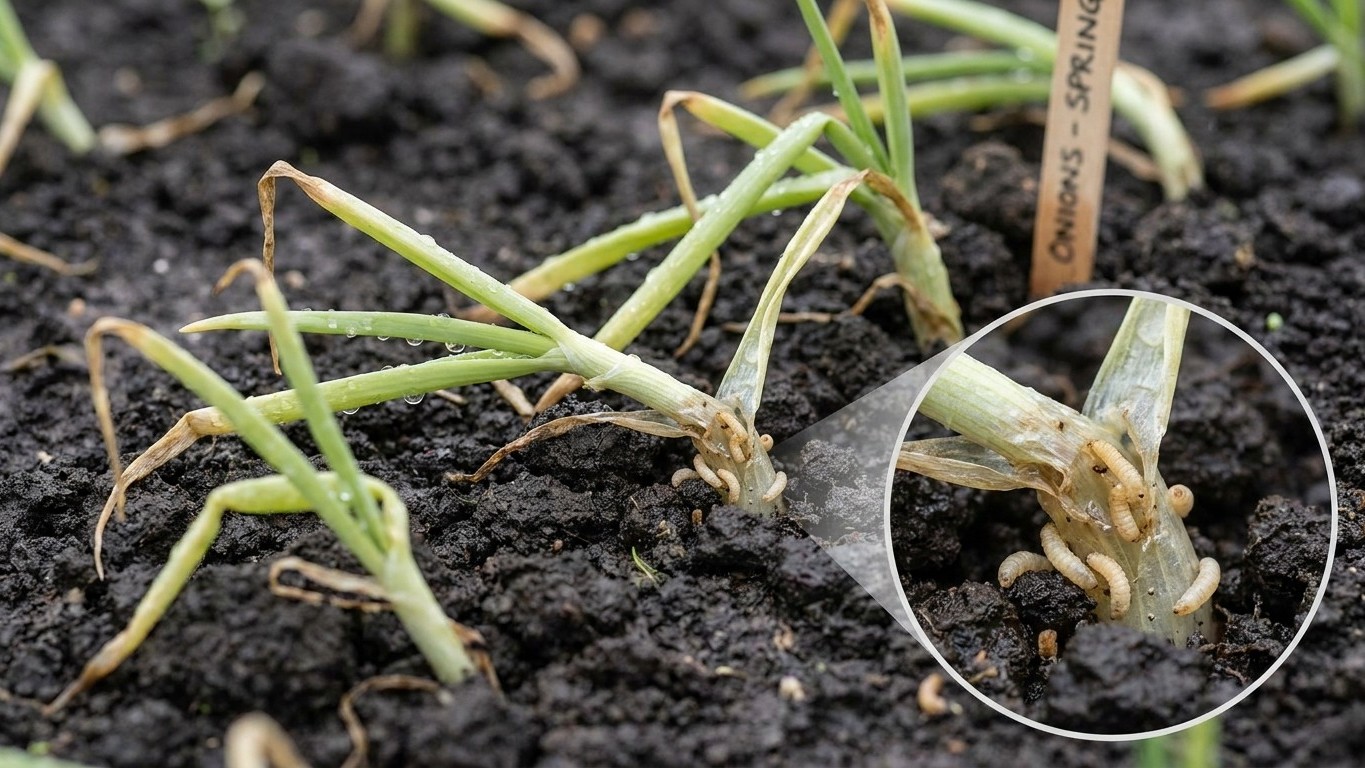

Onion maggot larvae start feeding on Manitoba onion sets around late May, right as soil temperatures climb past 50°F. The first generation is usually the most damaging one, since it attacks young transplants and seedlings that haven’t developed enough root mass to survive an infestation. If your onions are wilting in patches during early June, this pest is the first suspect on the list.
Why Manitoba’s climate shapes the onion maggot’s schedule

Delia antiqua, the fly behind onion maggot damage, overwinters as pupae in the soil. Manitoba’s long, cold winters actually work in the pest’s favor here, since the pupae need a solid cold period before they’ll emerge as adults in spring. That’s different from milder growing regions where erratic winter warm-ups can confuse the insect’s timing.
Once soil temperatures hold steady above roughly 50°F, adult flies emerge and start laying eggs at the base of onion plants, right where the stem meets the soil. In a typical Manitoba season, that first emergence lands sometime between mid-May and early June, depending on how quickly the ground thaws and warms that particular year. A cool, wet spring can push emergence back by a week or two; a fast warm-up can bring it forward just as quickly.
Manitoba growers generally see two to three generations per season, with the first being the most destructive because seedlings have so little root reserve to fall back on. The second generation shows up in July, often targeting bulbing onions that are sizing up. A third generation, when conditions allow it, hits in late August or September and can affect onions still in the ground close to harvest.
What separates onion maggot damage from other onion problems
Wilting, yellowing leaves that pull away from the bulb with almost no resistance is the classic sign. Pull one up and you’ll often find the base rotted or hollowed out, sometimes with small white larvae still inside. Onion maggot damage tends to appear in clusters rather than scattered randomly across a row, because the flies lay eggs near existing plants and larvae can migrate a short distance to neighboring bulbs once they’ve exhausted one host.
Compare that to thrips damage, which shows up as silvery streaking on leaves, or onion smut, which produces black streaks inside the bulb itself. Maggot damage is almost always at the base of the plant, not scattered across leaf surfaces.
Conditions that make an infestation worse in Manitoba gardens and fields
Cool, wet springs slow onion seedling growth, which gives the maggots more time to attack before the plant can outgrow the vulnerable stage. This is one reason growers in Manitoba’s Red River Valley, where clay soils hold moisture longer, sometimes report heavier pressure than growers on sandier ground further west.
Fields or garden beds where onions, garlic, or leeks were grown the previous year carry a higher risk, since overwintering pupae are often still present in that soil. Rotating away from allium crops for at least two years breaks that cycle in a meaningful way. Fresh manure or heavy organic matter worked into the soil right before planting can also draw egg-laying flies, since the flies are attracted to the smell of decomposing organic material near the soil surface.
- Onions or leeks planted in the same bed as the previous season
- Recently applied manure or compost that hasn’t fully broken down
- Heavy clay soil that stays cool and moist into late spring
- Delayed thinning, which leaves seedlings crowded and stressed
What actually stops onion maggot in Manitoba conditions
Timing matters more than any single product. Because the first generation does the most damage and lines up with early transplanting, protecting seedlings during that first three to four weeks after planting gives the best return on effort.
Physical barriers
Floating row covers, put down immediately after planting and sealed at the edges with soil or clips, block adult flies from reaching the base of the plants to lay eggs. This is one of the most reliable tools for home gardeners because it doesn’t rely on timing pesticide applications around fly emergence. The tradeoff is that covers need to come off before flowering onions need pollinator access, and they can trap excess heat during a hot stretch, so check under them regularly.
Cultural practices that reduce risk
Delaying planting by a week or two past the earliest possible date can help transplants get past the most vulnerable seedling stage before peak fly activity hits. Wider spacing between plants reduces the chance that larvae migrate easily from one bulb to the next once they’ve killed their first host. Removing and destroying infested plants promptly, rather than leaving them in the row, cuts down the number of maggots that can complete their life cycle and produce the next generation.
Crop rotation away from all allium species for two to three years remains one of the most effective long-term strategies, since it removes the food source pupae need when they emerge the following spring near where they overwintered.
Biological and chemical options
Beneficial nematodes applied to the soil around onion bases can target larvae before they cause serious damage, though results depend on soil moisture and temperature staying within the nematode’s active range. For larger plantings, registered insecticides applied as a soil drench at planting time or shortly after transplanting can protect the vulnerable root zone during the first generation’s egg-laying window. Manitoba growers dealing with repeated pressure often combine row covers early in the season with a soil-applied treatment at transplant, rather than relying on one method alone.
Diatomaceous earth worked into the soil surface around the base of plants can also deter egg-laying adults, though it needs reapplication after rain since moisture reduces its effectiveness.
Monitoring for early warning signs
Yellow sticky traps placed at ankle height near onion rows can catch adult flies before eggs are laid, giving a rough sense of when local emergence is happening in a given year rather than relying only on a calendar date. Checking traps twice a week starting in early May, and again in late June ahead of the second generation, catches both major waves before they cause damage.
Home gardeners without traps can watch for a simpler cue: once daytime soil temperatures at a 2-inch depth hold consistently above 50°F for several days running, treat that as the signal to have row covers in place if they aren’t already.
What to do if damage is already showing
Pull and dispose of any wilted or collapsed plants right away rather than composting them on site, since larvae inside can continue developing even after the plant above ground is dead. Check neighboring plants carefully, since larvae often move a few inches through the soil to reach an adjacent bulb once their first host is exhausted.
Replanting in the same spot the same season rarely helps, since the soil is likely to still hold pupae or larvae from the current generation. A better move is to shift remaining transplants to a bed that hasn’t hosted alliums recently, and treat the affected area as off-limits for onions, garlic, or leeks for at least the next full growing season.
One detail that surprises a lot of gardeners: a single female onion maggot fly can lay several dozen eggs near the base of one plant, which is why damage often appears to jump from a handful of wilting seedlings to a much wider patch within just a few days once that first generation gets established.
Related guides
- Onion maggot in Ontario: When It Shows Up and What Stops It
- Onion maggot in Minnesota: When It Shows Up and What Stops It
- Onion maggot in New York: When It Shows Up and What Stops It
- Onion maggot in British Columbia: When It Shows Up and What Stops It
- Onion maggot in Pennsylvania: When It Shows Up and What Stops It