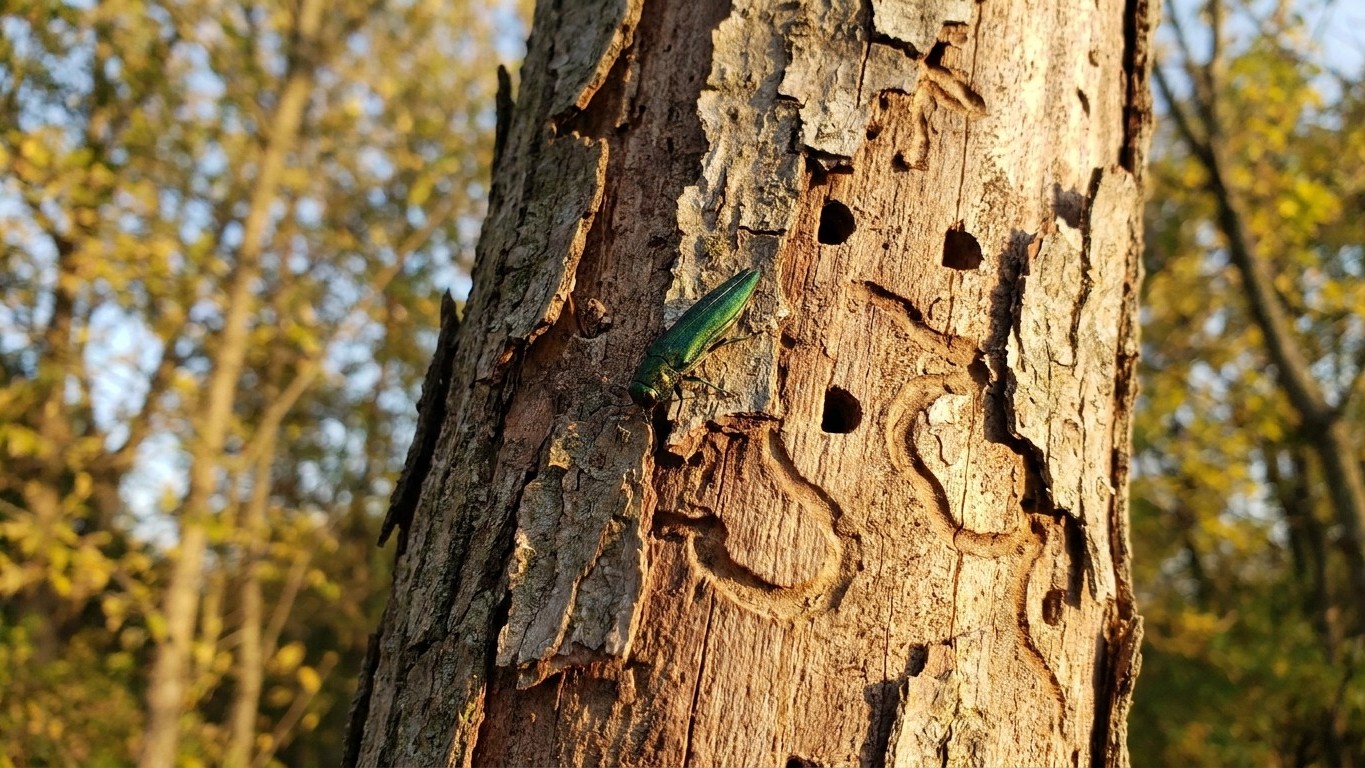

Emerald ash borer shows up in Michigan every year between late May and August, with adult beetles peaking in June and July. The insect has already killed an estimated 30 million ash trees across the state since it was first detected near Detroit in 2002, and it’s now established in every county. Stopping it means acting before symptoms appear, because once a tree shows heavy canopy loss, treatment rarely saves it.
Michigan’s Ground Zero Status

Michigan isn’t just another state on the emerald ash borer map. It’s where the beetle first landed in North America, likely arriving in wood packing material shipped from Asia sometime in the 1990s. By the time anyone noticed dying ash trees in Canton and surrounding Wayne County in the summer of 2002, the insect had probably been feeding undetected for close to a decade.
That head start matters. Trees in southeastern Michigan absorbed the first and heaviest wave of damage, and many mature ash stands there were wiped out before scientists even had a name for what was killing them. Communities in Detroit’s suburbs lost entire street-tree canopies within a few years, a scale of loss that later outbreaks in Ohio, Pennsylvania, and beyond never quite matched because those states had warning and, eventually, treatment options.
Today the insect is considered established statewide, from the Upper Peninsula down to the Indiana and Ohio borders. Federal quarantine rules that once restricted moving ash wood and firewood out of infested counties were lifted nationwide in 2021, since the beetle had already spread too widely for containment to make sense. That doesn’t mean the threat is over. It means the fight shifted from stopping the spread to managing individual trees.
When Emerald Ash Borer Is Active in Michigan
The beetle’s life cycle in Michigan runs on a fairly predictable clock, and knowing it helps homeowners time both inspections and treatments correctly.
Spring: Larvae Finish Feeding
From April through May, larvae that spent the previous fall and winter tunneling under the bark resume feeding and pupate. This is a quiet period visually, but it’s the last window before adults emerge and start the cycle over.
Summer: Adult Emergence and Egg-Laying
Adult beetles start emerging in late May, with numbers climbing through June and peaking in July. Adults are metallic green, about half an inch long, roughly the size of a grain of rice with wings. Females lay eggs in bark crevices from June through August, and those eggs hatch into larvae that bore inward to feed on the tree’s inner bark and cambium, the layer that moves nutrients and water.
Fall and Winter: Larvae Overwinter
By September, larvae have usually settled into their feeding galleries for the season, continuing to chew S-shaped tunnels that girdle the tree from the inside. They overwinter as larvae or prepupae, protected from Michigan’s cold under several inches of bark, ready to resume the cycle in spring.
This timeline means late spring through midsummer is the highest-risk window for new infestations to take hold, and it’s also the best window for applying most systemic insecticide treatments, since the chemical needs to be circulating in the tree before larvae start feeding heavily.
Signs an Ash Tree in Michigan Is Infested
Symptoms often lag behind the actual infestation by a year or two, since larvae feed hidden under bark before any external damage becomes obvious. By the time a homeowner notices problems, the beetle population inside the tree may already be substantial.
- Canopy thinning starting at the top of the tree and moving downward, often showing up first as sparse leaves on upper branches
- D-shaped exit holes about 1/8 inch wide in the bark, left when adults emerge
- Vertical bark splits exposing the winding larval galleries underneath
- Epicormic sprouting, meaning a burst of small shoots growing from the trunk or base as the tree tries to compensate for lost canopy
- Woodpecker damage, sometimes called “blonding,” where birds strip bark hunting for larvae, leaving patches of lighter wood exposed
Woodpecker activity in particular is worth taking seriously. Michigan homeowners who notice unusual, concentrated woodpecker feeding on an ash trunk should treat it as an early warning sign rather than a coincidence, since woodpeckers are remarkably good at locating larvae before the damage becomes visible any other way.
What Actually Stops Emerald Ash Borer
No single method eliminates the beetle from a landscape entirely, but a combination of chemical treatment, biological control, and smart removal decisions has kept many individual trees alive across Michigan.
Systemic Insecticide Treatment
For trees that are still healthy or only lightly infested, systemic insecticides applied by trunk injection, soil drench, or bark spray can protect against emerald ash borer for one to three years, depending on the product and application method. Trunk-injected treatments containing emamectin benzoate have shown strong performance in university trials, often protecting trees for two full growing seasons per treatment.
Treatment only works within a specific window of tree health. Once a tree has lost more than 30 to 50 percent of its canopy, most arborists consider it too far gone to save economically, and removal becomes the safer, cheaper option. This threshold is why early detection matters so much, since a tree treated at the first sign of thinning has a real chance, while one already half-dead usually doesn’t.
Biological Control
The USDA’s Animal and Plant Health Inspection Service has released several species of tiny parasitoid wasps in Michigan and other infested states, insects that attack emerald ash borer eggs and larvae without harming native species. These wasps, including Tetrastichus planipennisi and Oobius agrili, won’t save individual high-value trees fast enough to matter for a homeowner’s front yard, but over years they’ve shown promise in reducing beetle populations across forested landscapes, giving surviving ash trees and new seedlings a better long-term chance.
Removal and Replacement
For trees too far gone to treat, removal isn’t optional. Dead ash trees become structurally unstable within a few years of losing their canopy, since the wood dries out and the trunk weakens from the inside out, making them a real hazard near homes, driveways, and power lines. Michigan municipalities have removed hundreds of thousands of dead street trees since the outbreak began, and many replaced them with a mix of species rather than a single replacement tree, a lesson learned directly from how fast a monoculture of ash disappeared.
Firewood Rules and Why They Still Matter
Even though federal quarantines ended in 2021, moving firewood is still one of the fastest ways to spread emerald ash borer and other tree pests into new areas within the state. Michigan continues to recommend buying firewood locally, within about 10 miles of where it will be burned, and never transporting untreated ash firewood to campgrounds, cabins, or new properties.
The beetle can survive hidden in cut logs for months, meaning a load of firewood cut from an infested tree in one county can introduce the pest to an area that had previously been spared, or reintroduce it after local populations had declined. State parks and many private campgrounds still enforce local-sourcing rules for exactly this reason.
Protecting Ash Trees on Your Property
Homeowners with mature ash trees still standing have a narrower path than they did a decade ago, but it’s not closed. The first step is confirming the tree really is an ash, since compound leaves with 5 to 11 leaflets, opposite branching, and diamond-patterned bark on mature trunks are the identifying traits. Confusing ash with other species leads to wasted treatment money on trees that were never at risk in the first place.
Once identified, a healthy ash tree with sentimental or shade value worth protecting should be evaluated by a certified arborist for treatment, ideally in spring before adult emergence peaks. For ash trees already showing significant dieback, get a removal estimate before storm season rather than after, since dead ash wood becomes brittle and unpredictable, and Michigan’s ice storms and high winds have brought down plenty of untreated trees onto roofs and power lines in the years since the outbreak began.
Michigan’s experience with this beetle offers one lesson other states are still catching up to: waiting for visible symptoms before deciding whether to treat or remove almost always costs more, in both money and risk, than acting during the quiet years when a tree still looks fine from the curb.