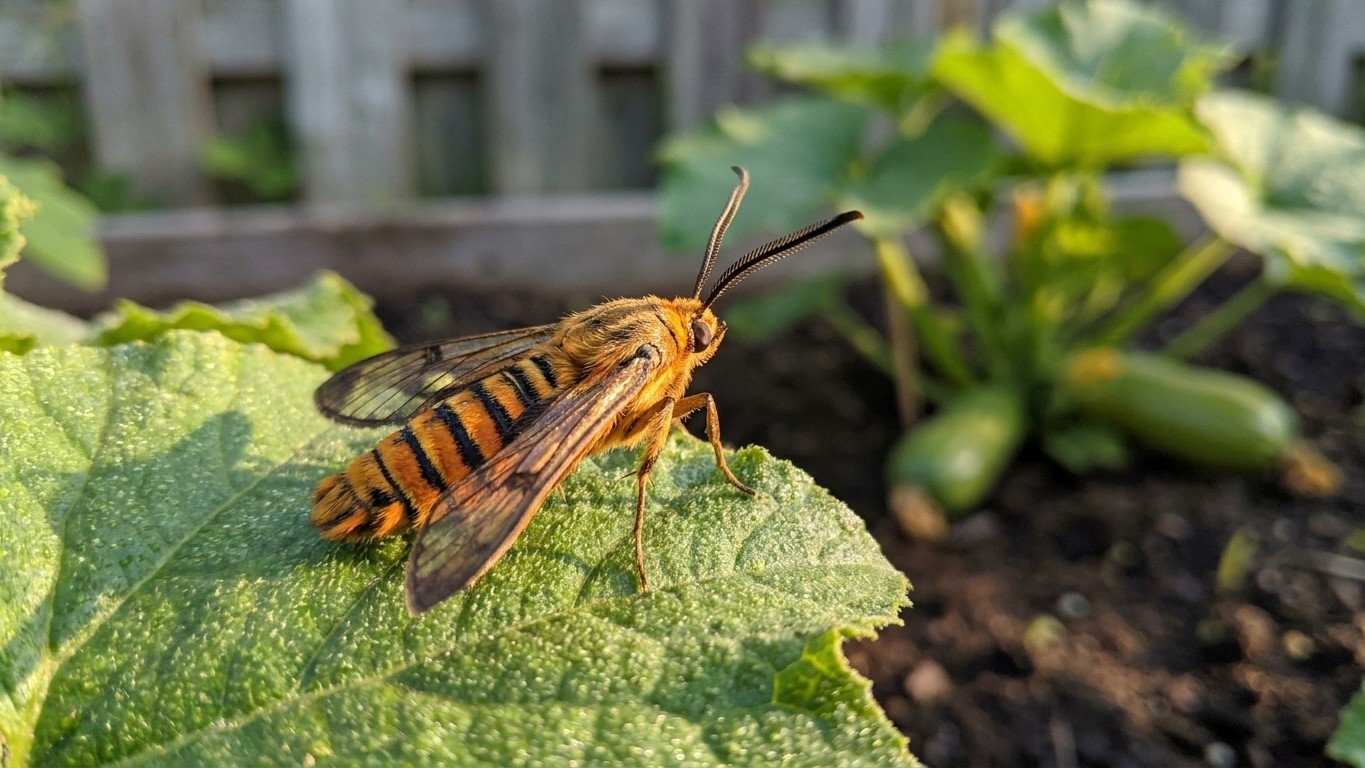

In Quebec’s growing regions, squash vine borer moths typically emerge from the soil between mid-June and late July, with peak egg-laying activity in the first two weeks of July. Because the province sits at the northern edge of this pest’s range, most gardens only deal with a single generation per year, unlike states farther south where a second wave can hit in August. Stopping it comes down to timing: row covers must go on before that emergence window and come off only when female moths are done laying, resistant squash varieties reduce losses without any spraying, and physically protecting the stem base blocks the larvae before they tunnel in.
When Squash Vine Borer Moths Emerge in Quebec Gardens

The moth (Melittia cucurbitae) spends winter as a pupa buried two to six inches deep in garden soil, sometimes in the exact spot where last year’s squash plants stood. Emergence isn’t tied to a calendar date so much as soil temperature and accumulated warmth. Entomologists track this with a growing degree day model, and in most seasons the moths start appearing once the soil has logged roughly 1,000 growing degree days from a base of 50°F. Depending on how quickly spring warms up, that milestone can land anywhere from the second week of June to the third week of July across Quebec’s different growing zones.
The adult itself is easy to mistake for a wasp at first glance: an inch-long body, orange and black markings, and a habit of flying during the day rather than at night like most moths. That daytime activity matters because it means the danger window is exactly when you’re out in the garden anyway, which makes early detection realistic if you know what to look for.
Because Quebec’s frost-free season is shorter than in Ohio or Pennsylvania, there usually isn’t enough time left after the first generation for a second brood to mature before fall cold shuts things down. That single-generation pattern is actually good news for gardeners here. It means a well-timed defense in late June and July can cover the entire threat for the season, rather than requiring vigilance clear through September. The University of Minnesota Extension, working in a climate similar to much of southern Quebec, documents this same one-generation pattern and uses the same degree-day threshold for predicting emergence.
Which Squash Are Most at Risk
Not every plant in the cucurbit family gets hit equally. Zucchini and other summer squash, along with pumpkins and most winter squash in the Cucurbita maxima and C. pepo groups, are prime targets. Butternut squash, which belongs to Cucurbita moschata, has a solid stem and a different chemical profile that female moths seem to find less attractive for egg-laying. Gardeners who’ve lost a zucchini patch two years running often report that butternut planted in the same bed sails through untouched.
Spotting the Damage Before the Plant Collapses
The first sign most people notice is a squash plant that looked fine on Monday and is wilting badly by Thursday, despite regular watering. By then, the larva has already been feeding inside the stem for a week or more. Checking the base of the plant, right at soil level, usually reveals the real clue: a small hole surrounded by a moist, sawdust-like material called frass. That frass is the larva’s excrement pushed out of the tunnel as it eats through the stem tissue from the inside.
A single larva can hollow out several inches of stem, cutting off the plant’s ability to move water and nutrients from the roots to the leaves. That’s why the wilting looks sudden even though the damage has been building quietly for days. Splitting open an affected stem with a knife will usually show the culprit directly: a creamy white caterpillar with a brown head, up to an inch long, packed inside the hollowed-out tissue.
Eggs are trickier to catch because they’re laid singly rather than in clusters, tucked against the stem near the soil line or on the underside of leaf stalks close to the crown. They’re tiny, flattened, and reddish-brown, roughly the size of a pinhead. Running a finger along the lower foot of stem every few days during the emergence window is the most reliable way to find them before they hatch, which typically happens seven to ten days after laying.
What Actually Stops Squash vine borer in Quebec
No single method works alone with this pest, because once a larva is inside the stem, insecticide sprays on the leaves do almost nothing. The strategies that hold up are the ones that either block egg-laying, kill eggs before they hatch, or physically stop larvae from reaching the stem’s interior.
Row Covers, Timed Correctly
Floating row covers or fine mesh netting placed over young plants right after transplanting or seeding can prevent moths from ever reaching the stems to lay eggs. The catch is timing removal correctly: covers need to come off once flowers appear, since squash requires pollinator access to set fruit. In Quebec, that usually means covers go on in late May or early June and come off by the time the plant starts flowering, roughly matching or slightly preceding the moth emergence window. Some gardeners split the difference by covering only until early July, then removing covers and switching to stem protection for the rest of the season.
Wrapping or Mounding the Stem Base
A strip of aluminum foil, nylon stocking, or even a section of paper towel roll wrapped around the lowest four to six inches of stem, and buried slightly into the soil, creates a physical barrier that keeps females from laying eggs directly on exposed stem tissue. This method takes maybe two minutes per plant and has held up well in university extension trials as one of the more effective low-cost defenses.
Choosing Resistant Varieties
Swapping part of a garden’s summer squash for butternut or other C. moschata types doesn’t guarantee zero damage, but it consistently shows lower infestation rates in field observations. For gardeners who depend on zucchini specifically, staggering plantings so a second round goes in the ground in early July can also help, since those younger plants miss the peak of the first moth wave entirely.
Trap Cropping With Blue Hubbard
Blue Hubbard squash is notoriously more attractive to squash vine borer moths than most other varieties. Planting a few Blue Hubbard plants around the perimeter of a squash patch can draw egg-laying activity away from the main crop. The trade-off is that those trap plants need to be monitored and, ideally, removed or destroyed once they’re infested, otherwise they just become a larva nursery a few feet from everything else.
Fall Cleanup and Soil Disturbance
Since the pupae overwinter in the top few inches of soil, tilling or turning garden beds in late fall after harvest exposes them to freezing temperatures and predators like birds. Removing and destroying infested vines immediately after the growing season, rather than leaving them to break down in place, cuts down the population of pupae available to emerge the following June. This single step is one of the most overlooked, partly because by October most gardeners have mentally checked out of the season.
Injecting Bt or Beneficial Nematodes
For plants that already show entry holes but haven’t wilted completely, some gardeners use a syringe to inject a solution containing Bacillus thuringiensis (Bt) or beneficial nematodes directly into the stem near the damage site. This targets the larva inside the tunnel rather than relying on surface sprays that can’t reach it. Success rates vary depending on how much of the stem is already hollowed out and how early the injection happens relative to the infestation.
Rotating Crops Matters More Than It Seems
Because pupae often sit in the soil close to where the previous season’s squash grew, planting cucurbits in the same bed year after year makes it easier for emerging moths to find host plants right where they overwintered. Moving squash plantings to a different section of the garden each year, even by just ten or fifteen feet, adds a small but real obstacle for a pest that doesn’t fly especially far in search of a meal.
Gardeners in Quebec’s shorter-season climate zones sometimes get an unexpected assist from the calendar itself: a late, cool spring can push moth emergence back far enough that fast-maturing summer squash is already past its most vulnerable seedling stage by the time the first moths appear. That’s not a strategy anyone can plan around, but it explains why the same garden can have a rough borer year followed by a nearly borer-free one, even without changing a single practice in between.
Related guides
- Squash vine borer in Ontario: When It Shows Up and What Stops It
- Squash vine borer in New Brunswick: When It Shows Up and What Stops It
- Squash vine borer in South Carolina: When It Shows Up and What Stops It
- Squash vine borer in South Dakota: When It Shows Up and What Stops It
- Squash vine borer in Minnesota: When It Shows Up and What Stops It