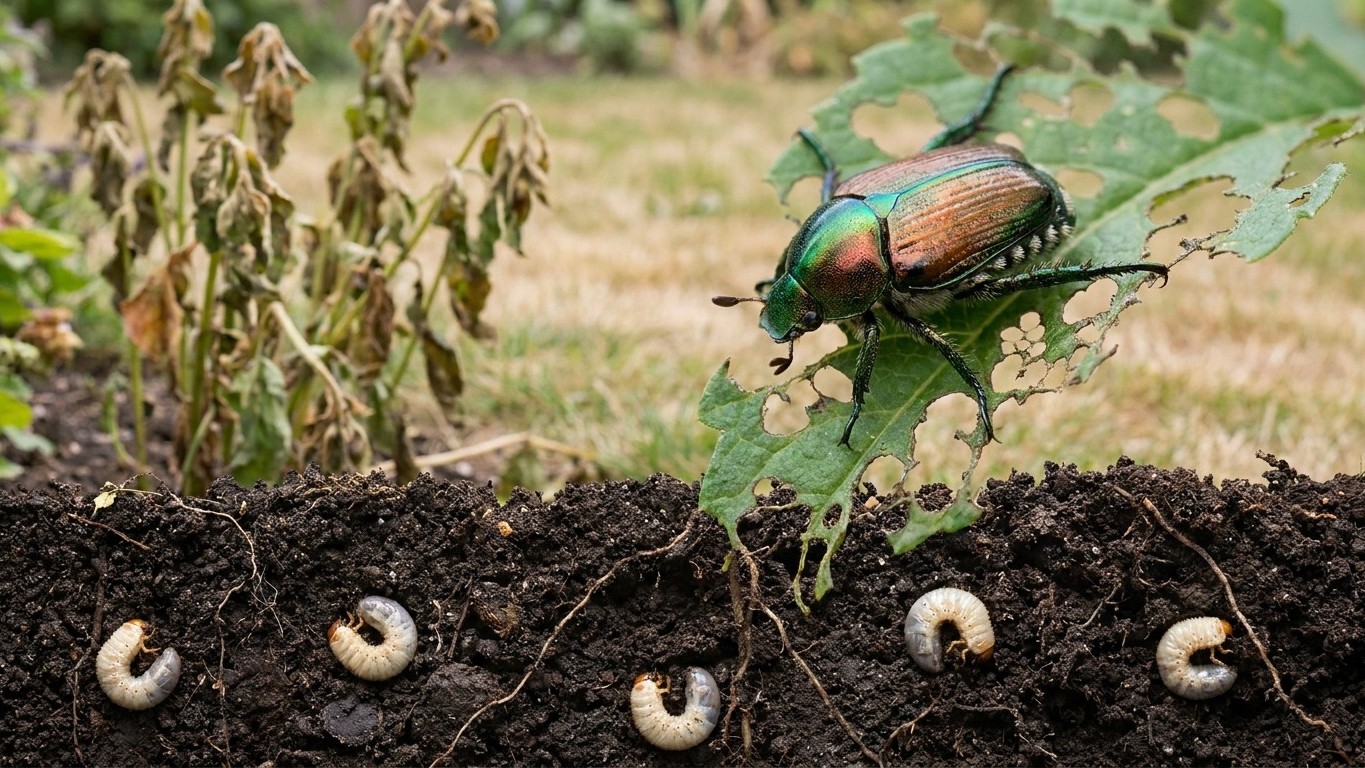

Adult Japanese beetles start showing up in Ohio in late June, with populations peaking through July and lingering into mid-August. Grubs, the larval stage that chews through lawn roots, stay active in soil from early spring through fall, becoming most destructive in September and October when they feed heavily before winter. Stopping them means treating two different pests on two different calendars, not one bug on one timeline.
When Japanese Beetles Show Up in Ohio

Soil temperature drives the whole schedule. Adult beetles emerge once soil hits roughly 65 to 70°F at a depth of a few inches, which in most of Ohio lands between mid-June and early July. Southern counties near the Ohio River often see beetles a week or two before northern counties along Lake Erie, where cooler spring soil delays emergence.
Once out, adults live about four to six weeks, feeding during the day and mating in the same breeding grounds they’re skeletonizing. Females burrow into turf to lay eggs starting in early July, and that egg-laying window is exactly when new grubs enter the soil to start the next generation. Ohio typically sees one full generation per year, unlike some warmer states where partial second generations complicate control.
Grub activity has its own rhythm. Eggs hatch in about two weeks, and young grubs feed close to the surface through August and September, doing the bulk of their root damage before temperatures drop. They burrow deeper as soil cools in November, sit dormant through winter below the frost line, then move back up in March and April for a shorter spring feeding period before pupating into adults by June.
Why Ohio Sees More Pressure Than Neighboring States
Ohio’s mix of clay-heavy soils, irrigated suburban lawns, and a dense population of preferred host plants makes it one of the more heavily affected states in the Midwest. Well-watered turf during dry July stretches is especially attractive to egg-laying females, since moist soil is easier to burrow into and better protects eggs from drying out. Lawns that get regular irrigation during peak egg-laying season often end up with heavier grub loads the following year, even if the surrounding neighborhood lawns look fine.
What Japanese Beetles Damage in Ohio Yards
Adults feed on more than 300 plant species, but they’re not subtle about their favorites. In Ohio landscapes, roses, linden trees, littleleaf and American varieties especially, grapevines, Japanese maples, crabapples, and birch trees take the heaviest hits. The feeding pattern is distinctive: beetles chew out the tissue between leaf veins, leaving a lace-like skeleton that browns and curls within days.
A single beetle doesn’t do much damage. The problem is aggregation. Beetles release pheromones that attract more beetles to an already-damaged plant, so infestations snowball fast. A rose bush that looked fine on Monday can be stripped by Friday once a feeding cluster forms.
Below ground, grubs cause a different kind of damage that’s easy to misdiagnose. They chew through grass roots, and heavily infested lawns develop irregular brown patches that peel back like loose carpet when tugged. That symptom often gets mistaken for drought stress, especially since it shows up in the same late-summer window when lawns are already struggling with heat. The giveaway is the peeling texture: drought-stressed grass stays rooted, while grub-damaged turf lifts away in sections because the roots are simply gone.
Raccoons and skunks digging up lawns overnight are frequently a secondary sign of a grub problem, since both animals will tear up turf hunting for the grubs as a food source.
What Actually Stops Japanese Beetles
Control splits into two separate strategies, one for the adults chewing on plants above ground and one for the grubs damaging roots below. Treating only one half of the life cycle is the most common reason homeowners feel like they’re losing the fight year after year.
Dealing With Adult Beetles
Pheromone traps are widely sold but generally a bad idea near plants you actually want to protect. Research from university extension programs has repeatedly shown that these traps attract more beetles to a property than they capture, often making damage worse in a 100- to 200-foot radius around the trap. If used at all, they belong far from ornamentals and gardens, not next to them.
Hand removal works surprisingly well on small properties. Beetles are sluggish in early morning and easy to knock into a bucket of soapy water, where they drown quickly. Doing this daily during the peak weeks in July can meaningfully reduce the aggregation effect, since fewer feeding beetles means less pheromone signal drawing in others.
For chemical options, neem oil and pyrethrin-based sprays offer short-term protection on ornamentals but need reapplication every few days, especially after rain. Systemic insecticides applied to high-value trees and shrubs in spring, before beetles emerge, give season-long protection but take weeks to move through the plant’s tissue, so timing matters more than the product choice itself.
Row covers are a low-tech option for vegetable gardens and small fruit plantings. Lightweight mesh fabric physically blocks beetles from reaching foliage during the peak feeding weeks, then gets removed once beetle activity drops off in August.
Dealing With Grubs in the Lawn
Timing separates effective grub control from wasted effort. Preventive insecticide treatments containing imidacloprid or chlorantraniliprole work best when applied in late June to early July, before eggs hatch, since these products need to already be present in the soil when young grubs start feeding. Applying the same products in September, after grubs are already established and larger, requires a different active ingredient, typically trichlorfon or carbaryl, because older grubs are harder to kill.
Milky spore, a bacterial product marketed for grub control, has a mixed track record in Ohio specifically. It targets Japanese beetle grubs almost exclusively but can take two to three years to build up sufficient soil concentration to work, and cold winters can slow the bacteria’s establishment compared to warmer states where it was originally developed. Beneficial nematodes offer a faster-acting biological alternative but need moist soil and careful application timing to survive long enough to find grubs.
A soil test before treating saves money and guesswork. Cutting a one-foot square of turf in a few different spots and counting grubs gives a real number to work with. Extension guidance generally sets the action threshold around 8 to 10 grubs per square foot, below which most healthy lawns can tolerate the damage without intervention.
Long-Term Management Across the Ohio Growing Season
Properties that stay ahead of Japanese beetles usually treat it as a year-round rhythm rather than a July emergency. Spring means checking for surviving grubs and watching soil moisture, since drought-stressed lawns are less appealing to egg-laying females later in summer. Early summer is the window for preventive grub treatments and for setting up physical barriers on vulnerable plants before adults ever emerge.
Natural predators help more than most homeowners realize. Birds, particularly starlings and grackles, will tear up lawns hunting grubs, and while that’s frustrating to watch, it’s free pest control. Tachinid flies and a parasitic wasp called Tiphia vernalis both target Japanese beetle grubs specifically and have become more established in Ohio over the past two decades as populations of the beetle have spread statewide since it was first detected in the region in the early 20th century.
Reducing turf area near high-value ornamentals is one of the more overlooked long-term fixes. Since egg-laying females strongly prefer moist, well-maintained lawn over bare soil or mulch, replacing a strip of irrigated turf near a prized rose bed with mulch or groundcover can lower local egg-laying pressure without any spraying at all.
Fall soil testing, after the main feeding period but before ground freeze, gives the clearest read on how bad next year’s problem might be. A high grub count in October is the strongest single predictor of adult beetle pressure the following July, which makes autumn the smartest time to plan next season’s approach rather than waiting for the first skeletonized rose leaf to show up.
Related guides
- Japanese beetle in Pennsylvania: When It Shows Up and What Stops It
- Japanese beetle in West Virginia: When It Shows Up and What Stops It
- Japanese beetle in Ontario: When It Shows Up and What Stops It
- Japanese beetle in Quebec: When It Shows Up and What Stops It
- Japanese beetle in Iowa: When It Shows Up and What Stops It