
Cabbage loopers don’t survive South Dakota’s winters. They arrive each year as migrants from warmer states, riding wind currents north sometime between late May and July, then build populations through late summer before frost wipes them out again. That single fact explains almost everything about managing them here: timing your defenses to the migration window matters more than fighting an entrenched, year-round population.
Why South Dakota Never Has a Resident Cabbage Looper Population

The cabbage looper, Trichoplusia ni, is a moth whose caterpillar stage does the damage in home gardens. Unlike squash bugs or Colorado potato beetles that overwinter in local soil and plant debris, the looper can’t survive a Dakota winter in any life stage. The pupae and adults freeze out once temperatures drop consistently below freezing, which in most of the state happens well before Thanksgiving.
That means every looper found feeding on a Sioux Falls broccoli patch or a Rapid City kale bed traveled there. Adult moths are strong fliers and get assisted by prevailing wind patterns moving up from Texas, Oklahoma, and the Gulf Coast states, where the insect overwinters successfully year after year. Some seasons bring heavier migrations than others, largely tied to weather patterns in those southern source regions during spring.
This migratory habit is shared with a handful of other agricultural pests, but it has a practical upside for gardeners: there’s no wintertime prevention step to worry about. Cleaning up brassica debris in the fall does nothing to stop next year’s loopers, because next year’s loopers aren’t hiding in that debris. They’re flying in from somewhere else entirely.
When Cabbage Loopers Actually Show Up in South Dakota Gardens
Because the insect arrives by migration, its appearance tracks later in the season compared to states closer to its overwintering range. Home gardeners across South Dakota typically don’t see meaningful looper damage until midsummer, roughly July into September, once moths have flown in and laid the first local generation of eggs.
Early-season damage on cole crops planted in April or May is far more likely to come from other culprits, imported cabbageworm chief among them. That’s a distinction worth getting right, because the tools that work on one pest don’t always match the timing needed for the other. Confusing an early-season cabbageworm outbreak with cabbage looper activity often leads gardeners to spray too early against a threat that hasn’t arrived yet, while missing the actual window when loopers become active.
Once loopers do establish locally, the state’s warm season allows for roughly two generations before fall frost ends things. A single generation runs about three to four weeks from egg to adult moth, so an August planting of fall broccoli can face pressure right through harvest if the season stays mild into October. Southeastern counties near Sioux Falls and Yankton, with slightly longer growing seasons than the western part of the state, tend to see looper activity stretch a bit further into autumn than gardens around Rapid City or the northern tier counties.
Signs You’re Dealing With Cabbage Loopers, Not Something Else
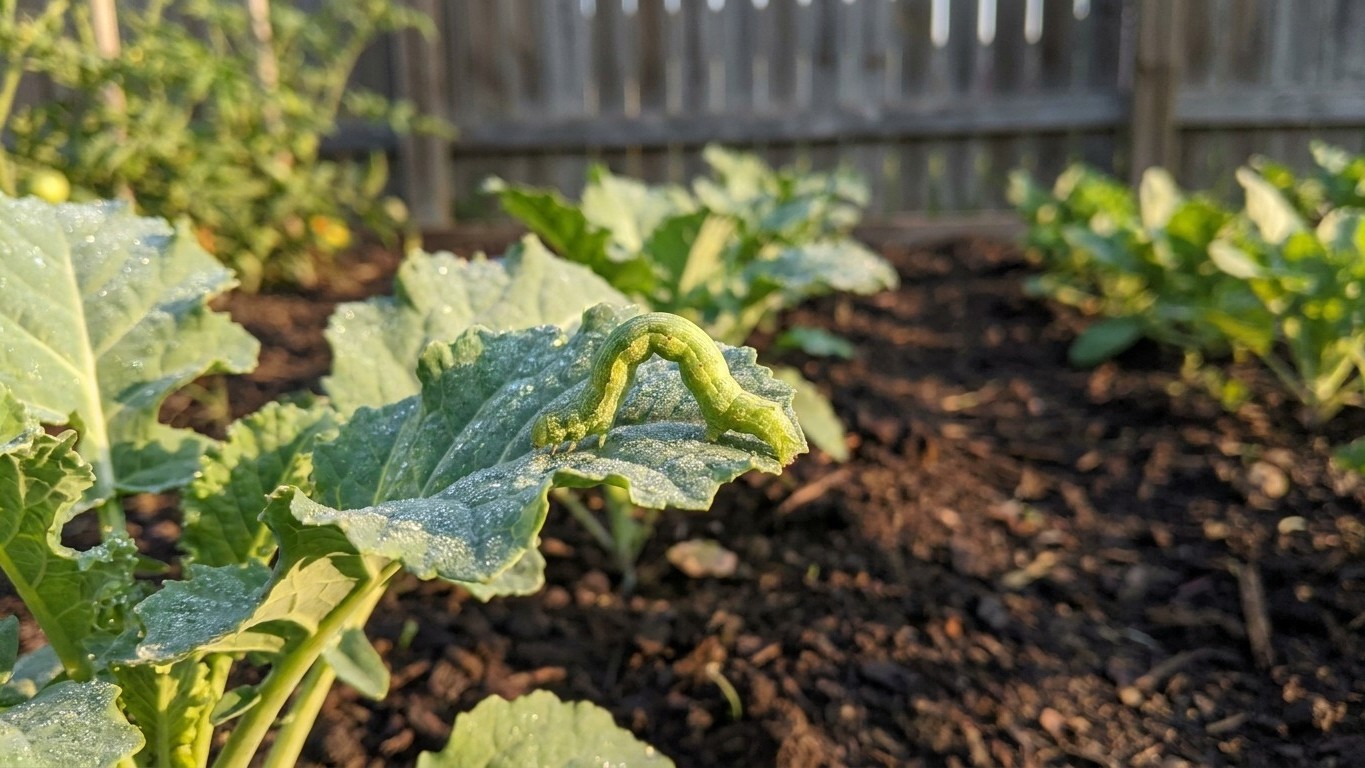
The caterpillar itself gives the clearest identification. Cabbage loopers are pale green, lightly striped, and they move in a distinctive arching motion, pulling their hind end up to meet their front legs because they lack a full set of middle legs. That looping crawl is where the name comes from, and it’s the single most reliable way to separate this pest from imported cabbageworms, which are fuzzier, slower, and crawl in a straight line.
Feeding damage looks like irregular holes chewed through leaves, often starting on outer leaves and moving inward as the caterpillar grows. Heavier infestations can skeletonize leaves entirely, leaving behind a lace of veins. On cabbage and broccoli, loopers will also tunnel into developing heads, leaving behind dark frass (caterpillar droppings) that can make an otherwise healthy-looking head unmarketable.
Adult moths are mottled gray-brown with a small silvery or white spot near the middle of each forewing, roughly an inch and a half across when wings are spread. They’re most active at dusk, which is when most egg-laying happens on the undersides of leaves.
What Actually Stops Cabbage Loopers in a South Dakota Garden
Biological control remains the single most effective tool available to home gardeners, and it comes in the form of Bacillus thuringiensis, commonly sold as Bt or under the variety name kurstaki (Btk). This naturally occurring soil bacterium produces a protein that’s toxic specifically to caterpillars once ingested, while leaving bees, birds, and beneficial insects untouched. Applied to leaf surfaces when caterpillars are small, typically within the first one to two weeks after hatching, Bt breaks down within a few days of sun exposure, so timing sprays for early morning or evening extends its effectiveness.
Bt works best against young larvae. Once a looper caterpillar reaches its later growth stages, it eats less relative to its body size and becomes harder to kill with any spray, biological or synthetic. That’s part of why matching application timing to South Dakota’s actual migration window matters: spraying Bt in June against a pest that hasn’t arrived yet wastes the product’s short window of activity.
Row covers offer a purely physical solution and work well for gardeners who’d rather skip spraying altogether. Lightweight floating row cover placed over brassica beds at planting time blocks adult moths from laying eggs on the plants in the first place. The covers need to come off, or at least get lifted, once plants start flowering if you’re growing anything that needs pollinator access, but for crops like cabbage and broccoli grown purely for the head, covers can often stay on right through harvest.
Natural predators do a fair amount of the work without any gardener input at all. Parasitic wasps in the Trichogramma and Hyposoter groups lay their own eggs inside looper eggs and caterpillars, and populations of these wasps tend to build through the season right alongside the pest they’re feeding on. Avoiding broad-spectrum insecticide sprays helps these predators stick around, since a general pesticide kills the parasitic wasps along with the target pest, sometimes making the following generation of loopers worse because their natural check has been removed.
Hand-picking remains a legitimate option for small home gardens, particularly since the caterpillars are large enough to spot easily once they reach mid-size, usually about three-quarters of an inch. Checking the undersides of leaves every few days during the July-through-September window catches most egg masses and young larvae before they cause significant damage.
Crop and Timing Choices That Reduce Pressure
Succession planting brassicas so that the most vulnerable seedling stage doesn’t line up with peak looper migration can meaningfully cut damage. Since loopers rarely become a serious problem before July in most of South Dakota, a spring crop of cabbage or broccoli planted in April often heads out and gets harvested before pest pressure peaks, sidestepping the worst of the season entirely.
Fall crops carry more risk simply because they’re actively growing right through the window when local looper populations are at their highest. Gardeners planning a fall harvest of kale, collards, or late cabbage should plan on monitoring closely from mid-July onward and have Bt or row cover ready rather than waiting for visible damage to show up.
- Watch for the distinctive arching crawl to confirm cabbage looper rather than cabbageworm
- Apply Bt only once caterpillars are small, and reapply after heavy rain
- Install row covers at transplant time, before moths have a chance to lay eggs
- Skip broad-spectrum sprays that also kill parasitic wasps working in your favor
One detail that surprises a lot of gardeners: cabbage loopers aren’t limited to cabbage family plants at all. They’ll feed on tomato, lettuce, potato, and even some flowers like snapdragons, so a garden with mixed plantings might see looper damage show up in unexpected spots well outside the brassica bed, and monitoring should extend to those crops during the same July-to-September window.