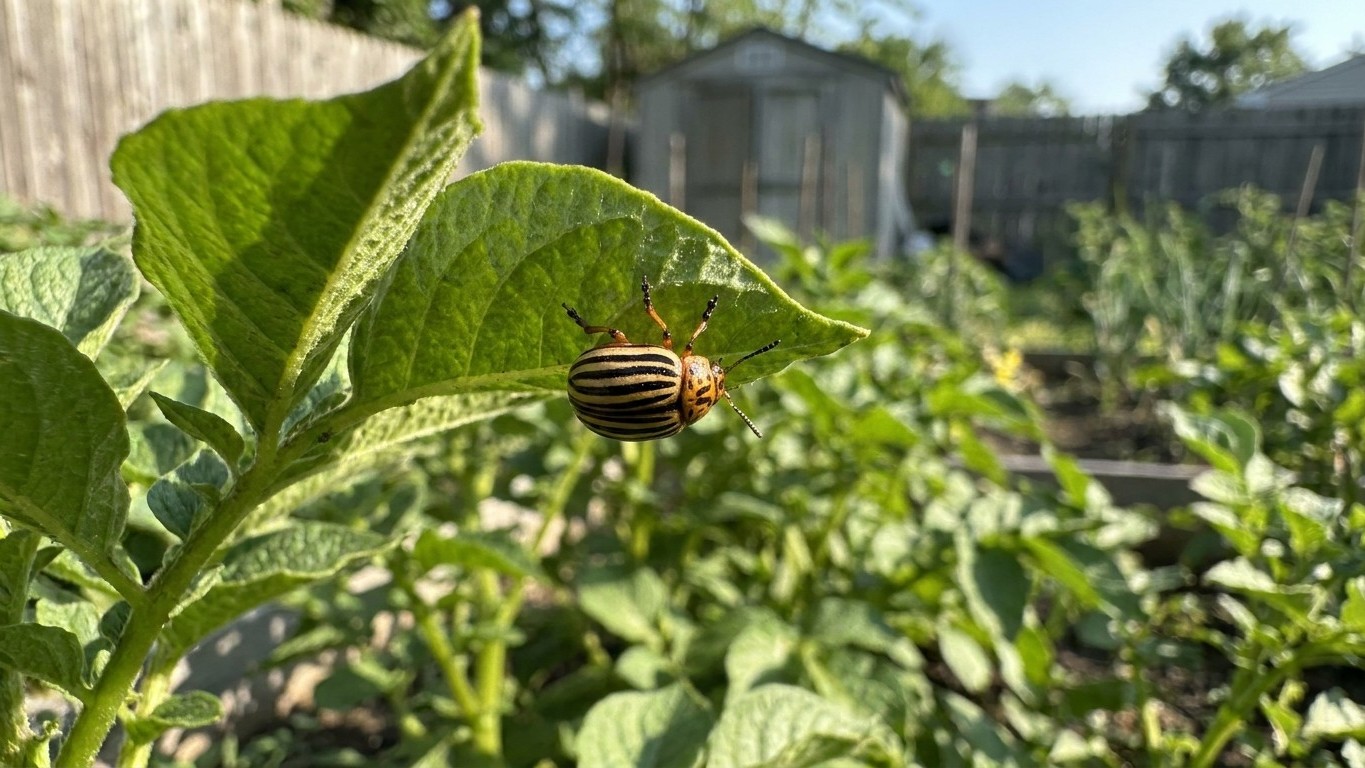

In New Jersey, Colorado potato beetles emerge from overwintering soil in mid to late April, right around the time potato plants push their first leaves above ground. By early May they’re already feeding, and a second generation typically hits gardens and farms in July. If you grow potatoes, eggplant, or tomatoes anywhere from Cumberland County to the Skylands, this pest isn’t a maybe. It’s an annual guarantee.
Life Cycle and Timing in New Jersey Gardens and Farms

Adult beetles spend the winter buried four to six inches deep in soil near last year’s potato patch, often at field edges or under fence rows. New Jersey’s clay-heavy soils in the central counties and the sandier ground down in the Pine Barrens region both offer decent overwintering shelter, which is one reason the pest never really goes away here.
Soil temperature drives the wake-up call. Once ground temps hold above 50°F for a stretch, adults dig out and start walking, sometimes flying, toward the nearest host plant. In a typical New Jersey spring that lands somewhere between April 20 and May 10, though a warm March can push emergence earlier. Females start laying eggs almost immediately after feeding for a few days, and each one can produce 300 to 500 eggs over her lifetime in clusters of a few dozen on the undersides of leaves.
Eggs hatch in four to nine days depending on temperature. Larvae feed for two to three weeks, then drop to the soil to pupate for another one to two weeks. That full cycle, egg to adult, runs about 30 to 45 days in New Jersey’s climate. With average frost-free stretches lasting from late April through mid-October in South Jersey, the state supports two full generations most years and occasionally a partial third in a long, warm fall, particularly in the southern counties where the growing season runs longest.
This matters for timing your response. A grower who only watches for the spring wave and stops scouting by mid-June often gets blindsided in late July when generation two arrives with more beetles than generation one, because survival rates from a mild summer boost numbers.
How to Identify Colorado potato beetle at Every Stage
Confusing this pest with something harmless costs growers real yield, so knowing what you’re looking at matters more than people assume.
Adults measure about 3/8 inch long, oval, with a hard shell striped in alternating black and cream-yellow lines running lengthwise down the wing covers. Ten stripes total, five per wing cover, is the detail that separates it from look-alike beetles. The head and area behind it show black spots on an orange-yellow background. They’re slow fliers but strong walkers, and they’ll play dead by dropping to the ground when disturbed.
Eggs are bright yellow-orange, football-shaped, and laid in tight clusters of 20 to 40 on the underside of leaves. A single leaf can host multiple clusters during peak egg-laying in May.
Larvae go through four growth stages, and the visual change is dramatic. First-stage larvae are tiny, dark red, almost black, and easy to miss. By the fourth stage they’ve grown to about half an inch, turned a soft brick-red or orange, and developed two rows of black spots along each side. This is the stage that does the most damage, since older larvae eat several times more foliage per day than younger ones.
Pupae live in the soil and aren’t something home gardeners typically encounter unless they’re digging around plant bases.
Which Crops and Regions in New Jersey Are Most at Risk
Potatoes remain the primary target, but this beetle doesn’t limit itself. Eggplant often gets hit even harder than potatoes in home gardens, since it’s frequently the only nightshade family plant around once potatoes are harvested early. Tomatoes get some feeding, mostly from adults, though damage tends to be lighter than on potato or eggplant foliage. Peppers occasionally show minor feeding but rarely serious damage.
Geographically, the risk splits along New Jersey’s two agricultural identities. South Jersey counties, Salem, Gloucester, Cumberland, and parts of Atlantic County, host commercial potato acreage where beetle pressure has built up over decades of continuous nightshade cropping. Insecticide resistance in these areas runs higher than almost anywhere else in the country, a legacy of this being one of the first regions where the beetle developed resistance to early synthetic pesticides back in the 1950s and again to newer chemistries in subsequent decades.
North and central Jersey home gardens face a different pattern. Smaller plantings mean beetle populations build more slowly, but isolated gardens without crop rotation options often see the pest settle in and become a fixture year after year, since there’s no larger landscape of alternative host patches to disperse into.
Effective Control Strategies That Actually Work
Nothing kills this beetle for good. The goal in New Jersey conditions is keeping numbers below the threshold where they defoliate plants faster than the plants can compensate, generally accepted as 20 percent leaf loss before tuber bulking and slightly higher tolerance after.
Cultural and Physical Controls
Crop rotation works, but only with distance. Moving potatoes or eggplant more than 200 yards from last year’s planting site cuts colonization significantly, since walking adults tire out before covering that ground. In a typical suburban lot this isn’t always possible, which is why row covers matter more for home gardeners than for commercial fields. Floating row covers installed at planting and sealed at the edges block the spring migration wave entirely, as long as they come off before flowering if the crop needs pollinators, or stay on the whole season for self-pollinating types like potatoes.
Hand-picking remains genuinely effective for garden-scale plantings. Adults and larvae are large enough to spot easily, and checking the undersides of leaves twice a week from late April through June catches egg masses before they hatch. Squishing eggs directly on the leaf, rather than trying to remove and dispose of them elsewhere, saves time and works just as well.
Mulching with straw has shown some benefit in university trials, likely because it interferes with adult beetles’ ability to locate host plants by ground-level cues, though the effect is modest compared to row covers.
Biological and Chemical Options
Natural enemies help but rarely provide full control on their own. Ladybird beetles, lacewings, and predatory stink bugs feed on eggs and young larvae. Spined soldier bugs, native to the Northeast, are among the more reliable predators of larger larvae in mid-Atlantic gardens.
Bacillus thuringiensis var. tenebrionis (often labeled Btt on product packaging) targets young larvae specifically and is one of the few organic-approved options with consistent results, though it does nothing against eggs or adults and needs reapplication after rain.
Spinosad-based products offer another organic-compliant option with broader activity against larvae of all stages, and it’s become a common recommendation for home gardeners who want to avoid synthetic pyrethroids.
For synthetic insecticides, resistance is the central problem in New Jersey specifically. Populations in the southern counties have documented resistance to multiple insecticide classes, including some neonicotinoids and pyrethroids, built up over repeated seasons of the same active ingredient being used on the same fields. Rutgers Cooperative Extension and other Northeast land-grant programs recommend rotating between different modes of action within a single season, and never relying on a single product class for more than two consecutive applications, specifically because of this regional resistance history.
Neem-based products offer a lower-toxicity option with anti-feedant and growth-disrupting effects on larvae, though results tend to be slower and less dramatic than with Btt or spinosad.
Timing Treatment for Maximum Effect
The single highest-leverage moment for control in New Jersey falls in the first two weeks after spring emergence, before females complete their first egg-laying cycle. A grower who scouts fields or garden beds starting the third week of April and treats or hand-removes the first wave of adults prevents the bulk of the season’s egg production. Miss that window, and by early June the overlapping generations of eggs, larvae, and new adults make timing any single intervention far less effective.
Scouting fifty plants (or all of them, in a typical backyard plot) twice weekly from emergence through mid-June catches problems before they compound. After the first generation cycles through, a second scouting push in mid-July targets the next wave, which in warm years arrives with higher numbers than the spring generation because summer heat speeds larval development and survival.
Growers in the Pine Barrens and sandy southern soils sometimes see a partial third generation in years with an extended warm fall, feeding on late-planted eggplant or second-crop potatoes into early October. It’s a smaller wave, usually manageable with the same larval-stage treatments used earlier in the season, but it catches gardeners off guard who assumed the beetle season had already wrapped up by Labor Day.
Related guides
- Colorado potato beetle in New York: When It Shows Up and What Stops It
- Colorado potato beetle in Pennsylvania: When It Shows Up and What Stops It
- Colorado potato beetle in North Dakota: When It Shows Up and What Stops It
- Colorado potato beetle in Nova Scotia: When It Shows Up and What Stops It