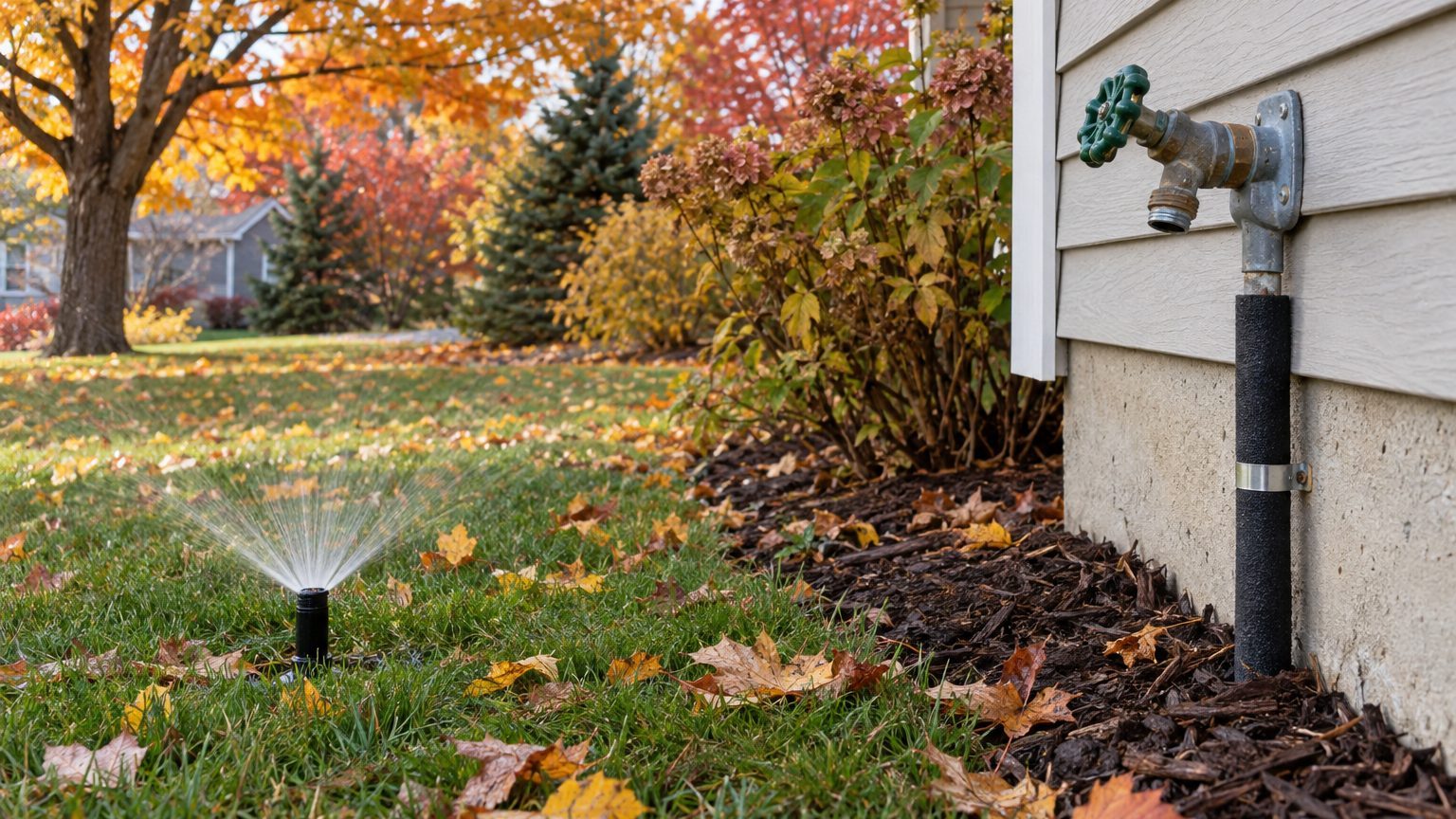

Do it before the first hard freeze, not after the first light one. In Iowa, that means finishing sprinkler and faucet work ahead of the first fall frost. NOAA’s 1991-2020 Climate Normals place that frost between October 14 and October 25 at the Des Moines airport station. Iowa State Extension county records run about 10 days earlier in fall, and the northern part of the state gets cold sooner than the middle. Draining a system takes an afternoon. Repairing a split one takes far longer.
When to do it in Iowa
Plan to winterize sprinklers and outdoor faucets in the stretch leading up to the first fall frost, which NOAA’s 1991-2020 Climate Normals put between October 14 and October 25 at the Des Moines airport station (the 30-70% probability band for a 32°F freeze). The rule is before the first hard freeze, not after the first light one.
Iowa is not a place where you can skip the full job. The coldest month at the Des Moines reference station has a mean daily minimum of 13.8°F, according to NOAA NCEI’s 1991-2020 Climate Normals. That figure is an average of the lows, so plenty of nights fall below it. Water left in a buried line or an exposed faucet has weeks of serious cold ahead of it, and a partial job is not enough.
Why the airport dates are the optimistic end
The airport sits in a city, and cities hold heat. Iowa State Extension county figures, which cover 1950 to 2021, run about 10 days earlier in fall than that station. If you live in a rural county, treat the airport range as the late edge of your window, not the middle of it. Farther north the first fall frost arrives earlier still, so a homeowner near the Minnesota line should move the whole job forward. Southern Iowa gets a little more breathing room, but the plan stays the same.
Zone maps say the same thing from another angle. The USDA Plant Hardiness Zone Map (2023) shows Iowa running from 4b to 6a. That system rests on a single variable, the average annual extreme minimum temperature, so it measures something different from the 13.8°F figure above. Des Moines is the reference city here, and other parts of the state differ, mostly in the direction you would guess: colder to the north, milder to the south.
Light frost versus hard freeze
A light frost blackens tomato leaves and coats the windshield. It rarely reaches the water inside a buried pipe. A hard freeze is a different event, with air temperatures that stay below freezing long enough to chill the ground, the valve box and the exposed parts of your system. The trouble is that the first light frost and the first hard freeze can be a single night apart in a fall like the ones Iowa gets.
So use the light frost as an alarm, never as a starting gun. Finish the blowout and disconnect every hose before the October 14 to October 25 range begins, and earlier if you live in the northern part of the state or on a county rather than airport schedule. Pick a weekend in advance, watch the extended forecast as the range approaches, and do not wait for a night that forces the decision. More seasonal timing lives in the Iowa guides.
Sprinkler lines: drain or blow out
Water expands when it turns to ice, and pipes do not. The ice forms a plug, the plug pushes on the water trapped behind it, and something gives. That something is usually a fitting, a valve body, a sprinkler head or a stretch of pipe. Nothing looks wrong in November. The split announces itself in spring, when pressure comes back on.
Three methods exist for clearing a system, and they are not equal in this climate.
| Method | How it works | Where it falls short |
|---|---|---|
| Manual drain | You open valves at low points and let gravity empty the lines | Only works if the system was built with those drains; pockets of water stay in any low spot without one |
| Automatic drain | Valves open on their own when line pressure drops | Can stick or clog with debris, and they only drain what sits above them |
| Compressed-air blowout | A compressor pushes air through each zone and forces water out of the heads | Needs the right equipment and careful handling; unsafe if done carelessly |
Drains are backup. With a mean coldest-month minimum of 13.8°F at Des Moines, this climate calls for a compressed-air blowout as the reliable finish. Gravity systems sometimes leave a puddle in a low corner, and a puddle is all a hard freeze needs. Even a system with automatic drains benefits from air, because it clears what the valves miss.
What a blowout involves
The order matters. Shut off the water supply to the system, set the controller so it will not run, then connect the compressor and work through the zones one at a time until only mist comes from the heads. Do it zone by zone rather than everything at once, and keep within what your pipes and heads are rated for. Stay clear of the sprinkler heads and any above-ground backflow assembly, and wear eye protection, because compressed air turns a small piece of plastic into a projectile. After the last zone, leave the backflow assembly’s handles midway so any water left inside has room to expand.
When to hire a professional
A pro is the sensible choice if you do not own a compressor with enough capacity, or if you are unsure what your system is rated for. The same goes for a system with many zones, an above-ground backflow assembly you have never handled, or valves in a buried box you have never opened. Book ahead of the window instead of waiting for a cold forecast. Get the appointment on the calendar before the October 14 to October 25 range and treat any earlier county-based timing as your deadline. Paying someone once is cheaper than replacing a manifold.
Outdoor faucets and hoses
This job takes ten minutes and involves nothing more than turning valves. Disconnect every hose, splitter, timer and sprayer from the outside tap. Find the interior shutoff valve that feeds the outdoor faucet (often in a basement or crawlspace), close it, then open the outside tap and let it drain. Leave the outside tap open through winter. For a step-by-step walkthrough, see Winterizing Outdoor Faucets Before the First Freeze.
Why a frost-free faucet still fails with a hose attached
A frost-free faucet has a long stem that puts the valve seat inside the warm side of the wall. When you shut it off, the water in the barrel is supposed to run out through the spout. A hose blocks that path. Water stays in the barrel, in the cold section outside the seat, and freezes there. The split happens in the pipe wall, and you find out when you turn the water on in spring and it sprays inside the house. A hose with a nozzle closed makes it worse, but even an open hose can hold enough water to matter. Details on how these faucets work are in Frost-Free Outdoor Taps.
The other way these faucets fail has nothing to do with hoses. The barrel needs to slope slightly downward toward the spout, so gravity can do the draining. If the faucet was installed level or tilted the wrong way, water sits inside even with no hose. You cannot fix that with a valve. That is a plumber’s job, and if you suspect it, call one before winter rather than after.
Foam covers over the spigot add a little margin against wind and are fine to use, but they do not replace disconnecting the hose. Before the October 14 to October 25 range begins, walk the whole property: the front, the back, the garage and the shed. Homeowners tend to remember the faucets they use and forget the one behind the shrubs, or the one at the far end of the garage wall.
What goes wrong here
The most common failure is timing. October in Iowa can turn overnight, and a mild week often gives way to a hard freeze before anyone has scheduled the blowout. Because Iowa State Extension county records run about 10 days earlier in fall than the airport, a rural homeowner using airport dates can find that the freeze arrived first. The fix is dull and effective: choose a date ahead of the range, and stick to it. Set the calendar reminder for the days before October 14 to October 25, and do it sooner in northern counties.
The forgotten hose
A hose left on a faucet through a hard freeze traps water in the barrel, as described above. In spring the tap looks fine. You turn it on, and a few minutes later you see a drip inside the wall, on the ceiling below or near the rim joist. Prevention is a walk around the house with a checklist. If a pipe has already split, or the tap will not stop leaking, shut the interior valve and read up on Frozen Pipes before calling a plumber.
The valve box that floods
Buried valve boxes collect runoff and snowmelt if they sit in a low spot or the lid is missing. Water pooled around valves freezes around them, and the valve bodies crack. In spring a zone will not shut off, another will not turn on, or a wet patch appears in the lawn where nothing should be wet. A blowout does not help if the box itself is full of water. Check the lid, clear soil and debris, and note any box that stays wet after rain, since that is a warning to raise it or move it before next fall.
Common questions
Is the first light frost enough to burst sprinkler pipes?
Usually not. A light frost is a warning that the season is turning, and a hard freeze is the event that does the damage. The trouble is that the two can arrive close together, so finish the work before the airport range of October 14 to October 25, and earlier in colder parts of the state.
Do Iowa systems need a blowout every year?
Yes. Des Moines has a mean daily minimum of 13.8°F in its coldest month (NOAA NCEI 1991-2020 Climate Normals), so the ground and the exposed parts of a system get cold enough to freeze any water left behind. A system that drains well and gets a blowout is far less likely to crack than one that was only partly drained.
Can I keep watering the lawn until I blow out the system?
Yes, and it helps. Keep watering into fall if the weather is dry, then shut down before the freeze window. If you need to water after the system is winterized, use a hose on an outside tap and disconnect it afterward. Seasonal lawn tasks are covered in Winterizing a Lawn.
Is it too early to winterize in late September?
No. Doing it a bit early costs you a few weeks of sprinkler use, which the lawn rarely needs by then. Doing it late risks the whole system. If a warm spell follows, use a hose and a hand sprinkler instead of turning the system back on, since restarting it puts water in the lines again and means another blowout.