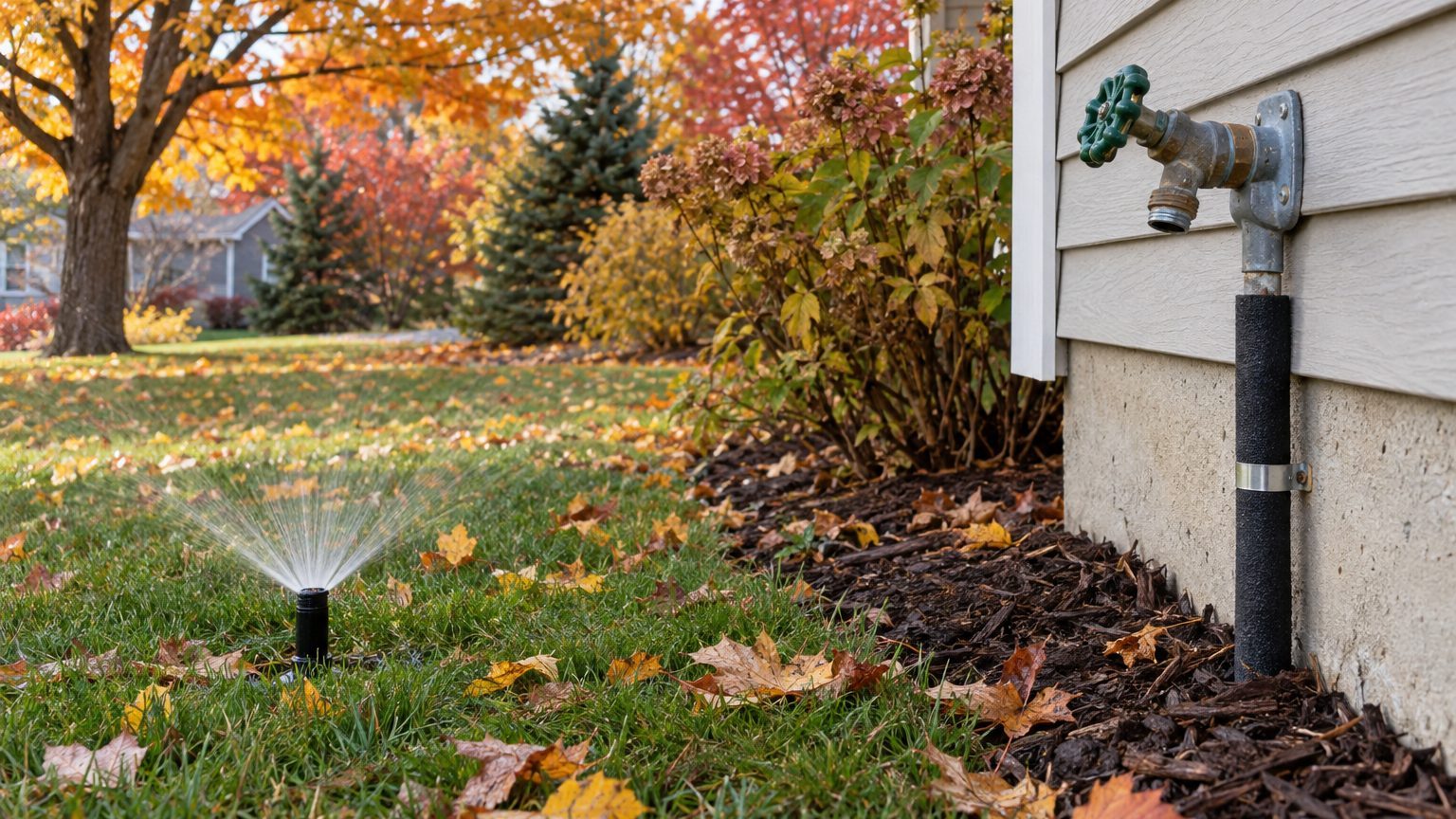

California runs two winterizing calendars at once. Along the coast and across Southern California, no freeze occurs in an average year, so draining sprinklers is mostly a ritual for other states. Northern California, the Central Valley and the Sierra do freeze, and there a missed deadline shows up in spring as a cracked valve or a split pipe in the wall. Which calendar is yours comes down to one thing: does your block ever see a night below freezing?
When to do it in California
Winterize in the stretch between the first cold-night forecasts of autumn and your area’s first fall frost, and hold to the rule of before the first hard freeze, not after the first light one. Where winter never reaches freezing, which describes the coast and Southern California, a full blowout is often unnecessary, and the useful work is a different, smaller list.
Where a freeze never comes
Los Angeles shows how different this calendar can be. NOAA’s 1991-2020 Climate Normals put the mean daily minimum of the coldest month at 49.1°F for that reference station, and the agency could not compute a freeze normal at all because no freeze showed up in the data. NOAA’s daily records list zero days at or below 32°F in 30 years, and the frost-free season is listed as 365 days (NOAA NCEI station data).
That is one city, not the state. Treat it as the answer for coastal and southern California only. In those areas the pressures on a yard are heat, drought and water restrictions, so the fall job is tuning the system rather than emptying it:
- Cut run times to match cooler weather and follow whatever watering-day rules your local water agency sets.
- Walk each zone and look for broken heads, geysers and soggy patches that signal a leak.
- Lift the valve box lids and clear out debris and standing water.
- Coil hoses and store them out of direct sun, which wrecks rubber faster than a mild winter does.
Where the cold arrives
Northern California, the Central Valley and the Sierra freeze, and the USDA Plant Hardiness Zone Map (2023 edition, built on 1991-2020 normals) lists California as a whole at 5a-11a. A spread that wide means no single date works for the state. The zone itself rests on one variable, the average annual extreme minimum temperature, so it tells you what plants survive, not when the first autumn frost lands.
The direction of the adjustment is simple. The farther north and the higher the elevation, the earlier the first fall frost arrives, so the draining deadline moves earlier too. A property in the Sierra needs the job done well ahead of one on the valley floor, and a cold pocket in the northern part of the state beats a milder spot nearby.
| Part of California | Freeze in an average year | What to do in fall |
|---|---|---|
| Coast and Southern California | None (Los Angeles: zero days at or below 32°F in 30 years) | Seasonal schedule, leak check, valve boxes; draining usually not needed |
| Central Valley | Freezes occur | Drain before the first hard freeze in your area |
| Northern California | Freezes occur; colder spots earlier | Drain before the first hard freeze, earlier in colder pockets |
| Sierra | Freezes occur; earliest first frost | Drain earliest and most thoroughly |
Why the “hard” in hard freeze matters: a light frost on a clear night often skims the surface and passes without freezing water buried in the ground. Exposed parts are another story. Backflow assemblies, above-ground pipe and outdoor spigots are the first to ice up. A hard freeze lasts longer and reaches deeper, and that is the one that splits things. Waiting for the first light frost to prompt you leaves little margin. The same cold calendar also governs Winterizing a Lawn, so one weekend in the interior can cover both. Regional context for other seasonal jobs sits in the California guides.
Sprinkler lines: drain or blow out
What freezing does to a system
Water expands as it turns to ice, and a closed pipe has nowhere to let that growth go. The ice squeezes the pipe walls from inside until the weakest spot gives way. In an irrigation system, the weak spots are fittings, valve bodies, sprinkler heads and especially the backflow preventer, which often sits above ground where nothing insulates it. Nothing looks wrong in winter. The split reveals itself in spring when the water comes back on.
Buried lines get some protection from the soil, which is why a light frost rarely hurts them. Deeper cold changes that. In the Sierra, where the first fall frost comes earliest, the ground itself can freeze, and lines that would be safe in the Central Valley are not.
Three ways to empty the lines
A manual drain uses valves placed at the low points of the system. You shut off the water supply, open those valves, and let gravity pull water out. It costs nothing but time, and it only works if the system has drain valves at every low point. Many older systems do not.
An automatic drain does the same job without you. Small valves at low points stay closed while the lines hold pressure and open when pressure drops after you shut the water off. They are convenient, but they can clog with grit, and they tend to leave water in the main valves and the backflow device, so a quick manual check of those parts still pays off.
A compressed-air blowout pushes the water out of each zone with air, one zone at a time, working through the heads. It is the most thorough method and the only one that clears systems with no drain valves. It is also the one that punishes mistakes. Air at too high a pressure can crack fittings and shred heads, and running air through dry heads for too long can overheat their internal parts.
Which one California calls for
On the coast and in Southern California, none of the three is usually needed. With no freeze in an average year, the water in the lines is not a threat. Spend the effort on the tune-up list instead.
In the Central Valley and Northern California, drain or blow out the lines before the first hard freeze in your area. A system built with drain valves can often be handled by draining it manually, and the backflow device deserves its own attention because it is the likeliest casualty. Where the layout has dips and no drains, blowout is the dependable route. In the Sierra, with the earliest cold and the deepest freezing, the margin for error is thin, so a blowout done early is the sensible default.
Hiring a professional makes sense in a few situations: you cannot find the drain valves or are unsure the system has them, you do not own an air compressor with a pressure regulator, the property has many zones or long runs, or you have had a split pipe before and do not want to learn the lesson twice. Ask about the air pressure they use and whether they will drain the backflow assembly too. That part of the visit is the one most often skipped.
Before any of it, turn the controller to off or rain mode so it does not try to run valves against empty lines. Leave the clock powered if it holds your programming, and write down the settings anyway. Spring is when people discover they never recorded them.
Outdoor faucets and hoses
The routine
Hoses first. Disconnect every hose before the first hard freeze, along with splitters, timers and spray nozzles, then drain each hose and coil it for storage. A hose left on a spigot is the single most common cause of a burst faucet line, and removing it costs nothing.
After that, the sequence is only valves:
- Find the interior shutoff for the outdoor line, often in a basement, crawlspace or utility room, and turn it off.
- Open the outdoor faucet and leave it open so the line drains.
- Open any small bleeder cap on the interior valve if it has one, to let the last water out.
- Leave the outdoor faucet open through the cold months, or at least until the drain slows to nothing.
The full routine, with more detail on each step, is laid out in Winterizing Outdoor Faucets Before the First Freeze. In coastal and southern California, where no freeze occurs in an average year, none of this is required, though pulling the hoses still keeps them from degrading in the sun.
Why a frost-free faucet still fails
A frost-free faucet puts its shutoff valve at the end of a long stem, deep inside the heated part of the wall. When you turn it off, the water in the barrel in front of the valve is supposed to run out through the spout. That only happens if the spout is free to drain.
A hose, or even a hose-end nozzle, holds water in the barrel. Once the temperature drops below freezing, that trapped water turns to ice in the cold section of the pipe and splits it. The leak appears in the wall when the ice thaws, which is why the damage often surfaces as a damp stain inside the house rather than a drip outside. Frost-free faucets also need a slight downward tilt to drain, and you cannot see that tilt from outside. More on how these faucets work and how to tell if yours is one is in Frost-Free Outdoor Taps.
Anything beyond turning valves belongs to a plumber. If you cannot find an interior shutoff, if the faucet keeps dripping after it should have drained, or if you suspect the pipe was installed without a slope, call someone licensed instead of opening up the wall yourself.
What goes wrong here
The early cold snap
In the Sierra, Northern California and the Central Valley, the first freezing night rarely announces itself. It tends to land before anyone has pulled out the compressor or put the date on the calendar, and the colder, higher ground gets it first. The spring evidence includes a head that sprays sideways, a zone that runs with weak pressure, a wet patch that never dries, or a wall spigot that leaks from behind the siding. The fix is to schedule the work ahead of the calendar and watch the forecast for the first run of cold nights. If a pipe has already frozen, Frozen Pipes covers what to do next.
The forgotten hose
It is usually the one around the side of the house, behind the shed or tucked next to the water heater. In spring the signs are a faucet that leaks at the wall, a bulging or split hose, and in the worst case a damp ceiling or wall beneath the spigot. Prevention takes a minute: walk the outside of the house and count every spigot, not only the ones you use. Splitters and drip-line adapters hide in the same spots.
The valve box that floods
Valve boxes sit below grade and collect rain and irrigation runoff along with leaves and soil. In freezing areas, standing water around the valves can ice up and crack a valve body. On the coast, where there is no ice, water sitting around the valves still leads to corrosion and slow seeps. Spring shows up as a valve that will not shut off, a zone that stays damp, or a water bill that jumps without explanation. Open every valve box lid once in fall, bail out standing water, clear debris, and look for cracked fittings before the cold or the rains arrive.
Common questions
Do I need to winterize sprinklers on the California coast or in Southern California?
Not for freezing. NOAA’s records for the Los Angeles reference station show zero days at or below 32°F in 30 years, and the coldest month’s mean daily minimum is 49.1°F. A fall tune-up is still worthwhile: adjust the schedule, fix leaks and check the valve boxes.
Is it too late once the first frost has passed?
Not if the frost was light. A light frost often passes without freezing buried lines, so drain or blow out the system right away instead of skipping it. The risk climbs with each cold night, and exposed parts like the backflow device and spigots are the first to suffer. Check for splits when you turn the water back on in spring.
Can I blow out my own sprinkler lines with a shop compressor?
It can be done, but air at too high a pressure damages fittings and heads, and running dry heads too long overheats them. Without a regulator and a clear idea of how your zones are laid out, hire a professional.
Does my USDA hardiness zone tell me when to winterize?
No. The 2023 USDA Plant Hardiness Zone Map, built on 1991-2020 normals, rests on one variable: the average annual extreme minimum temperature. California spans 5a-11a on that map. Your zone says which plants survive winter, while the date to drain depends on when your area’s first hard freeze is likely to arrive, which the zone does not predict.