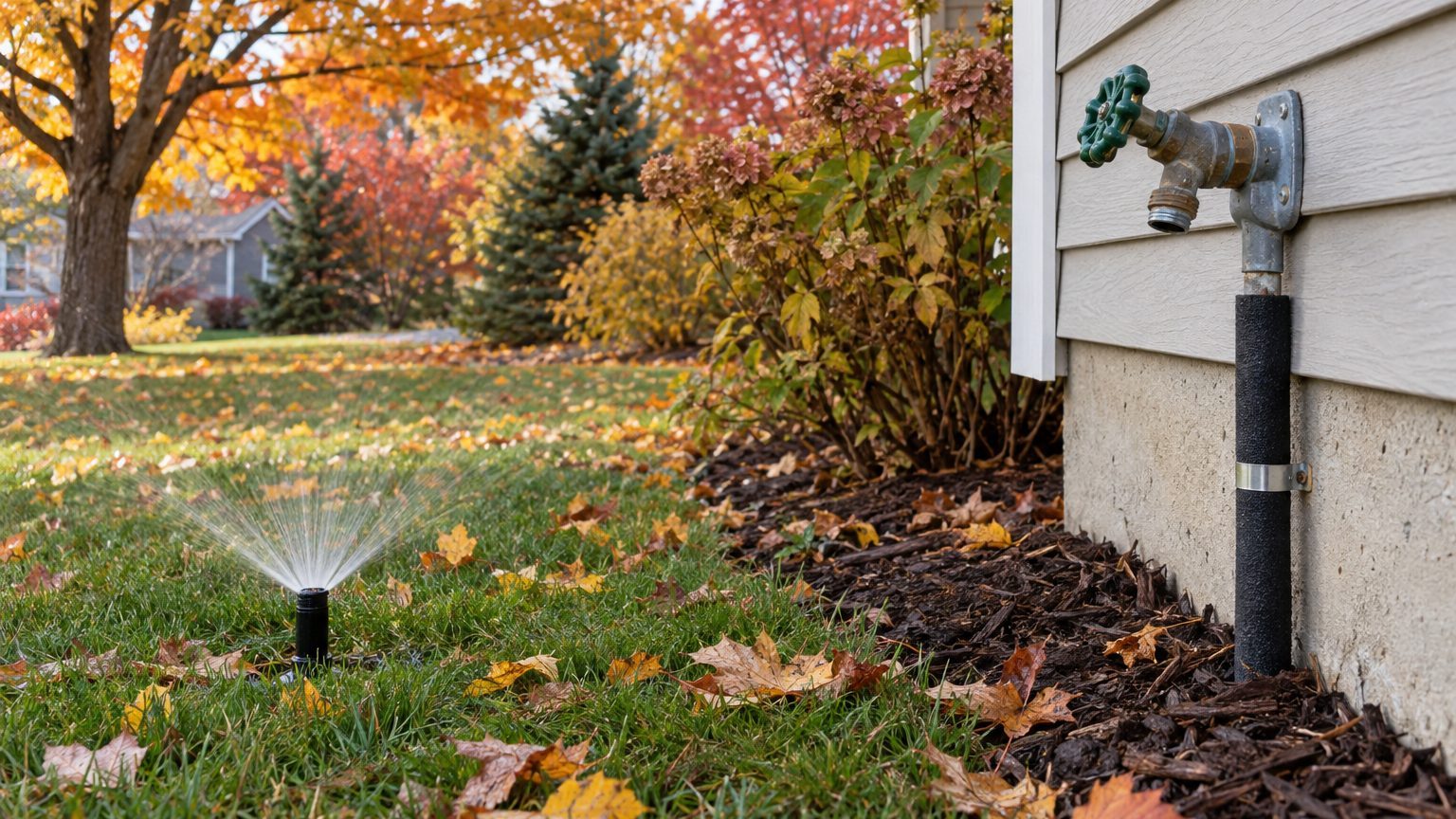

Drain the sprinkler system and shut down the outdoor spigots while the weather is still mild, in the weeks before the first hard freeze. Pennsylvania gets cold enough every winter to freeze buried pipe and exposed faucets. The damage stays hidden until spring, when the water comes back on and something leaks. This article covers the calendar, the three ways to clear a sprinkler line, what to do at the hose bib, and the failures that turn up most often in this climate.
When to do it in Pennsylvania
Around Philadelphia, finish winterizing before the first fall frost arrives between November 5 and November 16, and do it before the first hard freeze, not after the first light one. NOAA’s NCEI U.S. Climate Normals for 1991-2020 place that window where the odds of a 32°F freeze run between 30 and 70 percent. Have the sprinklers drained and the hoses off before the November 5 to November 16 frost window around Philadelphia, and earlier in the northern tier and the Alleghenies.
A light frost fools people. It is a night that touches 32°F for an hour or two and warms up by breakfast, and the ground still holds summer heat, so buried lines come through fine. A hard freeze is different. Temperatures stay below freezing for many hours, often across several nights, and the cold works down into the soil and into every pipe sitting in open air. Waiting for the light frost to “prove” winter has arrived is how people end up with a hard freeze before the lines are empty.
The winter that follows is not mild. NOAA’s 1991-2020 Climate Normals for the Philadelphia station put the mean daily minimum of the coldest month at 26.0°F. That is an average low, so plenty of nights fall below it. Nothing about that number suggests water can be left to take its chances outdoors. In this state the full job is worth doing every year: sprinkler lines cleared, hoses off, and the spigots drained.
Does the date change in northern Pennsylvania and the Alleghenies?
Yes, and it moves earlier. Philadelphia is the mildest corner of the state. The northern tier and the Alleghenies run colder, with later spring frosts and earlier fall ones, so fall chores land ahead of the Philadelphia range there. Treat the November 5 to November 16 window as the latest finish line for the southeast and give yourself more margin the farther north or higher up you live. The USDA Plant Hardiness Zone Map (2023 edition) lists Pennsylvania as 5a to 7b, built on the average annual extreme minimum, which gives a sense of how much colder some counties run than the city. Other Pennsylvania guides cover seasonal chores by region.
How do you know the freeze is close?
Start checking the extended forecast in early October. The first night forecast to sit at or near freezing is your signal to move, because an unseasonable cold snap can arrive before the averages say it should. The work itself takes an afternoon for most yards. A good habit is to do it the same weekend as the last mowing and the rest of your fall lawn work, which is covered in Winterizing a Lawn. One trip around the property, then you are done until spring.
Sprinkler lines: drain or blow out
Why does water left in sprinkler lines split them?
Ice takes up more room than the water it came from. In a pipe open at both ends the ice can push out. In a sprinkler system, water trapped between closed valves and fittings has nowhere to go, so the pressure goes into the weakest point. That is usually a fitting, a sprinkler head body, a valve, or the above-ground backflow preventer, the assembly that sits on the supply line near the house and is fully exposed to the air. Buried pipe is slightly protected by soil early in the season, but the valves, heads and risers near the surface freeze first and crack first.
The break is invisible until spring. The system looks fine all winter, and the split only shows when pressure returns. By then a small crack can run for hours before anyone notices.
Manual drain, automatic drain or compressed-air blowout?
The three methods differ in how much water they leave behind.
| Method | How it works | Where it falls short |
|---|---|---|
| Manual drain | You shut off the supply and open drain valves at the low points of each zone, and gravity does the rest | Only works if the system was installed with those valves, and water can stay in heads and dips in the pipe |
| Automatic drain | Valves open on their own when line pressure drops and let water out at low spots | Needs pipe that slopes toward every valve, which many flat yards do not have |
| Compressed-air blowout | Air is pushed through each zone from a hose connection until the heads stop spitting water | Needs a compressor, and too much pressure can damage heads and pipe |
With a coldest-month mean low of 26.0°F at the Philadelphia station (NOAA NCEI Climate Normals, 1991-2020), compressed air is what this climate calls for. Gravity drains leave pockets of water, and pockets are what freeze and split. A manual drain can be enough on a system laid out with drain valves at every low point, provided you know where each one sits. Automatic drain valves alone are a weak bet because they depend on slope the yard may not offer. A blowout also clears the heads and the backflow preventer, which drains rarely get completely dry.
When is hiring a professional the sensible choice?
A blowout is not a place to improvise. Air pressure that is too high can crack heads, fittings and the pipe itself, and the person running the compressor should wear eye protection and stay clear of the heads while the zones run. If you do not own or rent a compressor with a regulator, or you are unsure how your zones are laid out, call a licensed irrigation contractor. The same goes for any system with a pump, a very large number of zones, or a backflow assembly you have never touched. Book or do the blowout ahead of the November 5 to November 16 first-frost window around Philadelphia, and sooner in the northern tier and the Alleghenies.
Whoever does it, turn the controller to its off or rain setting rather than unplugging it, so the schedule survives for spring, and shut the main supply to the system before any air goes in.
Outdoor faucets and hoses
The outdoor spigot is the cheapest thing to protect and one of the costliest to ignore. The routine takes about ten minutes per faucet, and every step is a matter of turning a valve or pulling a hose.
- Unscrew every hose, splitter, timer and sprayer from the faucet.
- Drain the hoses and coil them for storage indoors or in a garage.
- Find the interior shutoff valve for that faucet, usually in a basement, crawlspace or utility room, and turn it off.
- Open the outside faucet and leave it open so any water left in the line can run out.
- Add an insulated cover over the faucet if you like, as a second layer.
If you cannot find an interior shutoff, or the valve will not turn, stop there and call a plumber. Installing or repairing a shutoff is plumbing work, and nothing here asks you to do more than turn valves. For a longer walkthrough, see Winterizing Outdoor Faucets Before the First Freeze.
Frost-free faucets, sometimes called frost-free hose bibs, are built to survive winter. The valve seat sits at the inner end of a long stem, inside the heated part of the wall, and the pipe barrel is pitched slightly downward so water runs out the spout when the faucet is closed. That design works only when the barrel can empty. A hose left screwed on keeps the spout sealed, and water stays in the barrel, in the exposed section outside the warm zone. It freezes there and splits the pipe, usually behind the wall or just inside it. The faucet looks perfectly fine all winter, and the leak shows up the first time you turn it on in spring. Frost-Free Outdoor Taps explains how the design works and how to check yours.
Older faucets without that design have no such margin. They need the interior valve off and the outside tap left open, every year, no exceptions. Unhook every hose before the first fall frost, which normally arrives between November 5 and November 16 around Philadelphia, and earlier in colder parts of the state. If your hose is still on a faucet in mid-November, you are already inside the window.
What goes wrong here
Three failures account for most spring repair calls in a climate like this one. All three come from timing and forgetfulness, not from the weather being unusually harsh.
The first is the early cold snap. The November 5 to November 16 range is where freeze odds sit between 30 and 70 percent at the Philadelphia station, and some years the freeze comes before the window opens. People who planned to drain “after the leaves come down” find the lines frozen first. In spring the signs are a zone that will not come on, a head that sprays sideways or in a mist, a geyser, or a soggy patch where a buried line cracked. The fix is to treat the forecast, not the calendar, as the final word. Once any night is forecast at or near freezing, drop other plans and do the job.
The second is the forgotten hose. It is usually the one on the far side of the house, behind the shed, or at a detached garage. The spring symptom shows up indoors: a wet spot on a basement wall or ceiling near the spigot, a hiss behind the wall, or water spraying inside when the outdoor tap is opened. A final walk around the property, checking every spigot for a hose, catches it. If a line has already frozen or you suspect it has, Frozen Pipes covers what to do and what to avoid.
The third is the valve box that floods. Sprinkler zone valves live in buried plastic boxes, and a box that collects groundwater or sits low in the yard can be full of water at the exact moment the first hard freeze hits. Frozen water cracks the valve bodies. In spring, a zone that will not shut off, a valve that weeps, or standing water inside the box point to this. Lift each lid after the blowout and look. If the box is wet, make sure the base has gravel under it for drainage and the lid seats tightly, and ask a contractor to look at any box that keeps refilling. Do a final walk-around the day the forecast first shows a freeze, with the lid of every valve box lifted.
Common questions
Is it too late to winterize after the first frost?
Not necessarily. A light frost does not freeze buried lines solid, so if the nights since have stayed short and mild you usually still have time. Do the work that day and keep an eye on the forecast. If a hard freeze has already come through with water in the lines, drain and then inspect for leaks before you restart anything in spring.
Do I have to blow out my sprinklers every year in Pennsylvania?
Yes, for any system that holds water in buried pipe and above-ground valves. The coldest-month mean daily minimum at the Philadelphia station is 26.0°F (NOAA NCEI Climate Normals, 1991-2020), and colder parts of the state run lower. A system with well-placed manual drain valves may get by on draining alone, but a compressed-air blowout leaves the least water behind.
Can I leave a hose on a frost-free faucet?
No. The hose keeps the spout sealed, so water stays in the barrel outside the heated wall and can freeze and split the pipe. Take every hose off before the first fall frost, even when the faucet is the frost-free type.
Does the timing change across the state?
It does. The November 5 to November 16 range belongs to Philadelphia, the mildest corner of Pennsylvania. The northern tier and the Alleghenies see freezing weather sooner, so finish earlier there. Your local Penn State Extension county office can tell you how your area compares, and the USDA hardiness zone for your address will not help much here, since that map is built on the average annual extreme minimum and says nothing about when the first freeze arrives.