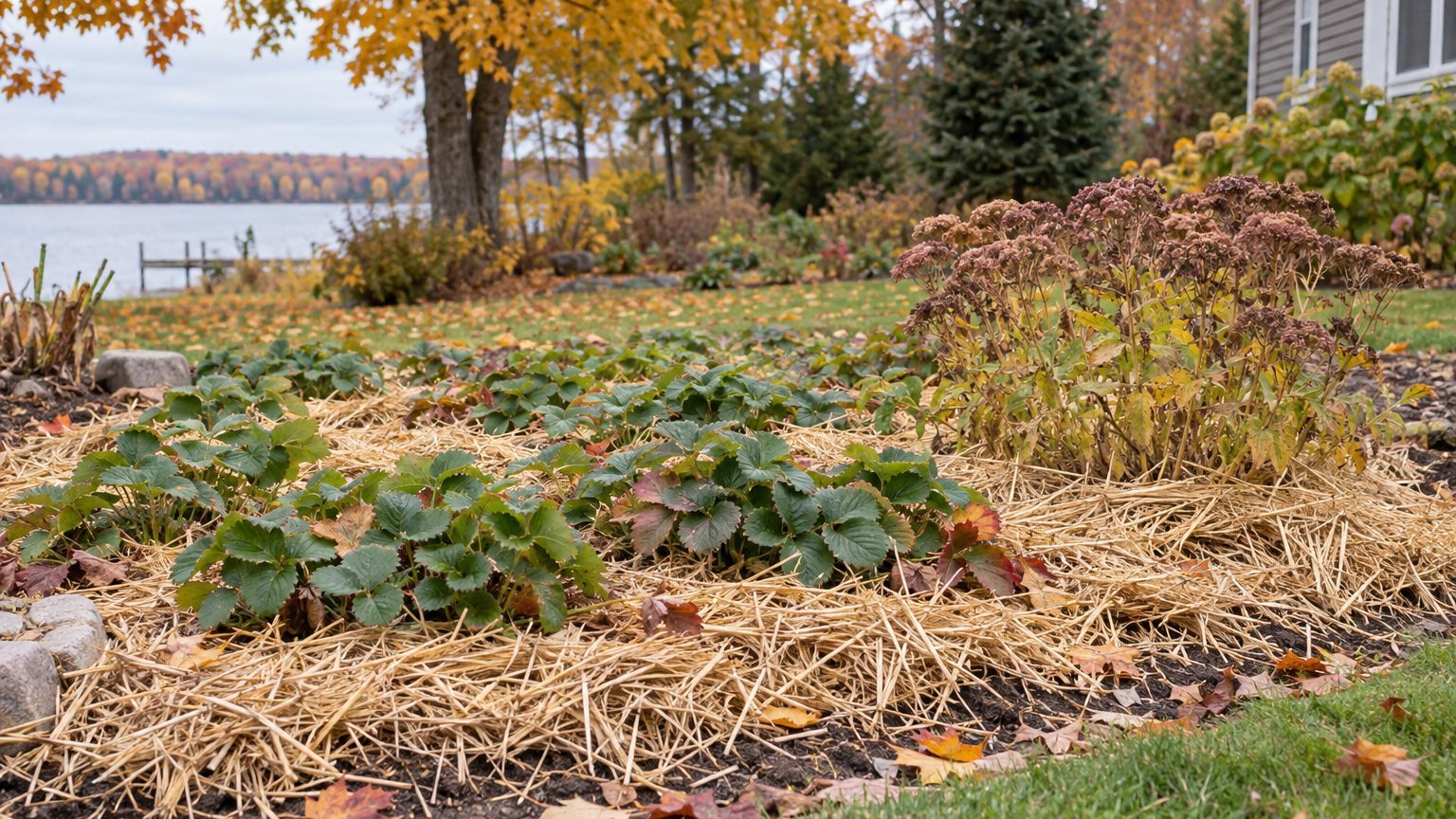

On the British Columbia coast, put winter mulch on strawberries and perennials in the weeks after the first fall frost, which averages November 10 at Vancouver’s airport station. That date is a midpoint, and in one year out of two the frost arrives earlier. Coastal soil rarely freezes, so the mulch holds moisture, holds down weeds, and covers plants on a cold night. In colder northern and upland districts the ground does freeze, and the old rule applies: wait for the freeze, then cover.
When to put winter mulch down in British Columbia
The classic rule sounds backward. Winter mulch goes on after the ground starts to freeze. Its job is to keep the soil frozen, not to keep it warm. A blanket spread over warm soil in October traps moisture against the crowns, which invites rot, and it gives mice and voles a cozy place to settle before the weather turns. Spread after the freeze, the same blanket stops the thaw-and-refreeze cycle that pushes shallow roots out of the ground.
Does the ground freeze on the British Columbia coast?
Mostly no. Environment and Climate Change Canada’s 1981-2010 normals for the Vancouver International Airport station put the mean daily minimum of the coldest month at 0.8 °C. That is above freezing. Clear, still nights still bring surface frost, and the same normals set the average first fall frost at November 10, but the soil beneath seldom freezes through. Natural Resources Canada places Vancouver in Canadian hardiness zone 9a, based on 1991-2020 normals. That system weighs seven climate variables and does not convert to a USDA zone, so compare it only with other Canadian zones.
With unfrozen soil, the heaving that northern gardeners fear has little to work with on the lowland coast. Timing therefore follows the first frost. Mulch in the weeks after your first fall frost, roughly mid-November into early December near Vancouver. Treat November 10 as the middle of a window. In one year out of two the first frost comes sooner, so watch your own thermometer rather than the calendar.
Is winter mulch needed at all on the coast?
Established strawberries and hardy perennials generally come through a coastal winter without it. A layer still earns its place in three situations:
- Weeds keep growing through the mild, wet months, and mulch shuts down their germination.
- Heavy rain batters bare soil, packs it down, and carries it away on slopes.
- Borderline plants need a buffer on the few nights when the temperature dips below freezing.
NC State Extension puts the weed benefit this way: “A 2-inch to 3-inch layer of mulch suppresses most annual weed seeds and makes it easy to hand-pull any that do germinate.” That depth is a ceiling worth respecting. More is not better, and a deep pile around stems is how a ring turns into a volcano. The NC State Extension Gardener Handbook says the same of moisture: “Provide a 3-inch layer of mulch to reduce water loss and maintain uniform soil moisture and temperature around roots.”
What changes in colder parts of British Columbia?
A province is not one climate. Northern and upland districts run weeks behind the Vancouver station, with a later last spring frost and an earlier first fall frost. Fall jobs move earlier on the calendar there, and the older rule returns: wait until the top of the soil has begun to freeze, then cover. The first and last frost dates in British Columbia give a starting point for your own district, and the other British Columbia guides cover regional differences. Gardeners east of the Rockies, where freezing ground is routine, can compare Alberta winter mulch timing and Manitoba winter mulch timing.
| Setting | Does the soil freeze? | When to mulch | What the mulch does |
|---|---|---|---|
| Lowland coast near Vancouver | Rarely; coldest-month average low is 0.8 °C | In the weeks after the first fall frost (average November 10), and only if you want the benefits | Moisture, weed control, frost-night cover |
| Colder northern and upland districts | Yes, in cycles of freeze and thaw | After the soil surface starts to freeze, which comes earlier than on the coast | Keeps soil frozen, prevents heaving, shields crowns |
Strawberries
Why do strawberry crowns need winter cover?
The crown is the short, thick stem at the soil line where the leaves and roots meet, and next year’s flower buds sit there. Strawberry roots are shallow. In a district where the soil freezes and thaws repeatedly, the soil heaves, lifts the plants, and leaves roots and crown exposed to drying wind and hard cold. A crown left bare in a deep freeze can die outright, which shows up in spring as a plant that never leafs out.
On the lowland coast the picture is gentler. The coldest-month average low of 0.8 °C means the crowns stay settled in unfrozen ground, and the risks are wet feet and the odd cold snap. A loose cover handy for frost nights does the job. In colder districts, wait for the ground to start freezing and then cover the whole bed. Planting details and variety choices are in Growing Strawberries.
What mulch works for strawberries, and how deep?
Clean straw is the standard. It is light, it drains, and it does not mat as quickly as leaves. Choose straw rather than hay, because hay carries seed heads that sprout into a weedy mess. Straw fluffs up when spread and compresses within a few weeks of rain, so a layer that looks generous on day one is often right by January.
On the coast, you can skip the permanent blanket. Leave the straw stacked beside the bed and shake it over the plants when a frost is forecast. Pull it off again in the morning if the next days turn mild. That way the crowns never sit under wet, warm straw for weeks.
When do you pull the mulch back in spring?
Straw left on too long smothers the plants. New leaves growing under the straw come up pale yellow, and that is the signal. Pull the straw back from the crowns as soon as new leaves start to push, and keep it close by in the aisles for frost nights. On the coast, that usually happens in late winter. In colder districts it comes after the soil has thawed and the hardest frosts are behind you, which falls later than at the coast. Straw raked into the aisles keeps the berries clean and the weeds down once fruit sets.
Perennials and borderline plants
Which perennials benefit from winter mulch in zone 9a?
Natural Resources Canada rates Vancouver as Canadian hardiness zone 9a, and most garden perennials sold in the region are comfortable there. The beneficiaries are plants at the edge of their range, or those that dislike wet and cold together. Typical candidates include:
- Agapanthus and canna clumps left in the ground
- Hardy fuchsias, which can die back to the soil line in a cold snap and resprout from the crown
- Salvias and other shrubby perennials from milder climates
- Young plants in their first winter, whose roots have not yet spread
Rosemary, lavender, and thyme are different. They resent wet crowns more than cold, so keep organic mulch pulled well away from them. The advice in Getting Perennial Herbs Through the Winter covers those in more detail.
Established, hardy perennials such as hostas, daylilies, and most ornamental grasses need no winter cover on the coast. In colder districts, the borderline list grows, because plants that are fully hardy near Vancouver can be marginal where the ground freezes hard. There, mulch after the soil surface starts to freeze, using the same trowel test described earlier.
How do you mulch around a crown?
Make a ring, not a pile. Spread mulch outward from the crown in a doughnut shape, leaving a hand’s width of bare soil around stems and growing points. Mulch pressed against the crown holds moisture there, and in a wet coastal winter that is a recipe for rot and a shelter for slugs. The full set of dos and don’ts is in Mulching Without Killing the Plant.
Keep the ring to 2 to 3 inches deep and leave the crown itself uncovered. That matches the NC State Extension range for weed suppression, and the same source’s 3-inch layer for moisture sits at the top of it. Shredded leaves, bark chips, and compost all work as the ring material. Shredded leaves are the cheapest, but whole leaves mat into a wet mass, so chop them with a mower first.
For plants that might see frost on the coast, a layer of mulch does little on its own. Pull the ring slightly closer, then drape frost cloth over the plant on the coldest nights and remove it in daylight. The mulch keeps the soil even, and the cloth handles the air.
What goes wrong
What happens if you mulch too early?
Warm, damp soil under a fresh blanket stays that way. On the coast, an October layer sits through weeks of rain and mild days. Crowns stay wet, slugs move in, and plants that should be going dormant keep growing soft, tender tissue that a later cold snap damages. In colder districts the same early layer holds warmth in the soil so the ground freezes later and more erratically. Prevention is simple: wait for the first fall frost on the coast, or for the soil surface to start freezing in colder districts.
Why does winter mulch rot the plant underneath?
Wet leaves, grass clippings, and thick compost pack into a dense mat that sheds little water and lets little air through. Under it, stems and crowns go soft and sour-smelling. Chopped leaves, straw, and coarse bark let air and water move. Keep the layer within the 2-inch to 3-inch range and keep it off the crown. Lift a corner on a mild day. If the underside is slimy, rake it loose and let it dry.
Do voles nest in winter mulch?
In colder districts where the ground freezes, a deep layer of straw or leaves is an inviting shelter for mice and voles. They tunnel through it and gnaw the bark and crowns of plants. A trimmed, thin layer, a bare ring around woody stems, and waiting until the ground has started to freeze all make the spot less attractive. On the lowland coast, where the ground stays unfrozen, slugs are the more common tenant, and a thinner layer pulled clear of the crown is the fix.
What if you forget to take the mulch off in spring?
Strawberries are the worst case. Straw left over the crowns produces pale, stretched growth, slows fruiting, and can rot the crown. Perennials sprout weakly under thick mulch and are slow to warm. Check under the mulch on a mild day in late winter on the coast, and on the first thawed days in colder districts. Pull it back as soon as you see new growth, but keep it nearby for a late frost.
Common questions
Should I mulch before the first frost?
Wait for the frost on the coast, and wait for the ground to begin freezing in colder districts. Mulch laid early traps warmth and moisture, which feeds rot and gives rodents time to move in. Because November 10 is only an average and half of all years see the first frost earlier, check your own thermometer from late October onward.
Do I need winter mulch if the ground never freezes?
Not for survival, but it can still pay off. A 2-inch to 3-inch layer suppresses weeds that keep growing in mild winters, softens heavy rain on bare soil, and buffers borderline plants on a cold night. Skip it for plants that dislike wet crowns, such as lavender and rosemary, or keep it well back from them.
Can I use shredded leaves instead of straw on strawberries?
Yes, if they are chopped. Whole leaves mat and hold water against the crowns, which is the opposite of what you want in a wet coastal winter. Chopped leaves work for perennials and in the aisles. For the strawberry crowns, clean straw stays fluffier and is easier to pull back when new growth starts.
When should I pull winter mulch off in spring?
Pull it back when new leaves begin to push, usually late winter on the coast and later in colder districts once the soil has thawed. For strawberries, rake the straw into the aisles rather than hauling it away. It will keep fruit clean in summer, and you will have it ready if a late cold night is forecast.