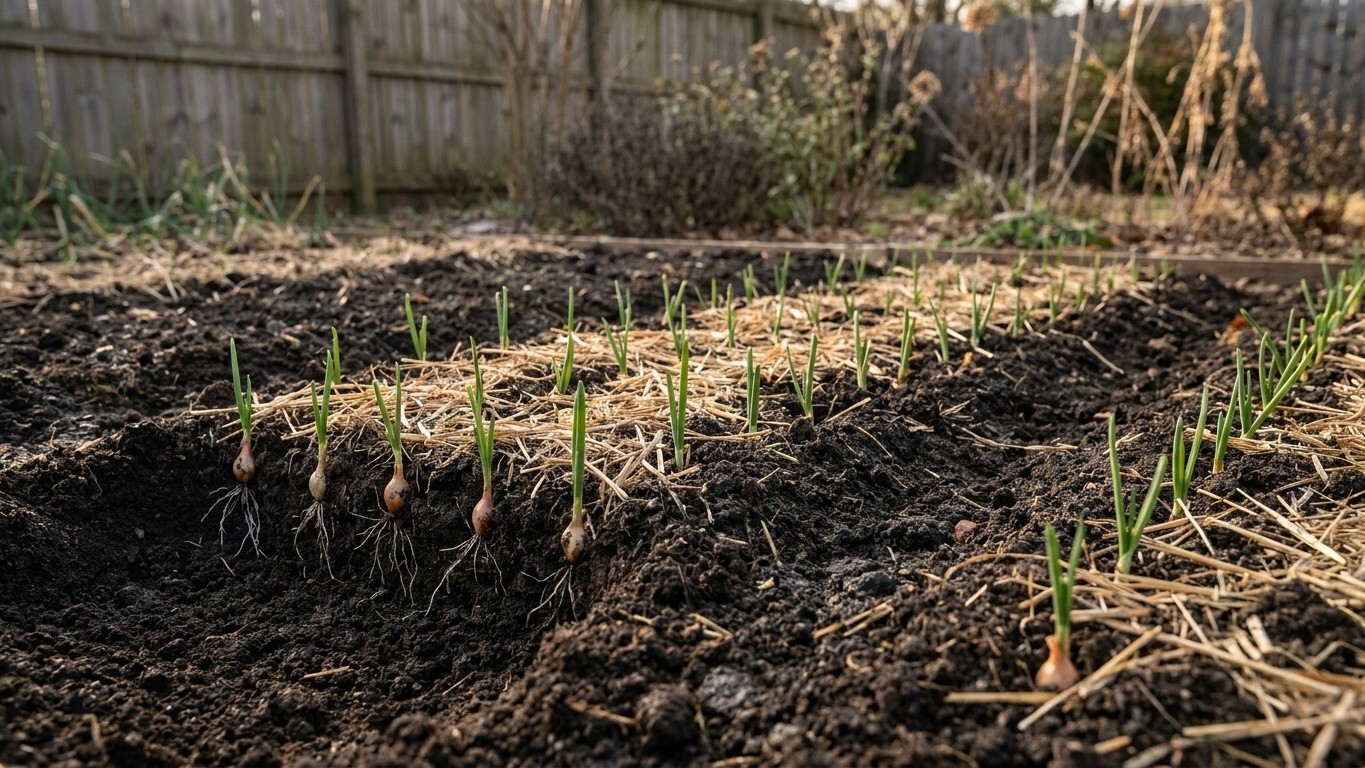

Garlic in Texas gets hit from three directions: insects that feed on the leaves, pests that work in the soil and the bulb, and problems that look like insect damage but are not. The calendar matters as much as the culprit. Garlic goes in during autumn and comes out the following summer, so it sits in the ground through a long stretch of mild weather. Which species are active in your county is a question for local extension staff, and this article shows you what to look for first.
Which pests attack garlic in Texas
Texas A&M AgriLife Extension is the service that tracks which insects and diseases are active in Texas gardens, county by county. Its guidance is the one to trust for naming a species. A named list only helps if you know where on the plant to look, so it is more useful to sort garlic trouble by where the damage happens.
The first group works on the leaves. Small sap-feeding insects and chewers collect in the fold where leaves meet the neck, and they show up as the weather warms. The second group works below the surface. Soil-dwelling insects and mites go after the cloves after planting and the swelling bulb in spring. The third group is microscopic worms in the soil, which you will never see without a lab, but whose effects show up as weak, stunted plants in the same spot year after year.
Timing is the first filter. Garlic is a cool-season crop, and at Houston’s IAH station the first 32°F freeze falls between December 1 and December 19, according to the NOAA NCEI 1991-2020 Climate Normals (the 30-70% probability band). That is a midpoint. The first freeze can arrive later than the early part of the window.
Houston is also the mild Gulf end of a very big state. Texas spans four USDA zones, and the Panhandle, North Texas and the Hill Country run on different clocks. Pests follow the weather, so the order in which they appear shifts with it. If you are still deciding what to plant, the guide to garlic varieties that suit Texas winters covers the plant side, and the general overview, growing garlic in Texas, covers the rest of the season.
When each one shows up, and what it does first
Start with planting. Cloves go into the ground in autumn, and at that point the soil-dwelling pests are the only ones with anything to eat. The first sign is a clove that never sends up a shoot, or a row with gaps. Dig one of the missing spots and look at the clove itself. A hollowed or chewed clove points to something in the soil, while a soft, discolored one points to rot.
Winter is quieter, but on the Gulf Coast it is not a true dormancy. Where the first freeze comes in early to mid December, and sometimes later, garlic leaves keep growing through much of the cold season. That growth is slow, and pest pressure stays low.
The leaf feeders move in as the weather warms and the plants put on growth. The first thing you see is rarely the insect. It is pale or silvery flecking on the leaves, streaks that run lengthwise, or tips that curl and stay curled. Look inside the fold at the base of a leaf, where small pests hide from the sun, and check the undersides as well. A hand lens helps a great deal here.
The bulb is the last stage. As the plants start to bulb, the bottom of the plant is out of sight, and damage from soil pests and mites often goes unnoticed until the tops begin to yellow near the end of the season. Lift one bulb early as a spot check rather than waiting for the whole row. Tunnels, soft spots, brown staining at the base, or cloves that have collapsed inside the wrapper are the signs to watch for.
Storage extends the calendar. Cure the bulbs in a dry, shaded, airy spot before you store them, and check them through the first weeks. The planting dates that set up this whole sequence are covered in when to plant garlic in Texas.
Telling the damage apart from everything else
Most garlic problems that get blamed on bugs turn out to be something else. Yellow tips, flecked leaves and stunted plants have many causes, and treating the wrong one wastes a season. Before you treat anything, dig up one affected plant and look at the roots and the base of the bulb. Insect damage leaves chewing marks, tunnels or visible pests. Other causes leave a different signature.
| What you see | Possible causes | What settles it |
|---|---|---|
| Leaf tips turning yellow, then brown and dry | Dry soil, wind, or an insect problem | Push a finger into the soil to the second knuckle. If it is dry, water is the first suspect. |
| Older, lower leaves yellowing evenly | A nutrient shortage | The pattern is uniform across the row. A soil test through the county extension office will say. |
| Silvery or pale flecks on leaves | Small leaf-feeding insects, or sun and wind scorch | Check the leaf fold with a hand lens for tiny moving specks. Scorch leaves nothing behind. |
| Orange powdery spots that rub off on your fingers | A fungal disease | Insects do not leave powder. The spots stain a finger. |
| Soft, brown bulb, sometimes with white fuzz at the base | Rot from wet soil | Look at drainage. Standing water after rain points away from insects. |
| Cut or ragged leaves, snapped stems | A hoe or string trimmer, or an animal chewing | A clean, straight cut is mechanical. A ragged edge is a chewer. |
Two of those rows deserve a second look. Dry soil and insect damage produce nearly identical yellow tips, and a gardener who sprays without checking the soil first loses time. Rot and soil pests also overlap, because chewed cloves invite rot and rotting cloves attract pests. When the signs point two ways, a photo and a sample taken to your county extension office will sort it out faster than guessing from a web page.
What actually works here, and what is a waste of time
Barriers and timing do more than any product. A lightweight row cover laid over the bed right after planting keeps flying insects off the leaves, and it is cheapest at the start of the season, before the first flecking appears. It has to go on before the pests arrive, with the edges buried or weighted down so nothing crawls under.
Clean planting stock comes next. Start with firm, undamaged cloves from a reliable seed source, and discard any that are soft or stained. Garlic from a grocery store is often treated to stop sprouting and may carry problems you do not want in your soil.
Rotation and drainage handle the soil side. Do not put garlic or its relatives in the same spot year after year, because soil pests and microscopic worms build up where the same crop keeps returning. A raised bed or a well-drained row cuts down on rot, which in turn cuts down on the pests that move into rotting tissue. Clearing old leaves and culls at the end of the season removes places for pests to wait out the summer.
Several common habits waste time. Spraying the whole bed on a schedule, with no pest identified, hits beneficial insects and does nothing for the pests that live in the soil or inside the leaf fold. Treating a yellowing plant before you have ruled out water, nutrients and rot is a guess. Planting early to get a head start also backfires in mild climates, since warm soil keeps pests active longer.
For a chemical question, this site names no product and gives no rates. Which materials are registered for use on garlic in Texas, and how they must be applied, is something only the extension service can answer for your situation. Ask them before buying anything.
Where to check this for your own county
The county office of Texas A&M AgriLife Extension is the place to start. Staff there know which pests were active this year in your part of the state, which diseases follow a wet spring, and which planting dates have worked locally. Most offices accept a sample or a clear photo, and many run a soil testing service.
The Houston frost window of December 1 to December 19 comes from the IAH station, and even within Houston, Hobby airport runs about two weeks milder. Move to the Panhandle or North Texas and the freezes come months earlier, the winters are colder, and the pest calendar looks different. The same applies to the planting dates, so compare against a cold-winter state if you are curious: the Utah guide to when to plant garlic and the list of garlic varieties that suit Utah winters show how much a colder season changes the plan.
Pick a bed that drains well and keep notes from one season to the next. Record when the first leaf flecking appeared, when you laid down the row cover, and what you found when you dug the first bulb. A season’s notes make a much better question to bring to the extension office than “what is eating my garlic?”
Common questions
Do I need to spray garlic in Texas?
Not as a routine. Most problems in a home bed are handled by clean cloves, good drainage, crop rotation and a row cover laid at planting. If you do think you have an insect problem, get it identified first, and ask your county extension office what is registered for garlic in Texas.
When should I start checking my garlic for pests?
Check soon after planting for missing shoots, then again as spring growth picks up and the weather warms. The leaf fold is the first place to look. Lift one test bulb before the tops fully yellow.
Is yellowing garlic always a pest problem?
No. Dry soil, a nutrient shortage, rot and fungal disease all cause yellow leaves. Check the soil moisture, then dig one plant and look at the roots and the base of the bulb.
Is the Houston frost window good for the whole state?
No. December 1 to December 19 is the 30-70% band for a 32°F freeze at one Houston station, and the first freeze can come later. Other parts of Texas freeze earlier or later, so the planting and pest calendar shifts with them.