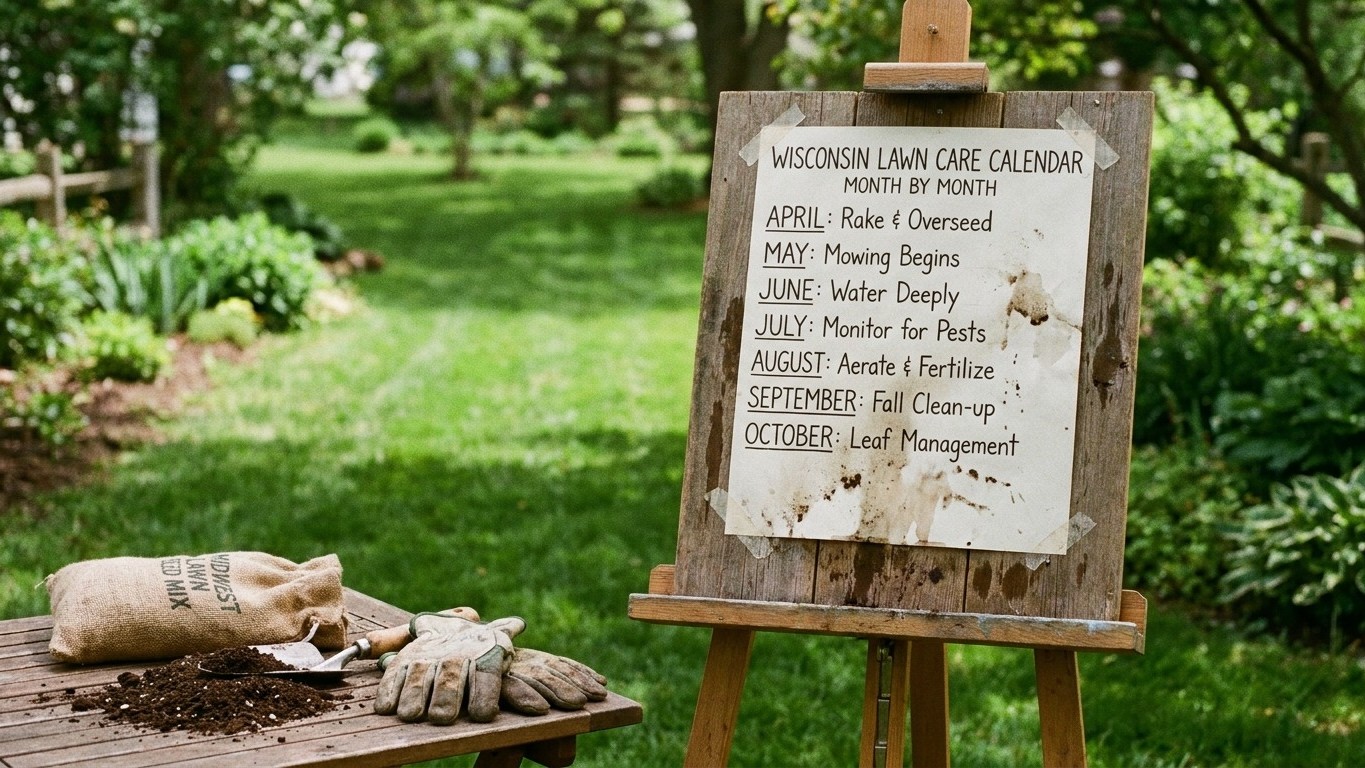

Wisconsin grows cool-season lawns: Kentucky bluegrass, fine fescue, perennial ryegrass, tall fescue and rough bluegrass, the five species Clemson Cooperative Extension and Penn State Extension list for this climate. Near Milwaukee, NOAA’s 1991-2020 climate normals put the first fall freeze between October 17 and October 29, and that window sets the deadline for the last mowing, the last nitrogen feeding, and the last day to get seed down. Check your own county’s frost timing before scheduling fall work, since the north and the lakeshore run on different clocks.
The short answer for Wisconsin
What’s the actual timing for feeding, mowing, and seeding a Wisconsin lawn? It runs on the calendar of a cool-season grass, growing hardest in spring and fall, coasting through summer, going untouched once the ground freezes. October is the hinge: the first fall freeze near Milwaukee lands between the 17th and the 29th, and everything you want the lawn to hold onto through winter needs to be finished well before that, not on it. Start by finding your own county’s frost date before you plan a single fall task off Milwaukee’s.
The other figure that drives the whole calendar is the first fall frost. NOAA’s 1991-2020 climate normals, measured at the Milwaukee-area station, put the 30 to 70 percent freeze-probability window between October 17 and October 29. Anything you want established before winter, new seed, a final fertilizer feeding, needs to happen well ahead of that date, not on it. That window comes specifically from the Milwaukee reference station, and it runs later than most of the rest of the state. Sites farther from Lake Michigan, and anywhere north, see their first freeze earlier.
Species choice matters as much as the calendar. Anyone ordering seed should read The Best Grass Seed for Wisconsin Lawns first, since sun exposure and foot traffic push the decision toward bluegrass, fescue or a blend in ways one calendar page can’t settle on its own.
Working through the year

Because Wisconsin’s grasses are cool-season, the two heavy-work windows are spring and fall, with summer mostly about survival rather than growth. This calendar assumes the lawn is already established through the steps covered in Wisconsin Lawn Care; if you’re starting from bare dirt, get seed down before applying any of the rates below. Clemson’s HGIC 1219 tall fescue maintenance calendar, written for the same cool-season species Wisconsin lawns are built from, is the closest published reference for mowing height, feeding rate and irrigation, even though its calendar dates are calibrated to a warmer climate than Wisconsin’s. Use its rates, but set the actual dates from Wisconsin’s own frost window.
| Season | Mowing height | Nitrogen | Irrigation |
|---|---|---|---|
| Spring | 3-4 in | Light feeding once growth starts | Rain-dependent |
| Summer | Top of 3-4 in range | None | 1-1.5 in/week |
| Fall | 3-4 in, mow until growth stops | Heavier feeding (HGIC 1219) | Rain-dependent |
| Winter | None | None | None |
Spring
Start mowing as soon as growth resumes, keeping the deck at 3 to 4 inches, the height range HGIC 1219 sets for tall fescue and one that also suits Kentucky bluegrass and the fescues most Wisconsin lawns are seeded with. Put down a pre-emergent herbicide once soil temperatures first hold in the mid-50s Fahrenheit for several days running, the same crabgrass-germination threshold the Clemson calendar uses. Waiting until you actually see crabgrass means the window already closed. Skip a heavy nitrogen feeding this early. A light feeding once the lawn is actively growing is enough. A second, heavier round belongs in fall.
Summer
Raise the mower toward the top of that 3 to 4 inch range once daytime heat sets in. Taller grass shades its own root zone and slows moisture loss, which matters most for a cool-season lawn already working against its preferred temperature range. Water to about 1 to 1.5 inches per week, the rate HGIC 1219 recommends, delivered in one or two deep sessions rather than a daily sprinkle that only wets the top inch of soil. Expect the lawn to slow down or turn a dull gray-green in a dry stretch. That’s drought dormancy, not death, and it greens back up once rain or irrigation resumes.
Fall
This is the main event for cool-season turf. Core-aerate compacted lawns and overseed thin spots while soil is still warm enough for germination but with enough time left before the ground freezes. Counting back roughly six weeks from Milwaukee’s first-frost window of October 17 to October 29 puts the safe overseeding cutoff at early to mid September for that area. The heavier of the year’s nitrogen feedings, the one HGIC 1219 weights toward fall for cool-season turf, goes down once temperatures cool but before growth stops for winter. Keep mowing until the lawn actually stops growing, not on a fixed date.
Winter
There’s no mowing or feeding to do once the ground freezes. The main task is staying off frozen or snow-covered turf, where traffic can crush dormant crowns, and making sure fallen leaves don’t sit thick enough to smother grass blades before real snow cover arrives.
What changes across Wisconsin
The Milwaukee-area figures above are a starting point, not a state-wide fact. Lake Michigan holds heat long into fall, which is why the lakeshore corridor around Milwaukee sees its first freeze as late as October 29 in NOAA’s normals, while inland southern Wisconsin, away from the lake’s moderating effect, typically freezes in early October. That gap matters directly for overseeding: a lawn in Madison or Janesville needs seed down earlier than one in a Milwaukee suburb, because the safe fall window closes sooner.
Farther north, the growing season compresses further. Wisconsin’s northern counties see their first fall freeze earlier still, which shortens the window for fall aeration, overseeding and the heavier of the two nitrogen feedings described above. A northern lawn run on a Milwaukee-timed calendar risks overseeding too late for grass to root before the ground locks up, and risks feeding nitrogen so late that fresh growth gets caught by frost instead of hardening off.
Elevation plays a smaller role in Wisconsin than the lake does, but low-lying frost pockets, valley bottoms and low spots without air drainage can freeze on nights when higher ground nearby does not. A lawn sitting in one of those pockets should plan around the early end of any stated frost range, not the late end.
None of this changes which grasses to grow. Kentucky bluegrass, fine fescue, perennial ryegrass, tall fescue and rough bluegrass all suit the whole state’s cool-season climate. What changes is only the calendar: when to start, when to stop, and how much margin to leave before the ground freezes.
The mistakes this climate punishes
Wisconsin’s cool-season lawns fail in predictable ways, mostly from applying warm-season timing, or warm-season products, to grass that doesn’t run on that schedule.
- Seeding in late spring or summer heat. Cool-season seed germinates poorly once soil warms into summer range, and seedlings that do come up rarely survive their first hot, dry month. The damage shows as bare patches by midsummer that never fill in on their own.
- Feeding heavily in high summer. A nitrogen push during a hot, dry stretch forces top growth the roots can’t support. It shows within a week or two as scorched, straw-colored blades on top of an already stressed lawn.
- Mowing too short when it’s hot. Cutting below the 3-inch range during summer heat removes the leaf area the plant needs to shade its own crown, and the lawn thins visibly within a couple of weeks.
- Overseeding too late in fall. Seed that misses the safe window, roughly six weeks ahead of the first frost, doesn’t root before the ground freezes. Most of it doesn’t survive winter, and the failure isn’t obvious until the following spring’s bare patches.
- Treating warm-season grass as an option. Bermudagrass and zoysia are built for a much longer, hotter growing season. Planted in Wisconsin, they go dormant at the first hard cold and, in most winters, don’t green back up the following spring at all.
Each of these mistakes has the same root cause: applying a task at the wrong point in the temperature curve rather than on the calendar date. Watching soil and air temperature, not just the month on the wall, catches most of them before they cost a lawn its whole season.
Checking this against your county
Every date and rate above comes from a single reference point near Milwaukee. Before locking in a fall overseeding date or a spring pre-emergent timing, check your own county’s numbers against the University of Wisconsin-Madison Division of Extension, at extension.wisc.edu, which runs county offices across the state with local frost and soil data. A call to your county’s office will tell you whether your site runs ahead of or behind the Milwaukee window used throughout this calendar, and whether your soil needs something this general guide can’t tell you, like a pH correction or a specific weed problem.
Common questions
What happens if I miss the fall seeding window?
Seed that goes down too close to the first frost usually germinates unevenly or not at all, and whatever does sprout often doesn’t survive winter. It’s safer to wait for spring than to gamble on a late fall seeding once the safe window described above has closed.
Will a spring pre-emergent herbicide hurt new grass seed I’m putting down the same season?
Most pre-emergent herbicides block grass seed from germinating, not just crabgrass, so putting one down and seeding the same spring usually fails. If you’re overseeding, hold off on the pre-emergent that year or choose a product labeled safe for seeding, and check the label against your timing before buying either one.
Can I mix in a little warm-season grass seed for extra summer color?
It’s not worth the money. Warm-season species like bermudagrass or zoysia won’t establish well in a single Wisconsin growing season, and any that do take will die out over winter, leaving bare spots where they were mixed in.
How do I find out if my area’s frost date is different from Milwaukee’s?
Your county office of the University of Wisconsin-Madison Division of Extension is the right place to ask, since local frost timing depends on distance from Lake Michigan and how far north you are. As a general rule, inland and northern sites freeze earlier than the Milwaukee-area window used in this calendar.