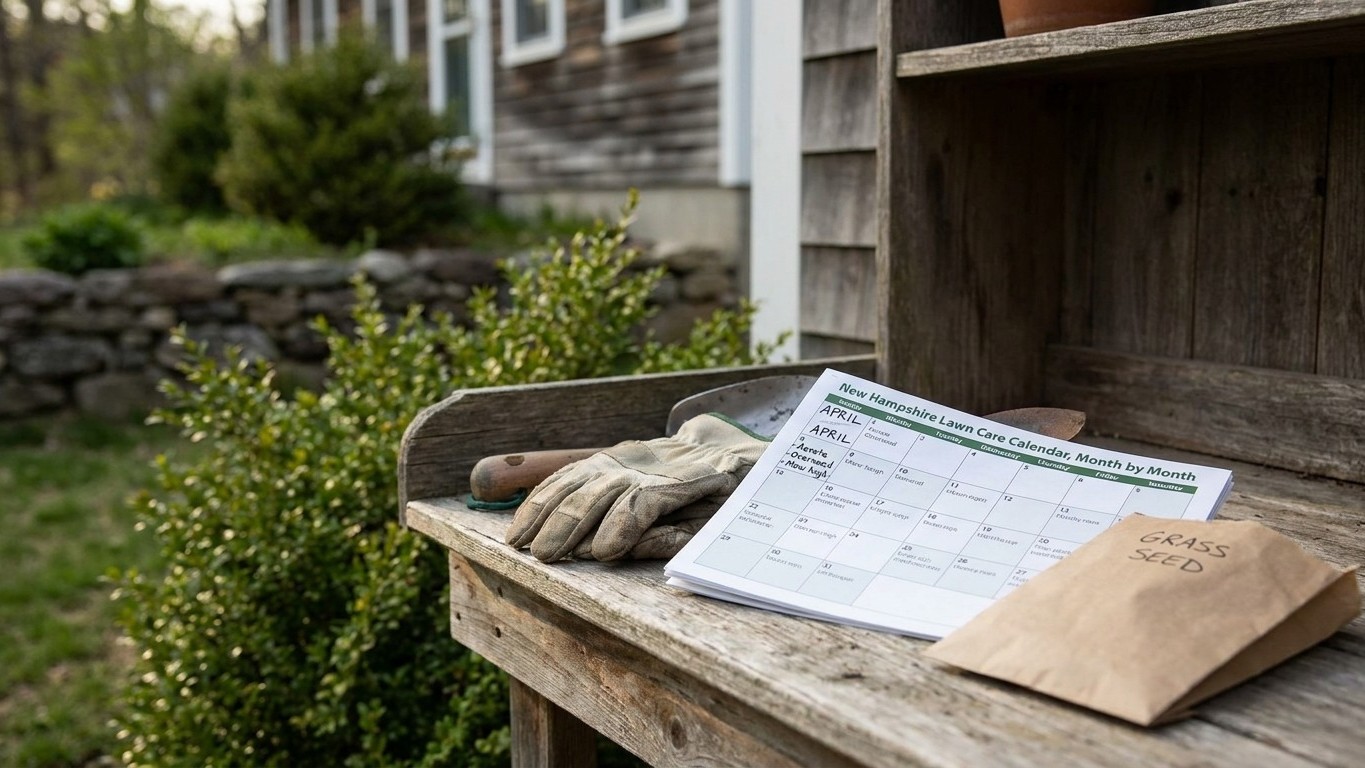

What actually grows here, and when do you work it? A cool-season lawn: Kentucky bluegrass, tall fescue, fine fescue, perennial rye, rough bluegrass, nothing warm-season sold in the southern catalogs, because it won’t survive a New Hampshire winter. Go stand at your calendar right now and mark the three weeks between October 13 and October 26 — that’s Manchester’s typical first frost — because fall seeding and fall feeding both have to be finished before that window closes, not after.
The short answer for New Hampshire
New Hampshire is a cool-season lawn state. The Homestead Post places Manchester in the cool-season zone, based on climate normals read against the season tolerances published by Clemson Cooperative Extension (HGIC 1214), and that classification holds for nearly the whole state, from the Seacoast to the Lakes Region to the Connecticut River valley. The species that actually hold up here are Kentucky Bluegrass, Tall Fescue, Fine Fescues, Perennial Ryegrass and Rough Bluegrass, the cool-season list named by Clemson HGIC 1214 and Penn State Extension. If you haven’t settled on which of those to plant, New Hampshire Lawn Care covers site prep and establishment before you get to a maintenance calendar like this one.
The warm-season turf sold in southern seed catalogs, Bermuda, zoysia, centipede, will not hold a New Hampshire winter. Those grasses stop growing once soil temperatures drop and simply never restart here, so listing them as an option would be misleading rather than generous.
The other number anchoring the whole calendar is the first fall frost. At Manchester, NOAA’s 1991-2020 climate normals put it between October 13 and October 26, a two-week range rather than a single date, because the airport station’s own record varies that much from one year to the next. Fall seeding, fall fertilizing and the last mow of the season all get scheduled around that window rather than a fixed day on the wall calendar.
What this answer depends on is where in the state you garden. Manchester’s figures come from the airport weather station there, and a lawn at higher elevation, further north, or in a valley that pools cold air will typically see frost arrive earlier, not later. Check your own county’s typical dates before locking in Manchester’s window as your own.
Working through the year

Clemson Cooperative Extension’s tall fescue maintenance calendar (HGIC 1219) is the closest published, task-by-task model for a cool-season lawn, and it’s worth following in sequence even though it was written for a different climate: the order of tasks (mow, feed, aerate, seed) stays the same, only the calendar dates shift to fit New Hampshire’s shorter season and later spring.
Spring
Mow as soon as the grass is growing again, keeping the blade sharp so you’re cutting rather than tearing. This is the window for a pre-emergent if crabgrass has been a problem, applied before the weed germinates rather than after it’s visible. Hold off on heavy nitrogen feeding in spring: cool-season grass that gets pushed hard this early puts on soft top growth it can’t sustain once summer heat arrives.
Summer
Raise the mowing height rather than lowering it. Cool-season turf slows down and can go semi-dormant in hot, dry stretches, and a taller blade shades the soil and roots through that stress. Skip fertilizing in the hottest weeks; feeding a heat-stressed lawn encourages disease more than growth.
Fall
This is the main season for a cool-season lawn, and it’s where the frost window matters most. Core aeration, overseeding and the season’s heaviest nitrogen feeding all belong here, timed to finish before the ground cools and growth stops, which at Manchester means working inside or ahead of that October 13 to 26 frost range. If you haven’t chosen your seed yet, The Best Grass Seed for New Hampshire Lawns walks through the trade-offs among bluegrass, fescue and ryegrass before you buy.
Winter
The lawn goes dormant. Skip mowing and skip feeding. The one task left is making sure the last cut of autumn wasn’t too tall going into snow cover, since matted, overlong grass under snow is what invites snow mold in spring.
| Season | Main task | Timing note |
|---|---|---|
| Spring | First mow, crabgrass pre-emergent | Before crabgrass germinates, light nitrogen only |
| Summer | Raise mowing height | Reduce feeding during heat stress |
| Fall | Aerate, overseed, main feeding | Finish before Manchester’s Oct 13-26 frost window (NOAA) |
| Winter | No mowing, no feeding | Dormant; last cut of fall should not be too tall |
What changes across New Hampshire
Manchester’s figures are a starting point, not a state-wide guarantee. The Seacoast, from Portsmouth south, gets some moderating effect from the ocean, and gardens there often see frost hold off later into fall than the inland figures suggest. The Lakes Region around Winnipesaukee gets a similar, smaller buffering effect near the shoreline, though it fades quickly a mile or two back from the water.
Elevation works the other way. Ground that climbs toward the White Mountains cools faster in fall and stays cooler into spring, so a lawn at higher elevation should expect its cool-season growing window to close earlier than Manchester’s does, not later. The same applies broadly to the North Country, up around Berlin and the Coos County towns, where the colder air mass simply arrives sooner in the calendar year.
River valleys and low pockets that trap cold air overnight behave like their own small climate even within a single town. Two lawns a few miles apart, one on a hillside and one down in a hollow, can see frost several days apart in the same week. None of this changes which grasses to plant, since the whole state sits in the same cool-season zone, but it does change how much slack to build into fall deadlines. Gardeners further from Manchester’s airport station should treat its frost window as a guide to lean earlier from, not a fixed date to work toward.
The mistakes this climate punishes
Most lawn failures in this state trace back to timing rather than technique. The mistakes below all cost something specific, and the damage doesn’t always show up right away.
- Seeding cool-season grass in the heat of summer. Seed sown in July or August germinates poorly or not at all, and what does come up gets scorched within days.
- Feeding heavily in late spring. A lawn pushed hard right before summer heat arrives puts on soft growth that thins out and browns badly once the dry weeks hit.
- Cutting too short in summer. A short cut in hot, dry weather exposes soil, stresses roots, and shows up as patchy browning within a couple of weeks, not immediately.
- Skipping fall aeration and overseeding. Compacted soil and thin turf don’t show their cost until the following summer, when the same lawn thins out faster under drought stress than a properly aerated one would.
- Mowing too tall going into winter. Long grass matted under snow cover is the classic setup for snow mold, which appears as circular gray or pink patches the moment snow melts in early spring.
None of these mistakes kill a lawn outright. A brown lawn in August is very often dormant, not dead, and a lawn thinned by winter mold usually fills back in once mowing and feeding resume. The cost is a season of poor appearance and slower recovery, which is exactly what following the calendar above is meant to avoid.
Checking this against your county
Manchester’s frost dates and this calendar’s sequence are a reasonable starting point for most of the state, but county-level advice will always beat a statewide page. UNH Extension maintains county offices that can confirm local frost timing, soil test results, and any pest or disease pressure specific to your area. Call or check their site before finalizing fall seeding or fertilizing dates if you garden well outside the Manchester area, particularly at elevation or in the North Country.
Common questions
Can I seed my lawn in spring instead of fall in New Hampshire?
You can, but fall gives cool-season grass a better shot. Spring-sown seed has to compete with weeds and then survive summer heat almost as soon as it germinates, while fall seeding gets cooler weather and less weed pressure to establish in.
My lawn turned brown in July, is it dying?
Probably not. Cool-season grasses like tall fescue and Kentucky bluegrass go dormant and brown under heat and drought stress, and most of them green back up once cooler, wetter weather returns in fall.
When exactly should I put down a crabgrass preventer?
It needs to go down before the crabgrass seed germinates, which is a soil-temperature trigger rather than a calendar date. Check with UNH Extension or watch local lawn-care reports for germination timing in your county rather than working off a fixed date.
Should I fertilize my lawn over the winter?
No. A dormant lawn isn’t taking up nutrients, so winter fertilizer mostly sits on frozen ground or washes off with snowmelt. Get the last feeding done before the ground freezes in fall instead.