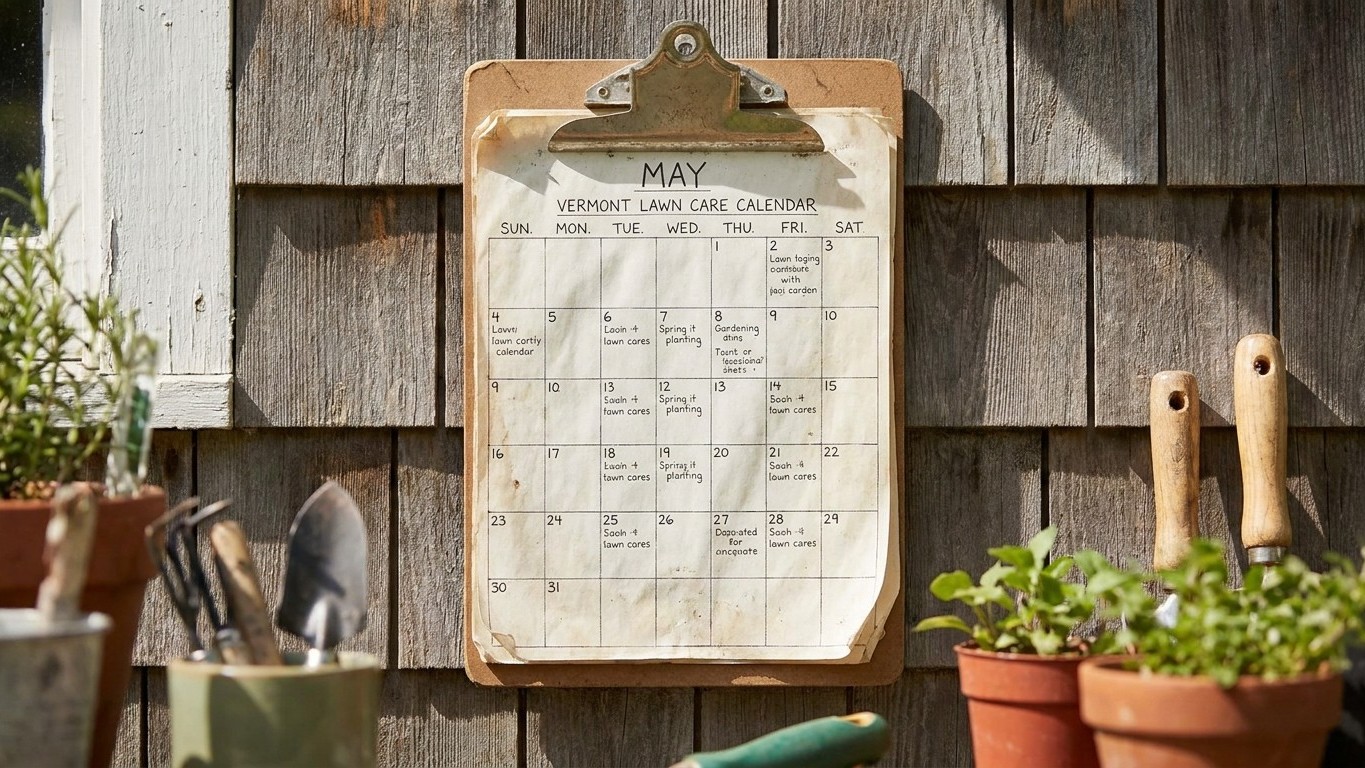

Vermont lawns run on a cool-season calendar, not a spring-summer one. The Homestead Post’s zone assignment, built from the temperature thresholds published by Clemson Cooperative Extension in HGIC 1214, places the state firmly in cool-season turf territory, where Kentucky bluegrass, tall fescue, fine fescues, perennial ryegrass and rough bluegrass are the grasses that actually survive a Vermont winter. The single move that matters most: put your seeding and heavy feeding in late summer into fall, not spring, and never chase a bare patch with grass seed once June heat sets in.
The short answer for Vermont
Burlington’s frost date isn’t Vermont’s frost date. A calendar built around one gets the seeding window wrong for anyone gardening up in elevation or away from Lake Champlain’s moderating water, where fall arrives earlier and the safe window for the last mowing closes sooner than the lakeshore suggests. The state doesn’t run on one clock, and a lawn calendar that pretends otherwise will have you seeding too late or aerating into ground that’s already hardening.
The answer depends on what’s already growing and where in the state you garden. A lawn near Burlington, on the shore of Lake Champlain, works to a slightly different clock than one in the Green Mountains or the Northeast Kingdom, because elevation and distance from the lake shift both the first and last frost. NOAA’s 1991-2020 climate normals put Burlington’s first fall frost between October 3 and October 13, and every fall task, seeding, aeration, the final mowing, gets timed off that window. Garden away from Burlington and expect that window to arrive earlier the higher and further from the lake you go.
For weighing fescue against bluegrass for a specific yard, see The Best Grass Seed for Vermont Lawns.
Working through the year

Clemson Cooperative Extension’s HGIC 1219, the Tall Fescue Maintenance Calendar, is written for tall fescue, one of the five cool-season grasses on this list, and it gives the clearest published rates for mowing height and nitrogen timing available for the species. Vermont’s growing season starts later and runs later into fall than the Carolina lawns HGIC 1219 was written for, so use its rates and its order of operations, mowing height, feeding priority, aeration, overseeding, but reset the calendar against Vermont’s own frost window rather than South Carolina’s.
| Season | Mowing height | Nitrogen | Key task |
|---|---|---|---|
| Spring | 2.5–3.5 in | Light, only if pale | Resume mowing |
| Summer | Toward 3.5 in | None | Mow high, do not seed |
| Fall | 2.5–3 in | Bulk of year’s feeding | Aerate, overseed |
| Winter | No mowing | None | Keep off frozen turf |
Spring
Cool-season lawns wake up slowly here. Mow as soon as growth resumes, keeping the deck at the height HGIC 1219 recommends for tall fescue, 2.5 to 3.5 inches, and hold that height through spring rather than scalping the first cut. Spring is not the season for a full nitrogen program on tall fescue by HGIC’s own schedule. A light feeding is enough if the lawn looks pale, and the bulk of the year’s nitrogen should wait for fall, when cool-season roots are actually building.
Summer
Summer is a holding pattern for cool-season turf, not a growing season. Mow high, closer to the top of the 2.5 to 3.5 inch range, since a taller blade shades the soil and slows moisture loss during the year’s hottest, driest stretch. Do not seed now. Cool-season grass seed germinates poorly in hot soil, and any seedling that does come up rarely survives a Vermont July.
Fall
Fall is the main event on a cool-season calendar, and HGIC 1219 treats it that way for tall fescue too. This is when the bulk of the year’s nitrogen goes down, when core aeration does the most good, and when overseeding actually takes. Working backward from NOAA’s Burlington frost window of October 3 to October 13, aim to get seed and fertilizer down while there’s still enough warm soil and daylight left for roots to establish before the ground closes down, generally six to eight weeks ahead of that frost range. For the Burlington area, that puts the working window in the second half of summer into early fall, earlier still the further you garden from the lake.
Winter
Once the lawn stops growing, mowing stops too. Keep foot traffic and heavy equipment off frozen or snow-covered turf, since compacted, dormant grass crowns bruise easily and show it as thin patches once spring arrives.
What changes across Vermont
Every date here is measured at or near Burlington, on the shore of Lake Champlain, which NOAA’s 1991-2020 climate normals show as the mildest corner of the state. The lake holds summer heat into fall and releases it slowly, which pushes Burlington’s first frost later than most of Vermont sees it. That single fact means every other part of the state should treat the October 3 to October 13 window as a late estimate, not a rule.
Move east into the Green Mountains and elevation starts working against you. Cold air sinks and settles into valleys, and higher ground loses its growing season from both ends, a later spring green-up and an earlier fall frost. A lawn well up in the Mountains is very likely finishing its fall feeding and overseeding window while a Burlington lawn is still comfortably inside it.
The Northeast Kingdom, Vermont’s northeastern corner away from the lake’s moderating effect, runs on the shortest calendar in the state. Without Lake Champlain’s warmth nearby, and generally at higher elevation than the Champlain Valley, the Kingdom’s growing season compresses from both directions, so any task tied to the Burlington frost date in this article needs to move noticeably earlier there.
The safest approach for a reader outside the immediate Burlington area is to treat the Burlington window as a late boundary and work backward from local experience, or a nearby weather station’s own normals, rather than assuming the lake-effect calendar applies statewide.
The mistakes this climate punishes
Seeding cool-season grass in late spring or early summer is the most common mistake on a Vermont lawn, and it shows up as a thin, patchy stand by the time July heat arrives. Cool-season seed wants cool soil to germinate and cool roots to establish, and Vermont’s brief warm window means anything sown after late spring is racing a clock it usually loses. Fall, timed against the Burlington frost window or your own local equivalent, does not have that problem.
Feeding heavily in spring instead of fall is the second mistake. It pushes a flush of soft, leafy top growth right before the stress of summer, which leaves the lawn thin and more open to disease at the exact moment it can least recover. Save the bulk of the nitrogen for fall, when the plant is building roots rather than leaves.
Cutting the lawn short in summer heat is a mistake that doesn’t show up right away, which is what makes it dangerous. A scalped lawn looks fine for a week or two, then the soil underneath dries out and browns fast in the next hot stretch, and by the time the damage is visible the roots are already stressed. Keeping the mower toward the higher end of the tall fescue range through summer shades the soil and buys real drought tolerance without watering more.
Assuming brown means dead is its own trap. Cool-season turf here goes off-color under summer drought stress and greens back up on its own once rain and cooler weather return, so resist the urge to reseed or heavily fertilize a lawn that has simply gone dormant for a few weeks.
- Seeding in May or June instead of the fall window
- Front-loading nitrogen in spring instead of fall
- Mowing below 2.5 inches during a hot, dry stretch
- Treating summer dormancy as a dead lawn
Checking this against your county
Every figure here is anchored to Burlington, and Vermont’s terrain is varied enough that your county can run meaningfully different. The University of Vermont Extension is the state’s land-grant service, and its county-level offices are the right place to confirm frost timing, soil test results and seeding windows for your specific location before committing to the dates above. For anyone building or renovating a lawn from scratch, it’s worth reviewing the groundwork covered under Vermont Lawn Care before layering a seasonal calendar on top of it.
Common questions
When should I overseed my Vermont lawn?
Aim for late summer into early fall, working backward from your local first frost date so seedlings get six to eight weeks of establishment before the ground cools down. Near Burlington, NOAA’s 1991-2020 normals put that frost between October 3 and October 13, but confirm the equivalent date for your own county before picking a weekend.
Can I grow a warm-season grass like zoysia in Vermont?
No. Warm-season species go dormant at temperatures cool-season grass shrugs off, and none of them survive a Vermont winter. Stick to the cool-season lineup: Kentucky bluegrass, tall fescue, fine fescues, perennial ryegrass or rough bluegrass.
Why is my lawn brown in August if I’m watering it?
Cool-season turf often goes semi-dormant under summer heat and drought stress even with some watering, and that shows as an overall dulling rather than true death. Check the crown of a few blades near the soil line. If it’s still white and firm rather than dry and brittle, the lawn is dormant, not dead.
Is it too late to fertilize in October?
A fall feeding timed close to your local frost date is usually the most valuable application of the year for cool-season turf, not a late one, since the plant is still moving nutrients into its roots after top growth slows. Confirm the specific cutoff with University of Vermont Extension for your county rather than guessing at a date.