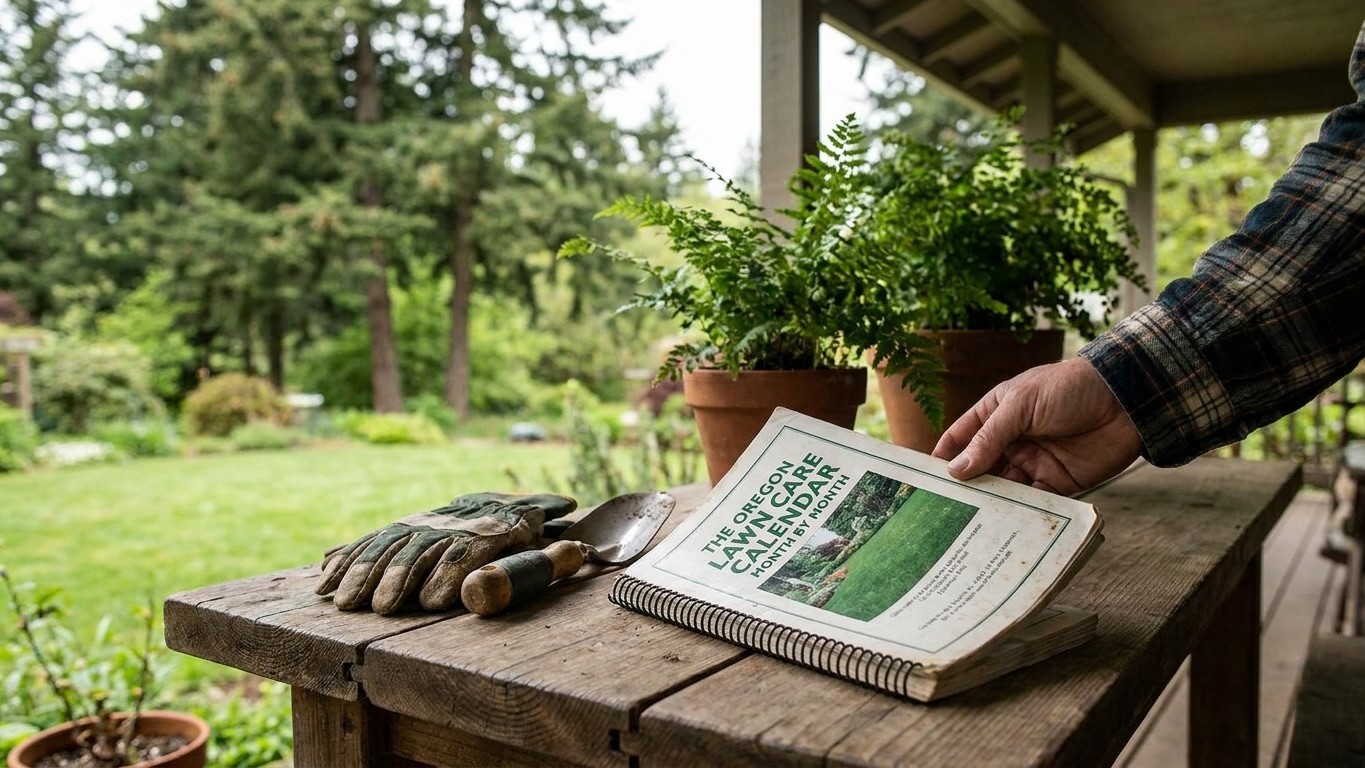

Oregon lawn care runs on two separate clocks, and the one that matters is the one your grass already follows. Near Portland, where The Homestead Post has placed the climate in a transition zone based on NOAA’s climate normals, cool-season grasses such as tall fescue do their growing in fall and spring while warm-season grasses such as zoysiagrass push hardest through summer. Check which type is already established in your yard before you touch a fertilizer bag or a seed spreader, because every date and rate below runs backward if you guess wrong.
The short answer for Oregon
There is no single best grass for a transition zone, and Oregon near Portland is one. A cool-season lawn, tall fescue, Kentucky bluegrass, or perennial ryegrass, stays green through the mild wet months and looks its best in spring and fall, but it thins and browns under summer heat and drought stress. A warm-season lawn, zoysiagrass or bermudagrass, does the opposite: it greens up late, holds color through the hottest weeks, and then goes brown and dormant from roughly October through April. Neither one is broken during its off-color months. Brown zoysia in January is asleep, not dead, the same way a drought-stressed fescue lawn in August is stressed, not dying, if the crown is still alive under the thatch.
Which one makes sense for a given yard depends on what’s already growing, how much summer irrigation the property can support, and how much winter brown a homeowner can tolerate looking at from the street. A lawn that’s already established in tall fescue is rarely worth tearing out to chase a warm-season look, and the reverse is just as true. If you’re planning a new lawn from scratch rather than managing an existing one, The Best Grass Seed for Oregon Lawns walks through how to weigh that decision before you buy seed.
| Grass | Season type | Peak growth | Off-season condition | Named maintenance calendar |
|---|---|---|---|---|
| Tall Fescue | Cool-season | Fall and spring | Slows in summer heat, semi-dormant in hard drought | Clemson HGIC 1219 |
| Kentucky Bluegrass | Cool-season | Fall and spring | Thins in summer drought, recovers with fall rain | Follows fescue’s cool-season pattern; no separate calendar named here |
| Perennial Ryegrass | Cool-season | Fall and spring | Stresses in summer heat, weaker heat tolerance than fescue | Follows fescue’s cool-season pattern; no separate calendar named here |
| Zoysiagrass | Warm-season | Summer | Brown and dormant, roughly October to April | Clemson HGIC 1217 |
| Bermudagrass | Warm-season | Summer | Brown and dormant, roughly October to April | Clemson HGIC 1216 |
Working through the year

A cool-season lawn in tall fescue is worked to the order of operations in Clemson Cooperative Extension’s HGIC 1219 tall fescue maintenance calendar. That fact sheet is written for South Carolina’s own frost dates, so treat it as a sequence, mowing height, nitrogen application, pre-emergent timing, aeration and overseeding, rather than as a set of calendar months, and shift the sequence to Oregon’s own frost window. Near Portland, NOAA’s 1991-2020 climate normals put the first fall freeze between November 11 and November 27. That window is the marker for the last stretch of active fescue growth in autumn and the point by which fall overseeding needs enough weeks of established root growth behind it, not seed still sitting on bare soil.
What the calendars actually specify
Rather than inventing numbers that vary by soil, sun exposure, and irrigation source, defer to the named calendar for the exact figures and use it for the categories it covers:
- Mowing height by month, raised in the stressed season and lowered in active growth
- Nitrogen rate, given in pounds per 1,000 square feet, split across the growing months
- Irrigation rate, given in inches per week during active growth
- Pre-emergent herbicide timing, tied to soil temperature rather than a calendar date
- Aeration and overseeding windows, timed to when the grass is actively rooting, not dormant
A warm-season lawn in zoysiagrass or bermudagrass runs on the opposite half of the year and follows Clemson’s HGIC 1217 or HGIC 1216 calendar respectively. These grasses green up later in spring than fescue does, hold their color and their mowing frequency through the hottest stretch of summer, and then take their last feeding of the year well before dormancy sets in. Fall growth slows and the lawn goes brown at the first hard freeze, the same November window that ends fescue’s active season near Portland, sometimes earlier at higher elevation. Feeding a warm-season lawn on a cool-season lawn’s fall schedule pushes tender new growth right into that freeze window, which is one of the more common ways a Oregon transition-zone lawn gets hurt by a calendar written for the wrong grass.
What changes across Oregon
Every figure above is measured at or near Portland, west of the Cascades, and the rest of the state does not share that climate. The Willamette Valley, where Portland sits, has the mild, wet winters and moderate summers that make cool-season lawns viable without heavy irrigation, and it’s also mild enough that a warm-season lawn can survive winter dormancy rather than dying outright. Move east across the Cascade crest and the picture changes. Central and eastern Oregon sit in high desert, with colder winters and a shorter frost-free season than the Portland figures reflect, and a lawn planned around Portland’s November frost window will be caught out if it’s actually planted near Bend or further east.
Elevation does the same thing on a smaller scale even within the western part of the state. A property at the base of the Cascade foothills or up in the Coast Range will see frost arrive earlier and leave later than a low-lying lot in the valley floor, which shortens the safe window for fall overseeding and pushes warm-season dormancy earlier in autumn. The coast itself runs the other direction: onshore air keeps summers cooler and winters milder than inland Portland, which favors cool-season grass and makes a warm-season lawn a harder sell, since it never gets the sustained summer heat that variety needs to look its best.
The mistakes this climate punishes
Feeding the wrong grass at the wrong time
Applying a fall nitrogen feeding meant for a cool-season lawn to a warm-season lawn pushes new growth right before dormancy. That growth doesn’t harden off in time, and the damage shows up as dead patches when the grass should be breaking dormancy the following spring, not as anything visible in autumn. The reverse mistake, skipping fescue’s main fall feeding because a warm-season lawn nearby is already going brown, leaves the cool-season lawn under-fed heading into its most productive season of the year.
Seeding cool-season grass too late or too early
Tall fescue, Kentucky bluegrass, and perennial ryegrass seed all need enough weeks of root establishment before the ground turns cold, and near Portland that means seeding well ahead of the November 11 to 27 freeze window NOAA’s normals describe, not up against it. Seed put down too close to that window germinates into a frost before it has rooted deeply enough to survive winter. Seeding in late spring instead, chasing a bare patch after the lawn has already gone from wet to dry, sets the new grass up to hit summer heat stress before it has any root system to draw on, and that failure doesn’t show until the whole patch is dead by August.
Mowing too short in summer
A cool-season lawn cut short during a hot, dry stretch loses the leaf area it needs to shade its own crown and root zone, and the damage compounds over the following weeks as the exposed soil dries out faster and weed seed gets the light it needs to germinate. This shows up as a thinning, patchy lawn by late summer that looks like disease or drought when the actual cause was the mower deck.
Checking this against your county
Oregon is large enough that a property in the Rogue Valley, the high desert, or up in the Coast Range will see different frost dates and a different balance between cool-season and warm-season success than Portland. Oregon State University Extension runs county offices and a Master Gardener program that can confirm local frost dates, soil conditions, and which grasses are actually performing well in a given area, and it’s worth a call before committing to either half of this calendar. For a broader look at how these choices fit together before deciding what to plant, Oregon Lawn Care covers the groundwork.
Common questions
Can I mix warm-season and cool-season grass in the same lawn?
Not successfully as an even blend. The two types have opposite growth cycles, so one will dominate depending on the season and the other will thin out under its shade or its mowing schedule. Most transition-zone lawns that look mixed are actually one species with the other creeping in as a weed, not a deliberate planting.
My zoysia lawn is completely brown right now, is it dead?
Probably not. Warm-season grasses like zoysiagrass and bermudagrass go dormant and brown from roughly October through April in a transition-zone climate, and that’s a normal seasonal response, not dieback. Scratch a small patch of the crown near the soil line. If it’s still white or pale green under the brown blades, the lawn is dormant and should green back up as temperatures warm.
How late can I seed a cool-season lawn in the fall near Portland?
Earlier than you’d think, given how mild fall feels. NOAA’s 1991-2020 normals put the first fall freeze between November 11 and November 27 near Portland, and new grass seed needs several weeks of root establishment before that date, not to have just germinated by then. Count backward from the earliest edge of that window rather than the latest if you want a margin of safety.
Is Oregon a cool-season or warm-season state for lawns?
Neither, at least not near Portland, which The Homestead Post has classified as a transition zone based on climate normals. Both cool-season grasses like tall fescue and warm-season grasses like zoysiagrass are grown successfully there, each with a different set of trade-offs, and the classification can shift with elevation and distance from the coast within the state.