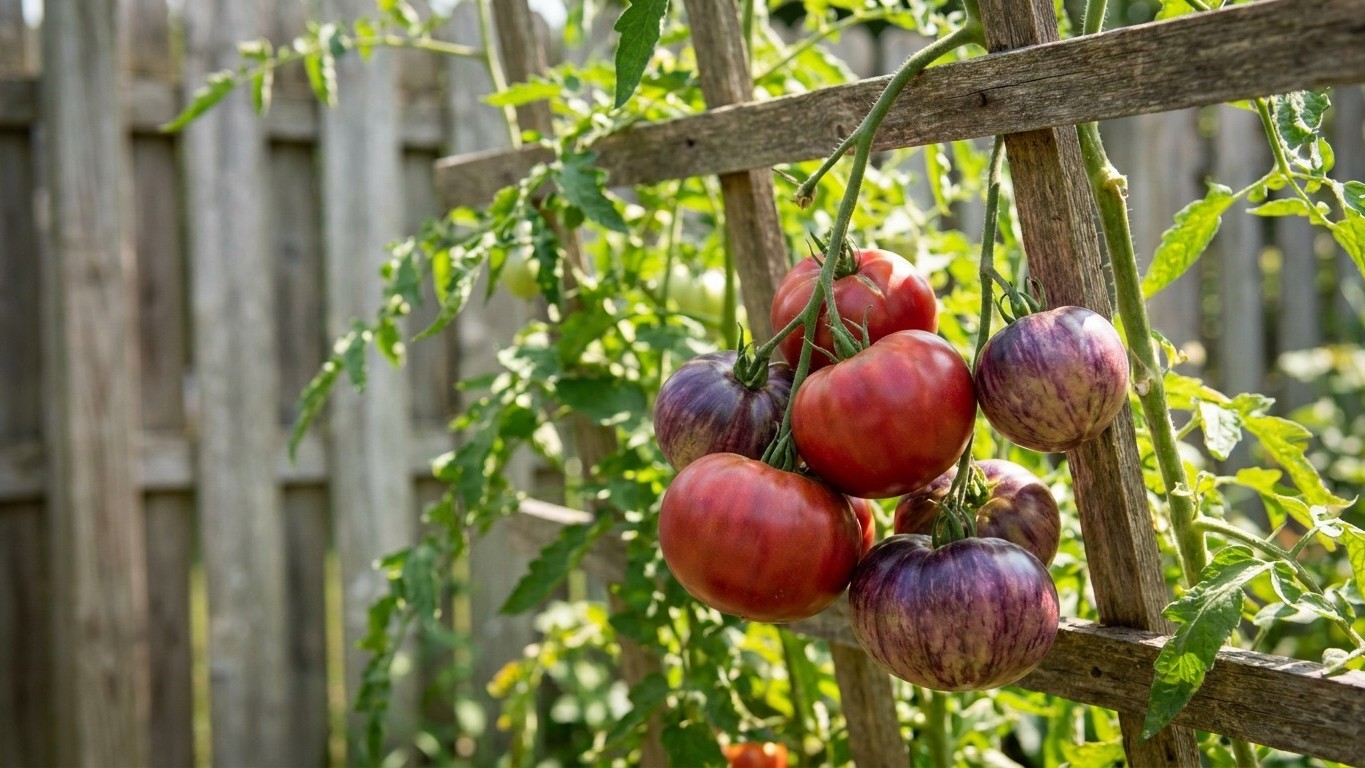

Tomatoes ripen in time across most of Illinois because the frost-free season is long enough for anything from a 55-day cherry tomato to an 85-day paste variety, provided you match the plant to the window you actually have. Near Chicago, NOAA’s 1991-2020 climate normals put the last spring freeze at April 11 to April 22 and the first fall freeze at October 24 to November 3. Check your own county’s frost dates before you plant anything with a days-to-maturity number past the high 70s.
What this comes down to in Illinois

A 75-day beefsteak sounds harmless until an Illinois spring runs cold and pushes transplant week back, and suddenly that variety is racing a Chicago-area frost line with almost no margin left. The result is a vine full of green tomatoes the week the forecast turns, and a season’s work sitting on the counter waiting to ripen indoors. The fix isn’t hoping for a warm October — it’s choosing varieties built for this window from the start, like Sakura, Sun Gold, Supersweet 100, Jasper, and Amalfi.
Sakura
Sakura needs about 55 days from transplant, the shortest on this list, and produces small, round cherry tomatoes in long clusters. It resists nematodes, tomato mosaic virus and two races of Fusarium wilt, and with roughly 116 days of margin before the Chicago-area frost window, it clears frost with room to spare even in a slow spring.
Sun Gold
Sun Gold matures in about 57 days and produces small cherry tomatoes with a sweet, almost tropical flavor. It resists tobacco mosaic virus and one race of Fusarium wilt, and its short timeline keeps it well clear of frost even if the transplant date slips by a week or two.
Supersweet 100
Supersweet 100 finishes around 60 days and carries very long clusters of small cherry tomatoes. Its resistance to verticillium wilt and Fusarium wilt suits it to garden soil that has grown tomatoes before, and the short season makes it forgiving of a cool start.
Jasper
Jasper also runs about 60 days to maturity and yields small cherry tomatoes on vigorous vines. Its high resistance to late blight is the reason to pick it over a similar cherry type in a wet year, since that disease can move fast once conditions turn humid.
Amalfi
Amalfi is a determinate paste tomato at about 68 days, producing elongated fruit suited to sauce and canning. It carries intermediate resistance to both late blight and early blight, which matters given how often an Illinois summer turns humid enough for both diseases to show up.
Big Beef Plus
Big Beef Plus takes about 72 days and produces large slicing tomatoes. Its resistance to nematodes, gray leaf spot and tomato mosaic virus makes it one of the sturdier full-size slicers here, and its roughly 99-day margin before the Chicago-area frost window still leaves a comfortable cushion.
Celebrity Plus
Celebrity Plus is a determinate slicer at about 78 days. It resists nematodes, gray leaf spot and tomato mosaic virus, but at 78 days it’s past the point where a late transplant leaves much room for error, so it wants the late-April-to-early-May window, not a June one.
Amish Paste
Amish Paste is the longest-season variety on this list at about 85 days, producing large fruit prized for sauce. It still finishes with roughly 86 days of margin before the Chicago-area frost window, but that margin is the smallest here, and it’s the first variety to cut if your spring runs cold or your transplant date slips.
Working it out for your own garden
The math is simple once you have three numbers: your last spring frost, your first fall frost, and the variety’s days to maturity from transplant. Near Chicago, NOAA’s 1991-2020 normals put those frosts at April 11 to April 22 and October 24 to November 3, so subtracting the transplant window from the fall frost window gives you a range of days to work with, never a single date. The full method for working backward from your own frost window is laid out in Tomato Planting Dates in Illinois: Counting Back From Your Frost Window.
A short-season example that clears frost easily
Take Sakura, which needs about 55 days from transplant. Set it out in the late-April-to-early-May window and 55 days lands you in late June for first ripe fruit, holding regardless of which end of the transplant window you use. From there to the earliest possible fall frost in late October is still well over three months of open season, which is why a 55-to-65-day cherry tomato is close to frost-proof in this climate.
A long-season example that cuts it closer
Now take Amish Paste, at 85 days. The same late-April-to-early-May transplant puts first ripe fruit in late July, and counting forward to the October 24 to November 3 window still leaves roughly 86 days of margin, so it finishes even at the reference city. But that margin is roughly a third of what Sakura carries, and it’s the first number that turns thin if your spring runs two or three weeks cold or your transplant gets delayed. A gardener in a shorter-season part of the state, or one who starts late because the soil stayed wet, can watch that cushion shrink to a few weeks without changing anything else about how the plant is grown.
| Variety | Days to maturity | Transplant window | Calculated first ripe | Margin before Chicago-area frost |
|---|---|---|---|---|
| Sakura | 55 | late April to early May | late June | ~116 days |
| Amalfi | 68 | late April to early May | mid July | ~103 days |
| Celebrity Plus | 78 | late April to early May | late July | ~93 days |
| Amish Paste | 85 | late April to early May | late July | ~86 days |
Once you know roughly when a variety will set its first ripe fruit, you also know which pests are likely due around then, which is covered separately in Tomato Pests in Illinois: Which Ones Actually Show Up Here.
What changes across the state
The figures above come from one weather station near Chicago, and Illinois runs about 400 miles north to south, so treat them as a starting point rather than a state-wide fact. Southern Illinois typically warms earlier in spring and holds warmth later into fall than the Chicago area, while the far north routinely sees frost arrive earlier and linger later into spring. Land close to Lake Michigan gets a buffering effect in both directions, since the lake moderates temperature swings and tends to delay both the last spring freeze and the first fall freeze compared with inland spots at the same latitude, while gardens even a short drive from the shoreline lose most of that protection.
USDA’s Plant Hardiness Zone Map places Illinois across zones 5a to 7b, with the colder zones concentrated in the north and the milder zones toward the south. A variety that just clears frost near Chicago has more margin to work with in the southern third of the state and less in the far north, so a cultivar like Amish Paste that finishes with a modest cushion at the reference city may need extra caution farther north, or in any low-lying spot that holds cold air. Elevation changes are modest across Illinois compared with mountainous states, so it plays a smaller role here than latitude and the lake’s influence do. Given that spread, treat the Chicago-area frost window as one reference point and check your own county’s normals before locking in a planting date.
The mistakes this state punishes

The most common mistake is trusting a warm week in April as proof the soil has caught up, then setting out transplants that sit still in cold ground for two weeks while a lingering cold snap undoes the head start. NOAA’s frost normals near Chicago run April 11 to April 22, but soil temperature lags air temperature, and a transplant that goes in during a warm snap ahead of a cold one often loses more growing time than one planted a week later into properly warmed soil.
The second mistake is choosing a long-season variety like Amish Paste for a garden with a shorter effective season, whether that’s a colder microclimate, a shaded bed that warms late, or a habit of transplanting in late May instead of the late-April-to-early-May window. An 85-day variety is not interchangeable with a 60-day one, and the margin that looks comfortable on paper at the reference city shrinks fast once any of those factors stack up.
The third is mistiming both ends of the window: rushing transplants out ahead of the frost date because a neighbor already has theirs in, or delaying out of caution and then wondering why a 78-day slicer like Celebrity Plus never quite gets there before the October 24 to November 3 fall freeze window. Both ends of that timing question, including how to adjust for a cold or late spring, are covered in Tomato Planting Dates in Illinois: Counting Back From Your Frost Window.
Checking this against your county
Everything above is anchored to one weather station near Chicago. Your county’s frost dates can run later in spring and earlier in fall, especially away from the lake, so before committing a long-season variety to the garden, check your own county’s normals against ILLINOIS Extension’s resources at extension.illinois.edu. The state’s land-grant extension service also publishes tomato-specific guidance on local disease pressure that goes beyond what a national frost dataset can tell you, and pairing it with the pest timing in Tomato Pests in Illinois: Which Ones Actually Show Up Here covers both ends of the growing season.
Common questions
Is it too late to plant tomatoes in June in Illinois?
Not for a short-season variety. Something like Sun Gold or Sakura, at 55 to 57 days, still has enough time to ripen well before the Chicago-area fall freeze window of October 24 to November 3 even from a June transplant. A 78-to-85-day variety planted that late is cutting it much closer, and in a shorter-season county it may not finish at all.
Do disease-resistance letters on the seed packet actually matter?
Yes, especially in soil that has grown tomatoes for several seasons. Codes like Fusarium wilt resistance or verticillium wilt resistance are rated High or Intermediate on the packet, meaning the plant either strongly resists infection or tolerates it with reduced damage. Intermediate resistance still lets some disease through in a bad year, so it’s not a substitute for crop rotation.
Why does my heirloom ripen later than the catalog date says it should?
Catalog days to maturity are counted from the transplant date, not from seed, and they assume fairly ideal conditions. A cool, cloudy stretch after transplanting, root stress from transplant shock, or a late frost that delays planting can all push the real ripening date a week or two past the catalog figure.
Can I direct-seed tomatoes outdoors instead of transplanting in Illinois?
It’s not standard practice here because the frost-free season, roughly six months at the Chicago-area reference point, is already tight for varieties in the 70-to-85-day range once you add the extra weeks a seed needs to reach transplant size. Starting indoors and setting out transplants in the late-April-to-early-May window is what makes those numbers work at all.