
New York tomato gardens see a predictable lineup: cutworms and flea beetles right at transplant, Colorado potato beetles and aphids through early summer, tomato hornworms once the heat sets in, and brown marmorated stink bugs as fruit ripens toward fall. NOAA’s 1991-2020 climate normals put New York City’s frost-free stretch between the March 23 to April 3 last-frost window and the November 14 to November 27 first-frost window, and that span is what lines up each pest’s arrival. Walk the row every few days from transplant through fruit set, since that’s when the earliest and most preventable damage happens.
What this comes down to in New York

Cutworms and flea beetles do more damage to New York tomato patches than the hornworm ever gets credit for. Everyone braces for that thick green caterpillar because it’s the one every general guide photographs, but by the time it turns up in July, cutworms have already dropped transplants in late May and flea beetles have already perforated the first true leaves in early June. Here, the season gets decided in that narrow early window — not by the pest with the best reputation.
Cutworms

Cutworms show up in the first two or three weeks after transplant, while stems are still soft. The larvae are dull gray-brown to black caterpillars, an inch or two long, that curl into a tight C-shape when you disturb the soil around a plant. They feed at night and sever young stems right at the soil line, so a healthy transplant one evening can be a bare stub the next morning. A cardboard collar pushed an inch into the soil around each stem stops them, since the caterpillar can neither climb over it nor tunnel through it.
Flea Beetles

Flea beetles arrive in that same early window, while leaves are still tender. They’re tiny, shiny black beetles about the size of a pinhead that jump like fleas when the plant is brushed. The damage looks like a shotgun blast: rows of small round holes peppering the leaf surface. Seedlings can usually outgrow light feeding once they’ve put out four or five true leaves, but a floating row cover set at transplant keeps the beetles off until the plant is past that vulnerable stage.
Colorado Potato Beetle

Colorado potato beetle moves in as plants size up in late spring. The adult is a rounded, yellow-orange beetle about three-eighths of an inch long with ten black stripes running down its back, and it lays clusters of orange eggs on the undersides of leaves. The larvae do the real damage: humpbacked, reddish-orange grubs with two rows of black spots that can strip foliage down to the ribs within days of hatching. Hand-picking adults and crushing egg clusters before they hatch works well at home-garden scale, since populations build fast once the first generation is missed.
Aphids

Aphids are present for most of the growing season but peak as new growth flushes in early summer. They’re small, soft-bodied, pear-shaped insects, pale green to black, clustered on stem tips and the undersides of leaves, often tended by ants feeding on the honeydew they excrete. Heavy infestations curl and yellow leaves and can spread virus between plants. A strong jet of water knocks most colonies down, and insecticidal soap handles what’s left without harming the pollinators working the flowers.
Tomato Hornworm

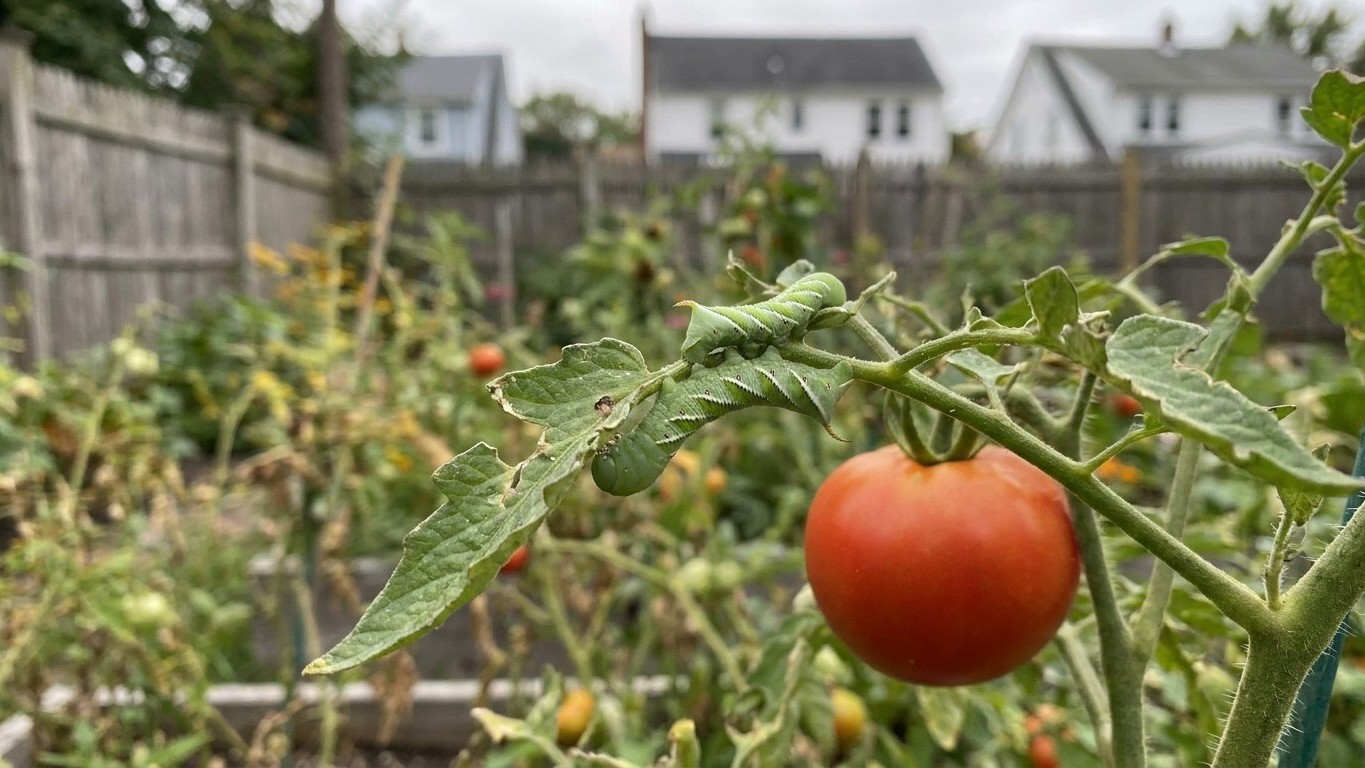
Tomato hornworm shows up as the season peaks, usually once fruit has started to set. It’s hard to miss once spotted: a pale green caterpillar up to four inches long, with white diagonal stripes down each side and a curved horn at the tail end. A single hornworm can strip a branch of leaves in a day or two and will chew into green fruit as well. Check the leaves below the plant for black droppings before hunting for the caterpillar itself, since its coloring blends almost perfectly with the foliage.
Brown Marmorated Stink Bug

Brown marmorated stink bug turns up as fruit ripens, from midsummer into fall. It’s a shield-shaped bug about three-quarters of an inch long, mottled brown, with alternating light and dark bands along the antennae and the edge of the abdomen. Both nymphs and adults pierce ripening fruit to feed, leaving cloudy, discolored patches under the skin, usually on fruit near the top of the plant. Netting ripening trusses is the most reliable home-garden fix, since the bug is a strong flier and keeps moving in from wild hosts nearby all season.
Working it out for your own garden
Start with what’s damaged and when, not with whatever bug you happened to see crawl away. Match the timing to the season: damage right after transplant points to cutworms or flea beetles, foliage stripped to the ribs in early summer points to Colorado potato beetle, and stripped branches or bored fruit in high summer point to tomato hornworm or brown marmorated stink bug. Aphids are the exception, since they can turn up almost any time once new growth is flushing. Check the undersides of the newest leaves whenever growth looks stunted or curled, regardless of the calendar.
A short diagnostic checklist
- Stem severed at the soil line, plant otherwise healthy: cutworm.
- Small round holes peppering young leaves: flea beetle.
- Foliage stripped to the ribs, orange humpbacked grubs present: Colorado potato beetle larvae.
- Curled, sticky new growth with tiny insects clustered underneath: aphids.
- Large sections of a branch gone overnight, black droppings below: tomato hornworm.
- Cloudy, sunken patches under the skin of ripening fruit: brown marmorated stink bug.
Once you’ve narrowed it to one or two candidates, confirm with a flashlight after dark for cutworms and hornworms, since both feed mostly at night and hide during the day. For beetles and bugs, check the undersides of leaves first, since that’s where eggs and early instars sit before they move out to where they’re easier to notice.
The timing of all this rides on the same season length that governs Tomato Planting Dates in New York: Counting Back From Your Frost Window. A plant set out within NOAA’s early April frost window is putting out the new growth that aphids and flea beetles target within a few weeks, and it’s carrying ripening fruit right through the stretch when stink bugs are most active. Choosing among Tomato Varieties That Ripen in Time in New York with built-in disease resistance won’t stop insect pests, but a plant already stressed by early feeding has one less problem stacked on top of it.
What changes across the state
The pest calendar above is built on New York City’s frost window, and the rest of the state runs on a different clock. USDA’s plant hardiness map puts New York across zones 3b to 7b, a span that covers everything from the mild lower Hudson Valley and Long Island to the short, cold seasons of the Adirondacks and the Tug Hill Plateau. A pest that shows up reliably by early June near the coast may not appear for several weeks longer at higher elevation or farther north, simply because the soil is cooler and the plants themselves are smaller for longer.
Elevation and the lakes
Elevation matters more than distance north or south in a lot of cases. Gardens in the Catskills or the Adirondack foothills sit noticeably cooler than valley gardens a short drive away, and that delay pushes back everything from flea beetle emergence to when tomato hornworm moths lay their first eggs. Proximity to Lake Erie and Lake Ontario works the other direction in places: the lakes moderate spring and fall temperatures enough to stretch the pest-active season slightly along the immediate shoreline, even though winters a few miles inland can be harsher.
Brown marmorated stink bug pressure also tracks how built-up the surrounding area is, since the bug overwinters inside structures. Gardens near dense housing or commercial buildings tend to see heavier pressure in early fall than gardens surrounded by open farmland. None of this changes which pests are possible in a given county, but it shifts when to start checking for them by anywhere from a few weeks to a month compared with the New York City figures above.
The mistakes this state punishes

The most common mistake is skipping the early check because nothing looks wrong yet. Cutworm and flea beetle damage both happen fast, inside the first two or three weeks after transplant, and by the time wilted stems or skeletonized leaves are obvious, the window for a simple collar or row cover has already closed. Check new transplants every few days for the first three weeks, not just once at planting.
Treating the wrong pest
The second mistake is treating every leaf hole as the same problem. Flea beetle damage and early hornworm feeding both start as small perforations, but the response is different: a row cover stops flea beetles, while a hornworm has to be found and removed by hand or treated once it’s actually identified. Spraying broadly for one pest when the other is present wastes effort and can knock back the beneficial insects that would otherwise keep aphids in check on their own.
The third mistake is assuming a pest problem will resolve itself once the plant is established. Colorado potato beetle populations build fast across a season, and a handful of adults left unchecked in early summer becomes several generations of leaf-stripping larvae by August. The same holds for aphids on a plant already stressed by heat or uneven watering, a common issue for anyone still working out the basics of growing tomatoes in New York for the first time. A stressed plant draws aphids in and recovers from their damage more slowly than a well-watered one.
Checking this against your county
Every figure above is anchored to New York City, and pest arrival dates shift by county depending on elevation, lake effect and local microclimate. Cornell Cooperative Extension maintains offices across the state, and its extension service is the right place to confirm what’s actually active in your county this season, including current pest alerts where they’re tracked. A quick call to your county office beats guessing from a statewide range, especially in a year running unusually warm or cold.
Common questions
Do I need to spray for pests every year even if I didn’t see any last year?
No, spray only when you actually find a pest at damaging levels. Cutworm and flea beetle pressure varies year to year with weather and with what was planted in that bed before, so scout first and treat only the plants that show damage.
Are ladybugs going to eat my aphids for me?
Often, yes, if the local population hasn’t already been knocked back by a broad insecticide. Ladybug larvae and adults both feed heavily on aphids, and a garden left unsprayed usually builds up enough of them to keep small aphid colonies in check on its own.
Why do my tomato leaves have small round holes but I never see anything on the plant?
That pattern usually means flea beetles, which feed mostly at dawn and dusk and drop off the plant the instant it’s disturbed. Check right after sunrise with a flashlight if you want to actually catch one on a leaf.
Is the brown marmorated stink bug the same as a regular stink bug?
No, it’s a distinct, invasive species, and it’s the one most likely to damage ripening tomato fruit in New York gardens. Native stink bugs occur here too, but they cause less fruit damage and turn up less often on tomatoes specifically.