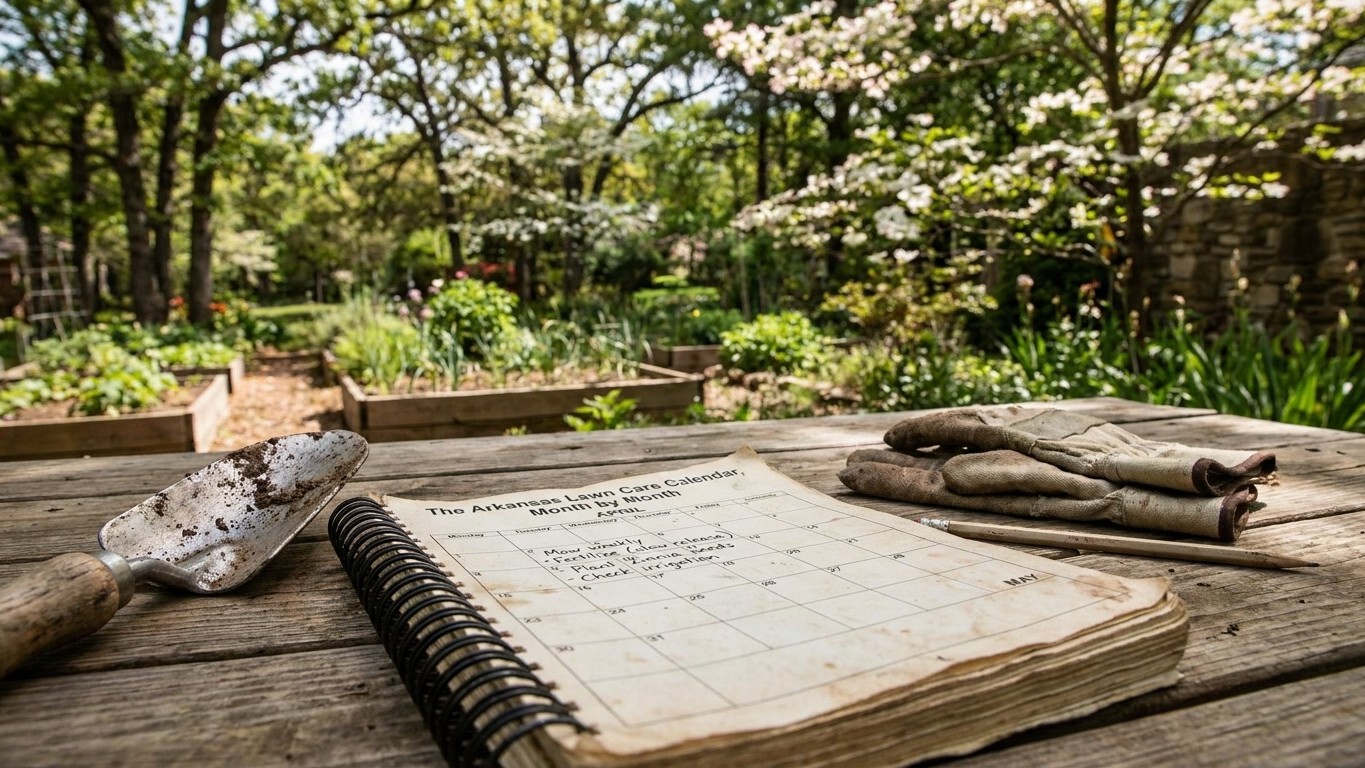

Arkansas falls in a warm lawn zone, based on the climate normals used to classify Little Rock, so the grasses that actually persist here are Bahiagrass, Bermudagrass, Carpetgrass, Centipedegrass, Seashore Paspalum, St. Augustinegrass and Zoysiagrass. A cool-season lawn like tall fescue thins out fast once Little Rock’s summer heat arrives. Before doing anything else this season, find out which of the seven warm-season species is already growing in your yard, because every date and rate below depends on that answer.
The short answer for Arkansas
The calendar for a warm-season Arkansas lawn runs from spring green-up through summer growth to a fall slowdown and full winter dormancy, and the grasses that make it through that cycle here are the seven warm-season species Clemson Cooperative Extension names in HGIC 1214. Bahiagrass, Bermudagrass, Carpetgrass, Centipedegrass, Seashore Paspalum, St. Augustinegrass and Zoysiagrass all tolerate the heat that a Little Rock summer brings. A cool-season lawn does not belong in that list for most of the state, and it fails in the same predictable way each time: it establishes fine in cool weather and then collapses once the heat and humidity of a Little Rock July settle in.
What the answer depends on
Which grass you actually have changes the whole schedule, because Clemson publishes a separate maintenance calendar for each one. Bermudagrass follows HGIC 1216, Zoysiagrass follows HGIC 1217, Centipedegrass follows HGIC 1215 and St. Augustinegrass follows HGIC 1218, and the mowing height, the nitrogen rate and the timing of each task differ across those four. If you have not settled on a species yet, The Best Grass Seed for Arkansas Lawns is worth reading first, since the seed choice has to come first. The answer also shifts with elevation and latitude. Little Rock’s frost dates are not the state’s frost dates, and a lawn in the Ozarks or the Delta runs on a different clock than the one below.
Working through the year

Clemson’s HGIC 1214 guide to selecting a lawn grass rates shade tolerance by species, and that single detail decides which calendar you should be following in the first place.
| Grass | Clemson maintenance calendar | Shade tolerance |
|---|---|---|
| Bermudagrass | HGIC 1216 | Low, needs full sun |
| Zoysiagrass | HGIC 1217 | Moderate |
| Centipedegrass | HGIC 1215 | Low to moderate |
| St. Augustinegrass | HGIC 1218 | Moderate to high |
Spring green-up
Warm-season turf breaks dormancy as soil warms, not on a fixed date. NWS Little Rock’s average last light frost at the 36F threshold falls on April 3, and green-up generally starts a few weeks behind that as soil temperature builds. Put a pre-emergent down before the lawn greens and before crabgrass germinates. The exact height and the first nitrogen rate depend on the grass you have, so check the calendar for that species, HGIC 1216, 1217, 1215 or 1218, once green-up is complete. Feeding a lawn that has not fully greened up just feeds the weeds coming up ahead of it.
Summer maintenance
Once growth is active, mowing frequency and irrigation both step up. Clemson’s species calendars set the mowing height range and the nitrogen rate in pounds per 1,000 square feet for each grass, and those figures differ enough by species that it is worth checking the specific calendar rather than working from memory. Never remove more than about a third of the blade height at one mowing in summer heat. Scalping a warm-season lawn during a hot, dry stretch opens it to disease and weeds faster than almost anything else you can do to it. Aeration, where a calendar calls for it, belongs in the growing season too, while the lawn can still heal from the plugs pulled.
Fall slowdown
Growth tapers as days shorten. NOAA’s 1991-2020 climate normals, using the 30 to 70 percent freeze-probability band at the Little Rock station, put the first fall freeze at the 32F threshold between November 7 and November 20, with light frost at 36F arriving earlier, around October 31 on average at NWS Little Rock. The last nitrogen application of the year should go down well ahead of that window, because nitrogen pushed into the lawn right before a freeze produces soft new growth the cold kills outright. Mowing height often steps down slightly in the weeks before dormancy, per the species calendar, to reduce the leaf mass the plant has to carry into winter.
Winter dormancy
Once temperatures drop through that November window, warm-season turf goes dormant and turns brown. That color change is not a dead lawn. It is the plant protecting its crown until spring green-up starts the cycle over. Mowing stops other than picking up leaves, and no nitrogen goes down again until next spring’s green-up is complete.
What changes across Arkansas
Every date above is anchored to Little Rock, the reference station behind the NOAA and NWS figures, and the rest of the state does not share one calendar with it.
Higher ground runs behind
The Ozark and Ouachita highlands in the northwest and west-central parts of the state sit at meaningfully higher elevation than the river valley around Little Rock, and higher ground cools faster in fall and warms slower in spring. A lawn on a ridge in Washington or Newton County can expect frost ahead of the Little Rock window and green-up behind it, even though no separate set of dates exists yet for those counties in the sources cited here. The far northern edge of the state, along the Missouri border, is also where the warm lawn zone gets thin. Higher, more northern ground can behave more like a transition zone, where a cool-season lawn becomes a workable option for part of the year instead of a losing bet, and that is worth a call to a local office before buying seed.
The Delta and the south run ahead
The Delta counties in the east and the lower stretches of the state toward the Louisiana line generally sit at lower elevation with milder winters than Little Rock, which can push green-up a little earlier and delay the first frost a little later. A lawn on the Delta floodplain should not assume the Little Rock frost window applies without checking a nearer station.
The mistakes this climate punishes
Three mistakes account for most of the warm-season lawns that limp through an Arkansas summer or die back hard in the fall.
Feeding nitrogen too late in the year
Putting down nitrogen in September or October, once growth has already started slowing, pushes soft new leaf tissue right when the plant should be hardening off. That new growth has no time to toughen before NOAA’s 32F freeze window arrives at Little Rock between November 7 and November 20, and it is usually the first tissue to blacken when the freeze hits. The damage shows up as dead patches the following spring, not in the fall when the mistake was actually made.
Seeding a cool-season lawn in the wrong months
Tall fescue and Kentucky bluegrass germinate and establish in cool, moist soil, not in the heat of a Little Rock May or June. Seeding either one in late spring produces a stand that looks fine for a few weeks and then collapses the first time summer heat and humidity settle in. If a cool-season lawn makes sense at all, and that is only realistic on the higher, cooler ground discussed above, the seeding window is fall, not spring.
Cutting too short in summer heat
Scalping a warm-season lawn, mowing well below its normal height, during a hot, dry stretch removes the leaf area the plant needs to shade its own crown and roots. The lawn rarely dies outright from one bad mow. It thins, opens bare soil to weed seed, and becomes far more vulnerable to the next dry spell. The damage from a single scalped mow in July is usually visible within two to three weeks, showing up as thinning rather than as an immediate brown patch.
Checking this against your county
Every figure here is tied to Little Rock, and a lawn thirty or sixty miles away can be running on a different clock. The University of Arkansas Division of Agriculture’s Cooperative Extension Service keeps county-level agents who can confirm local frost timing and which of the recommended grasses actually performs best on your soil. Before buying seed or sod, a call to the county office is worth the time. Until then, the general practices covered in Arkansas Lawn Care are the baseline to work from. A calendar built on one reference station is a starting point, not a guarantee.
Common questions
Should I overseed my Bermuda lawn with ryegrass for winter color?
You can, but it is a cosmetic step, not a required one, since a dormant brown lawn is not a dead one. Overseeding adds mowing and watering through winter and has to be phased out carefully in spring so the ryegrass does not compete with the Bermudagrass coming out of dormancy, so check Clemson’s Bermudagrass calendar, HGIC 1216, for how that transition is handled.
My lawn turned brown in July, not just in winter. Is it dead?
Probably not. Warm-season grasses go into drought dormancy during a hot, dry stretch the same way they go dormant after a fall frost, and it protects the crown rather than killing it. Tug on a few blades. If they resist and the base still looks intact rather than pulling free with rotted roots, the lawn is dormant, not dead, and it should recover once rain or irrigation returns.
Can I plant a cool-season lawn like fescue anywhere in Arkansas?
Only realistically on the higher, cooler ground in the Ozark and Ouachita highlands discussed above, and even there it demands more water and more disease management through summer than a warm-season lawn does. Across most of the state, including the Little Rock area, a cool-season lawn is fighting the climate rather than working with it.
Do I need to aerate every year?
Not automatically. Aeration is warranted when the lawn shows compaction or a heavy thatch layer, not on a fixed annual schedule. Clemson’s species calendars list it as a growing-season task to use when the lawn needs it, so check the calendar for your specific grass rather than aerating on autopilot every spring or fall.