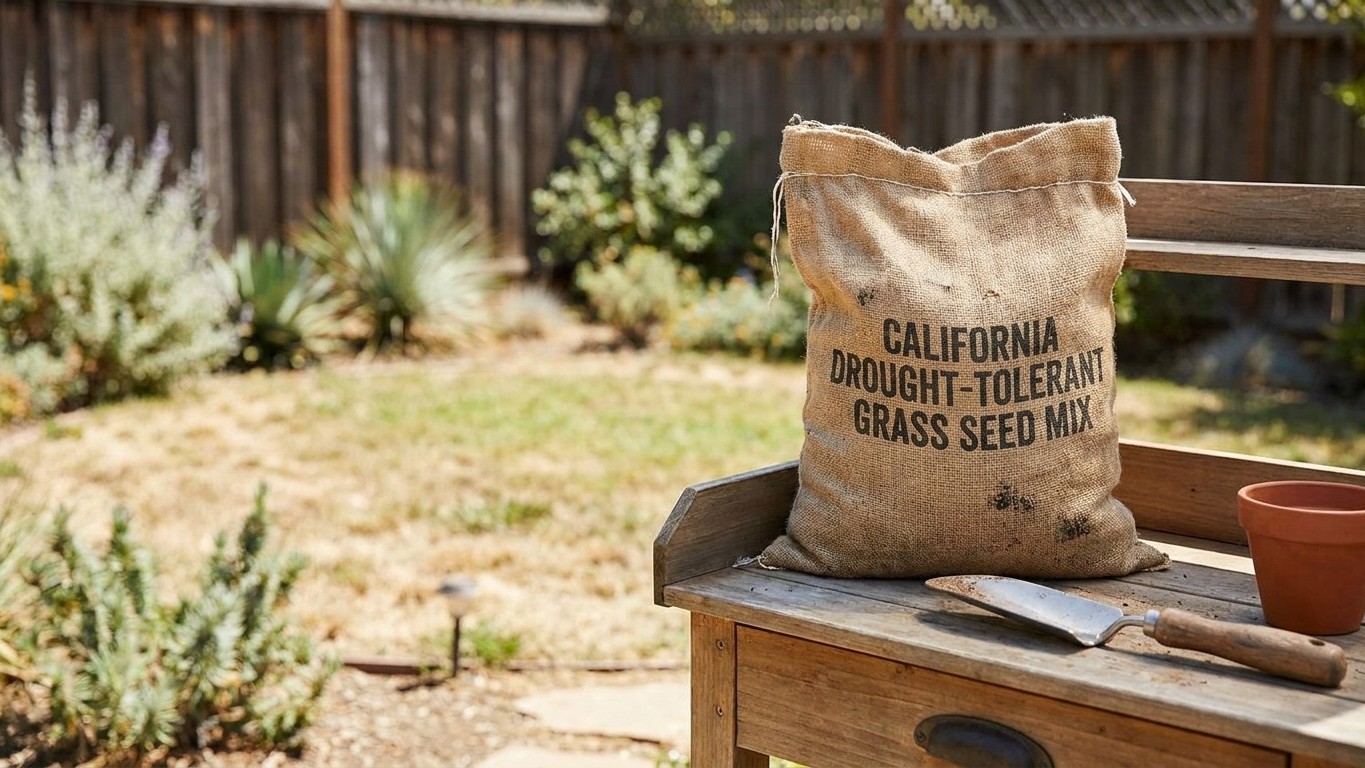

For most of California, the best grass seed is a warm-season species such as Bermudagrass or Zoysiagrass, because Los Angeles sits in a warm turf zone with a frost-free growing season, according to NOAA’s 1991-2020 climate normals, which record zero freezing days across thirty years at that station. Cool-season seed struggles here once summer heat sets in. Check your own elevation and distance from the coast before buying seed, since the Central Valley and the Sierra freeze even though the coastal basin does not.
The short answer for California
St. Augustinegrass has a reputation as the grass for shade and heat together, which makes it tempting for a California yard with a few stubborn dark corners. But it was bred for the humid Southeast, and here that same shade tolerance just means higher water bills, not a healthier lawn. Bermudagrass and Zoysiagrass, plainer and less fussy, are what actually carry most California lawns through the dry months. The real decision isn’t which grass performs best, it’s which one your irrigation can honestly sustain.
For most yards in the state, the practical shortlist narrows fast: Bermudagrass and Zoysiagrass are the two most commonly seeded warm-season grasses in California, because both tolerate long dry summers and take full sun without complaint. St. Augustinegrass and Centipedegrass can work in specific spots, more shade, less traffic, but were bred for the humid Southeast, and the state’s low humidity works against them in ways that matter for water bills more than survival.
The right answer depends on three things: how much direct sun the lawn gets, how much irrigation the household is willing or able to run, and how far the property sits from the coast. A lawn near the San Francisco fog belt behaves nothing like a lawn in the Central Valley or in the high country past the Sierra foothills, even though NOAA’s frost-free record for Los Angeles reflects none of those places. Match the species to the water budget first, then to the sun, because a grass that needs more water than the property can supply will look ragged no matter how well it was chosen for heat.
Working through the year

Ranking California’s realistic seed choices means weighing what each species asks for against what a California lawn actually needs: heat tolerance, low water use, and the ability to sit in full sun without cooking. The order that shows up most often on the ground runs like this.
Bermudagrass

Bermudagrass roots deep and spreads fast by stolons and rhizomes, which makes it the most drought-tolerant of the widely seeded options and the quickest to fill in bare patches. The cost is upkeep: it needs frequent mowing through the growing season and will creep into beds and walkways if left unedged. Clemson Cooperative Extension’s HGIC 1216 Bermudagrass Maintenance Calendar lays out the mowing height, nitrogen rate and irrigation schedule week by week, and is worth reading in full before buying seed, since the exact rates shift through the season.
Zoysiagrass

Zoysiagrass forms a denser, finer-textured turf than Bermudagrass and holds its color longer into cooler weather, but it grows more slowly, and a seeded Zoysia lawn can take a full season or more to fill in compared to sod or plugs. That slow establishment is the tradeoff: less mowing once mature, more patience up front, and more exposed soil for weeds to colonize while it fills in. Clemson’s HGIC 1217 Zoysiagrass Maintenance Calendar covers the mowing and feeding schedule for an established stand.
St. Augustinegrass

St. Augustinegrass tolerates more shade than Bermudagrass or Zoysiagrass, which matters under mature trees, but it was bred for the humid Gulf Coast and Southeast, and it is usually established from sod or plugs rather than seed because viable seed is not widely sold for the common cultivars. Clemson’s HGIC 1218 St. Augustinegrass Maintenance Calendar sets out its water and mowing needs for the pockets where it does establish.
Centipedegrass

Centipedegrass asks for the least fertilizer of any grass on this list, which appeals to anyone trying to keep a lawn on a tight water and feed budget. It is also the least tolerant of foot traffic and does poorly in the alkaline soils common across much of California, since it evolved for the acidic sandy soils of the Southeast coastal plain. Clemson’s HGIC 1215 Centipedegrass Maintenance Calendar is the reference for anyone testing it in a compatible pocket of soil.
| Species | Drought tolerance | Shade tolerance | Typically seeded or vegetative |
|---|---|---|---|
| Bermudagrass | High | Low | Seed |
| Zoysiagrass | Moderate to high | Moderate | Seed (slow) or plugs |
| St. Augustinegrass | Moderate | High | Sod or plugs |
| Centipedegrass | Low to moderate | Low to moderate | Seed or sod |
| Bahiagrass | High | Low | Seed |
| Carpetgrass | Low | Moderate | Seed |
| Seashore Paspalum | Moderate, salt-tolerant | Low to moderate | Sprigs or sod |
Bahiagrass, Carpetgrass and Seashore Paspalum round out Clemson’s warm-season list but see far less use on California lawns. Bahiagrass is coarse-textured and mainly grown for pasture and roadside cover, Carpetgrass needs consistently moist soil that runs against the state’s drought reality, and Seashore Paspalum is propagated almost entirely from sprigs or sod rather than seed, despite useful salt tolerance along the coast.
Whatever species goes down, the sowing window follows the temperature curve rather than a fixed calendar date, and The California Lawn Care Calendar, Month by Month lays out when that curve typically turns for a given region.
What changes across California
The frost-free record NOAA keeps for Los Angeles describes the coastal basin of Southern California, not the state as a whole. Move inland or uphill and the picture changes fast. The Central Valley, running from Redding down through Bakersfield, sees summer heat well past what the coastal station records, along with winter nights cold enough to bring real frost, something the Los Angeles record shows none of. A Bermudagrass lawn planted in the Central Valley will go dormant and brown in winter there in a way it barely does near the coast.
Move up in elevation and the growing season shortens further. The Sierra Nevada foothills and higher ground statewide see freezing winters that no warm-season grass on Clemson’s list is built to survive without going fully dormant for months, and at high enough elevation, cool-season grass becomes the more realistic choice even though it struggles through a California summer everywhere else.
The coastal fog belt around the San Francisco Bay Area runs the opposite way: cooler summers, marine-layer overcast for weeks at a time, and less heat stress on a lawn than either the Central Valley or the Los Angeles basin sees. A grass chosen for its heat tolerance is not solving the problem a shaded, foggy coastal lot actually has, which is closer to a shade and moisture question than a drought one.
None of this shows up in a single statewide number, because California crosses more climate zones than most countries. Treat any figure attributed to Los Angeles as a Southern California coastal figure only, and check conditions for the specific county before ordering seed.
The mistakes this climate punishes
Seeding a cool-season lawn, tall fescue or perennial ryegrass, in late spring is one of the most common mistakes on a California property, because the seed germinates fine in mild weather and then hits a summer heat stretch it was never bred to survive. The lawn doesn’t fail immediately. It thins through the hottest weeks and often looks like a watering problem when the real cause was choosing a species built for the wrong season months earlier.
Feeding at the wrong end of the season
Pushing nitrogen onto a warm-season lawn in early autumn is a second common error. Bermudagrass, Zoysiagrass, St. Augustinegrass and Centipedegrass all slow their growth as the days shorten, even where a hard freeze never arrives, and nitrogen applied on top of that slowdown feeds soft new growth that has no time to harden off before the grass goes semi-dormant. The damage shows up the following spring, not that fall, as patchy, weak green-up instead of the vigorous start the lawn should have.
Cutting too short in summer heat
Scalping a warm-season lawn during the hottest stretch of summer strips the leaf tissue the plant needs to shade its own root zone and slow water loss from the soil. The damage from scalping doesn’t announce itself right away. The lawn often looks fine for a week or two, then browns out in patches once the next dry spell hits, and it recovers far slower than a lawn that was simply mowed a notch higher through the same stretch.
Overwatering on a fixed schedule regardless of weather is the fourth mistake: running the same irrigation cycle in a cool, overcast week near the coast as in a hot inland week wastes water in one case and starves the lawn in the other. A lawn that has already been through California lawn care basics, soil prep, grading, a sensible seed choice, still needs its watering schedule adjusted to the week’s actual weather, not a fixed calendar setting.
Checking this against your county
Every figure above is anchored to Los Angeles, and California is too large and too varied for one station to speak for it. Before buying seed, check the current guidance for your own county through the University of California’s statewide extension network, part of the USDA’s land-grant extension system, at ucanr.edu. County advisors there can confirm whether a species handles local water restrictions, soil pH, and the real length of your frost season, none of which a statewide page can settle on its own.
If you’re setting up a full-year maintenance plan rather than a single seeding, county extension staff can also point to soil testing services and local water-district rules that affect how often a new lawn can be irrigated while it establishes.
Common questions
Can I grow a cool-season lawn like tall fescue in California?
Only in the cooler pockets, mainly higher elevations or the fog belt near the coast, where summer heat stays mild enough for it to hold on. Even there, it needs more frequent watering and a higher mowing height than a warm-season lawn, and it will still struggle through the hottest weeks of a dry summer.
Why does my Bermudagrass turn brown in winter if it never freezes here?
Warm-season grasses respond to shortening days and cooling soil temperatures, not just frost, and Bermudagrass will thin and brown as growth slows even without a freeze. It isn’t dead. It greens back up on its own once daylight and soil temperature rise again in spring.
Is seed cheaper than sod for a California lawn?
Seed usually costs less upfront, but the tradeoff is time and exposed soil. A seeded Zoysiagrass lawn can take a full season to fill in, and species like St. Augustinegrass and Seashore Paspalum are rarely sold as seed at all, which pushes those choices toward sod or plugs regardless of budget.
How do I know if my property is actually in a frost-free area?
Don’t assume it from a statewide label. The Los Angeles figures in this article are frost-free, but the Central Valley and the Sierra foothills freeze most winters, so check the nearest weather station or ask your county extension office before assuming your yard behaves like the coast.