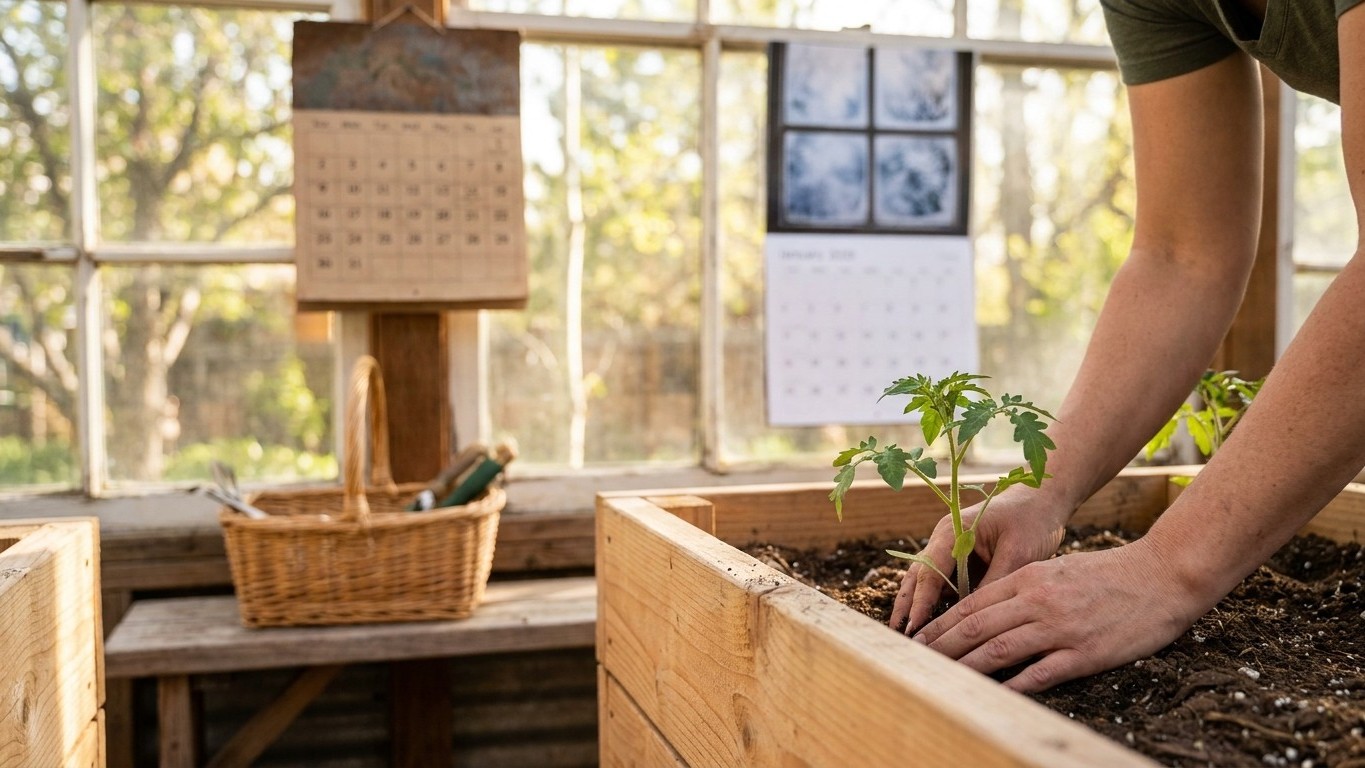

Colorado tomato growers set transplants out only after the last spring freeze passes, and NOAA’s 1991-2020 climate normals put that date at Denver’s reference station (USW00003017) somewhere between May 1 and May 11. Treat that whole span as live frost risk rather than picking a single day inside it. The one thing to do now: pull your seed packet’s days-to-maturity number and start counting backward from that window instead of from the calendar.
What this comes down to in Colorado

A transplant set out on May 1 looks fine for a week, then a frost nobody warned about drops in on the ninth and the stem blackens overnight. The opposite mistake costs just as much: a long-season variety put in on schedule that’s still holding green fruit when October’s freeze finally arrives. Both failures trace back to the same error, treating the frost window as a single date instead of a range with two edges, one you count forward from and one you count back from.
The same normals put Denver’s first fall freeze between September 30 and October 12. That’s the other wall the season runs into, and it decides whether a longer-season tomato has time to finish at all. A cultivar’s days-to-maturity figure has to fit inside the gap between the two ranges, spring close and fall open, with room to spare. Both ends of the range carry equal weight in picking a planting date. It’s easy to fixate on the spring frost and forget that a slow, cool August costs a crop just as surely from the other direction.
Which cultivars actually fit that gap, and by how much margin, has its own answer at Tomato Varieties That Ripen in Time in Colorado. What matters here is the arithmetic that turns the frost window into a transplant date you can act on.
Working it out for your own garden
Counting from the frost window
The method survives any year, warm or cold, because it works from ranges rather than points. Start with NOAA’s Denver window for the last spring freeze, May 1 to May 11. Growers here generally wait an extra couple of weeks past that date before setting an unprotected transplant outside, since soil temperature lags air temperature and a young tomato planted into cold ground stalls instead of growing. That pushes the actual transplant date to roughly mid-May through late May for most seasons, which is why the same range attaches to every cultivar below rather than a single day.
From the transplant date, add the days-to-maturity number printed on the seed packet. That figure is counted from the day a seedling goes into the ground, not from seed, and catalog numbers typically run a week or two off in either direction depending on how hot the summer actually gets. Subtracting or adding weeks to a range gives another range, never a single date, so the arithmetic should stay in ranges all the way through.
Two cultivars, worked through
Anything that needs more than about 85 days from transplant starts running thin on margin in a Denver-length season, even before a slow year is factored in. The table below lays out how several catalog cultivars land inside that arithmetic.
| Cultivar | Days from transplant | Calculated first ripe | Margin before fall freeze window |
|---|---|---|---|
| Sakura | 55 | mid July | 73 days |
| Sun Gold | 57 | late July | 71 days |
| Jasper | 60 | late July | 68 days |
| Amalfi | 68 | early August | 60 days |
| Cherokee Purple | 72 | early August | 56 days |
| San Marzano II | 78 | mid August | 50 days |
| Amish Paste | 85 | mid August | 43 days |
Take Sun Gold end to end. Transplant lands mid-May to late May, add 57 days from the catalog, and first ripe fruit falls in late July, leaving 71 days of cushion before Denver’s earliest fall freeze date of September 30. That’s about as comfortable as this climate gets. Amish Paste, at 85 days, still finishes, with first fruit around mid-August and 43 days before the freeze window opens, but that margin shrinks fast in a cool or wet year that slows ripening. Push past that toward a hypothetical 100-day heirloom paste tomato and first ripe fruit would land in September, close enough to Denver’s September 30 to October 12 freeze window that a slow August could cost most of the harvest. That’s the practical edge this climate draws for long-season fruit.
What changes across the state
Elevation does most of the work
Denver’s frost window is a plains figure, not a state figure. The USDA Plant Hardiness Zone Map, built from the 1991-2020 normals, spans zone 3b to zone 7b across Colorado, and that spread is really a stand-in for elevation. Every thousand feet of elevation gain pushes both frost dates in the wrong direction, later in spring and earlier in fall. A mountain town can sit in a shorter growing season entirely, with real frost risk even in July in the highest valleys, while a lower spot can run warmer and longer than Denver’s plains window.
Local terrain and the western slope
Beyond elevation, terrain does its own work. A valley bottom that pools cold air overnight frosts before a slope a few hundred feet upslope, even at the same elevation and latitude. A south-facing yard against a house wall often runs milder than an open, wind-exposed lot nearby, because the structure holds heat and blocks the coldest air from settling. None of this shows up in a single reference-station figure, which is why Denver’s May 1 to May 11 window has to be treated as a starting point rather than a rule for the whole state.
The western slope, generally lower and drier than the Front Range, is often milder in spring but can still catch late cold snaps plains gardeners don’t see coming. Rather than guess at a number for your own valley or hillside, use the NOAA figure above as the plains baseline and adjust it based on how your own site has behaved in past years, which local growers usually track better than any published range.
The mistakes this state punishes

Cold soil, not just cold air
The single most common mistake here is trusting a warm stretch in April instead of the calendar. Front Range weather can swing sharply in a week, and a run of warm days in late April does not mean the frost risk covered by NOAA’s May 1 to May 11 window has passed. Tomatoes set out during that kind of warm snap often survive the air temperature but stall for weeks afterward because the soil underneath is still cold, and a stalled transplant rarely catches up to one planted correctly a week or two later.
Long-season varieties without margin
The second mistake is choosing a variety for flavor or size without checking whether its days-to-maturity actually fits the season. An 85-day paste tomato like Amish Paste still works in a typical Denver-area year, but pushing further, toward a 90 or 100-day heirloom, leaves almost no cushion against a late spring or an early fall freeze. Pick the days-to-maturity number before you pick the flavor, and treat anything past about 85 days as a plant for a warm year, not a guaranteed one.
Missing a pest’s window
The third mistake is missing a pest’s window because attention stays fixed on frost dates. Several of the insects and diseases that hit Colorado tomatoes arrive on their own schedule regardless of when a transplant went in, and by the time damage is obvious the best treatment window has often already passed. Tomato Pests in Colorado: Which Ones Actually Show Up Here lays out what to watch for and when, and that timing matters just as much as getting the planting date right.
Checking this against your county
Every figure above comes from one station near Denver, and Colorado’s counties spread across plains, foothills, high mountain valleys and the western slope, each running its own version of these dates. Before committing to a planting date, check it against your own county’s extension office, which tracks local conditions far more closely than a single statewide reference point can. Colorado State University Extension maintains a directory of county offices along with its own tomato-specific guidance, and that’s the source to cross-check your planting dates against. Treat the Denver window as the starting arithmetic, not the final answer, and let your county office adjust it for where you actually garden.
Common questions
Can I plant tomatoes earlier if I use a wall of water or frost cloth?
A season-extending cover can push the transplant date earlier than the bare frost window allows, but it protects against air-temperature frost, not against cold soil, so growth often stalls under cover until the ground warms on its own. Treat covers as insurance against a repeat freeze after transplanting, not as a way to skip weeks off the NOAA window entirely.
What if my seed packet just says days to maturity with no start point?
Almost every tomato seed packet counts days to maturity from transplant, not from seed, unless it specifically says direct sow. Tomatoes are started indoors and transplanted almost everywhere in Colorado, so treat the printed number as days from the day the seedling goes into the ground.
Is it too late to plant tomatoes if I missed the mid-May window?
A short-season cultivar like Sakura at 55 days or Sun Gold at 57 days still has room to finish even set out several weeks into June, since Denver’s fall freeze window doesn’t open until September 30 at the earliest under NOAA’s normals. A long-season paste tomato like Amish Paste has much less room to absorb a late start.
Does starting seeds indoors earlier make the tomatoes ripen sooner outside?
Only up to a point. A seedling held indoors too long before soil and air are actually ready gets root-bound and stressed, and a stressed transplant often ripens later than a younger, healthier one planted at the right time. Match the indoor sowing date to the transplant window rather than pushing it earlier for its own sake.
The Moon calendar is a separate, older custom: see when to plant tomatoes by the moon, written as tradition rather than fact.