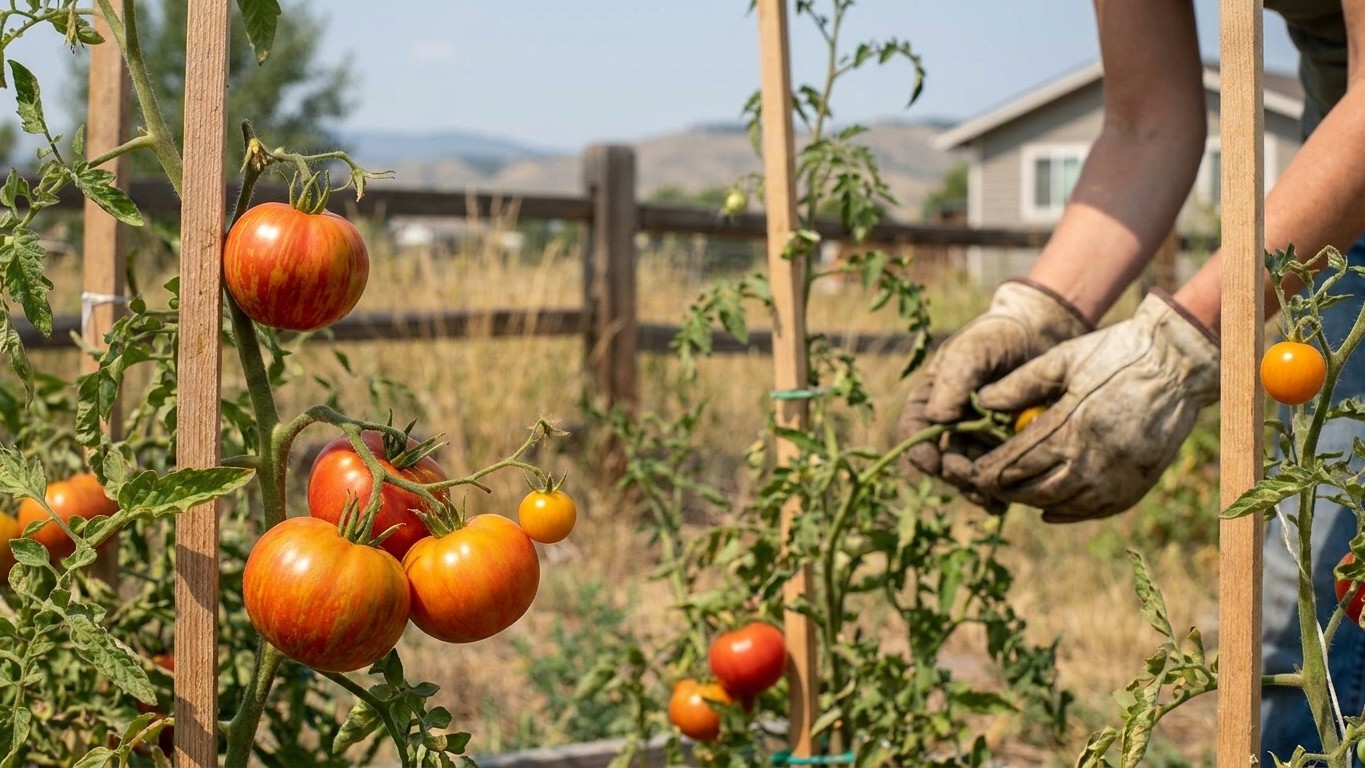

Days-to-maturity is the number printed on every seed packet, and it’s the number that quietly lies to Colorado gardeners. A tomato listed at 60 days doesn’t count from your last frost, or from New Year’s — it counts from transplant, mid to late May here, which pushes ripening into a fall freeze window that arrives faster than the packet implies. What matters isn’t that figure alone but the margin left over once frost is factored in, and that margin varies more between varieties than the days-to-maturity numbers ever suggest.
What this comes down to in Colorado

Every cultivar listed below is set out mid May to late May, once the soil has had time to warm past the tail end of NOAA’s frost window at Denver, and the “first ripe” and “margin” figures are calculated from that transplant date forward to the earliest and latest edges of the fall freeze window. The margin is what actually matters, not the days-to-maturity number by itself, because a short margin means a single cold snap or a wet, cloudy August can push ripening past the point where it does you any good.
| Variety | Days from transplant | First ripe | Margin before fall freeze |
|---|---|---|---|
| Sakura | 55 | mid July | 73 days |
| Sun Gold | 57 | late July | 71 days |
| Supersweet 100 | 60 | late July | 68 days |
| Juliet | 60 | late July | 68 days |
| Jasper | 60 | late July | 68 days |
| Amalfi | 68 | early August | 60 days |
| Cherokee Purple | 72 | early August | 56 days |
| Big Beef Plus | 72 | early August | 56 days |
| Tiren | 75 | early August | 53 days |
| Granadero | 75 | early August | 53 days |
| San Marzano II | 78 | mid August | 50 days |
| Celebrity Plus | 78 | mid August | 50 days |
| Brandywine | 78 | mid August | 50 days |
| Amish Paste | 85 | mid August | 43 days |
Sakura
Sakura is the fastest cultivar on this list at about 55 days from transplant. Set out mid May to late May, it can be handing you cherry tomatoes by mid July, with roughly 73 days of margin before frost. It carries intermediate resistance to nematodes and high resistance to tomato mosaic virus and two races of fusarium wilt, which matters if you’re replanting a bed that has grown tomatoes before.
Sun Gold
Sun Gold needs about 57 days from transplant and starts producing late July with about 71 days of margin left. It’s an indeterminate vine that keeps setting fruit until frost, with high resistance to tobacco mosaic virus and fusarium wilt race 1. It’s grown for fresh eating off the vine, not for sauce or canning.
Supersweet 100
Supersweet 100 comes in at 60 days from transplant, ripening late July with 68 days of margin. It resists verticillium wilt and fusarium wilt race 1 at a high level, and the indeterminate vine produces long clusters of small fruit right through the season if you keep it staked.
Juliet
Juliet also needs about 60 days from transplant, first fruit late July, 68 days of margin. It’s an elongated grape tomato with intermediate resistance to both late blight and early blight, useful in a wet stretch, and it holds up well for roasting or halving into sauce.
Jasper
Jasper matches Juliet at 60 days and the same late-July start with 68 days of margin. Its standout trait is high resistance to late blight, the one disease that can move fast through a garden in a cool, damp August, with intermediate resistance to early blight as well.
Amalfi
Amalfi runs 68 days from transplant, first ripe early August, with 60 days of margin. It’s a determinate paste tomato, so the plant sets its fruit over a shorter window rather than trickling all season, which suits anyone canning sauce in one or two batches. It carries intermediate resistance to nematodes, late blight and early blight.
Cherokee Purple
Cherokee Purple takes 72 days from transplant and ripens early August with 56 days of margin, a heirloom slicer with no listed disease resistance, so it depends more on crop rotation and airflow than genetics to stay healthy. It’s grown for flavor and size, not for toughness.
Big Beef Plus
Big Beef Plus also needs 72 days, ripening early August with the same 56 days of margin as Cherokee Purple, but it carries intermediate resistance to nematodes and high resistance to gray leaf spot and tomato mosaic virus. It’s the steadier bet of the two beefsteaks if disease pressure worries you more than heirloom flavor.
Tiren
Tiren needs 75 days from transplant, first fruit early August, 53 days of margin. It’s a mid-size slicer with high resistance to verticillium wilt and fusarium wilt race 1, plus high resistance to tomato mosaic virus, a reasonable middle-ground choice for a garden that has had disease trouble before.
Granadero
Granadero matches Tiren at 75 days and the same early-August start with 53 days of margin. It’s a roma-type paste tomato with intermediate resistance to nematodes and high resistance to verticillium wilt and tomato mosaic virus, a solid sauce tomato for a garden with nematode history.
San Marzano II
San Marzano II needs 78 days from transplant, ripening mid August with 50 days of margin, right at the point where the season starts to feel tight. It’s the classic long Italian paste tomato, grown for canning, with no listed disease resistance, so give it good spacing and don’t crowd it with other nightshades.
Celebrity Plus
Celebrity Plus also runs 78 days, mid-August ripening, 50 days of margin, but it’s determinate and carries intermediate resistance to nematodes plus high resistance to gray leaf spot and tomato mosaic virus. Being determinate, it sets most of its crop in a shorter window, which works in its favor once the season is already tight.
Brandywine
Brandywine ties the other 78-day varieties for timing, mid August with 50 days of margin, but it’s an heirloom with no disease resistance bred in. It’s grown for its large size and rich flavor rather than reliability, and it’s one of the varieties where a cool, cloudy August will be felt most.
Amish Paste
Amish Paste is the longest-season variety on this list at 85 days from transplant, first ripe mid August, and only 43 days of margin before the fall freeze window opens. It’s a big oxheart-shaped paste tomato grown for canning, and it’s the one to treat as optional rather than a given if your garden runs on the shorter end of the frost window, or the one to give a warm south-facing wall to if you grow it at all.
Working it out for your own garden
The mid-May-to-late-May transplant window used above isn’t arbitrary. NOAA’s 1991-2020 normals put the last spring freeze at Denver somewhere between May 1 and May 11, and tomatoes go into the ground only once that risk has passed and the soil has had time to warm, which in practice pushes transplanting into the back half of that stretch or a bit later. If you want the full method for pinning that down for a colder or warmer spot than Denver, the Tomato Planting Dates in Colorado: Counting Back From Your Frost Window page walks through it in more detail than fits here.
Working a real example
Take Big Beef Plus, 72 days from transplant. Set it out mid May to late May and count forward 72 days: that lands you at first ripe fruit in early August, which matches the catalogue figure once you allow the usual week or two of variation that comes with weather in any given year. From early August to NOAA’s fall freeze window of September 30 to October 12 is roughly eight weeks, which is where the “56 days of margin” figure above comes from. That margin is what lets the plant keep producing a second and third flush of fruit after the first one ripens.
Now run the same arithmetic on a hypothetical 95-day paste tomato, longer than anything on this list. Set out at the same mid-to-late May window, it wouldn’t set its first ripe fruit until early September at the earliest. That leaves under a month before Denver’s fall freeze window opens, not enough time for a second flush, and in a cooler-than-normal year it risks not finishing its first fruit at all. That’s the line a 78 to 85 day variety is already brushing up against, and it’s why the longest cultivars on this list carry the smallest margins in the table above.
What changes across the state
Every figure above is measured at or near Denver, on the plains at 5,280 feet, and the USDA’s hardiness map puts the state anywhere from zone 3b to zone 7b depending on where you are, which tells you how much this changes. Elevation is the biggest single factor. Mountain towns a few thousand feet higher than Denver run a much shorter frost-free season, and some can see frost even in July, which knocks the longer varieties on this list (San Marzano II, Amish Paste, Brandywine) out of contention entirely unless you’re growing under cover or against a heat-holding wall.
The Western Slope runs on a different pattern again, with its own frost timing shaped by the Colorado River valley rather than the plains weather that drives Denver’s numbers. The Front Range south of Denver and the areas east toward the Kansas line will generally run closer to Denver’s window than the mountain corridor does, but “closer” is not “the same,” and a few days either way in the frost window can shift which of the 78-day varieties in the table above are worth the risk.
None of this changes the arithmetic, only the two numbers you plug into it. Once you know your own area’s frost window from a source that covers it, run the same days-to-maturity math shown above against it rather than borrowing Denver’s dates outright.
The mistakes this state punishes

The most common one is planting into cold soil after a warm spell in April fools you into thinking spring has arrived early. A few 70-degree days on the plains don’t mean the frost risk is over, and NOAA’s freeze window at Denver runs into May for a reason. A transplant set out too early doesn’t die outright most of the time, it just sits and sulks, and that lost week or two eats directly into the margin a variety like Celebrity Plus or Brandywine was counting on.
The second is choosing a long-season heirloom because it sounds appealing on the seed rack without checking its days-to-maturity against your own frost window first. Amish Paste and Brandywine are the two on this list with the least room for error, and they’re also two of the most tempting names for anyone who’s grown tomatoes before and wants a bigger, richer fruit. Save them for a year when the season has been kind, or give them the warmest spot in the yard.
The third is skipping the basic groundwork, spacing, staking, watering consistency, all of which are covered on the main growing tomatoes in Colorado page. A short-season cherry tomato like Sakura or Sun Gold will still underperform if it’s crowded or under-watered, no matter how much margin the calendar gives it.
Checking this against your county
Denver’s frost window is a starting point, not a guarantee for wherever you garden. Confirm your own county’s frost dates with your local Colorado State University Extension office before locking in a planting date, since the statewide directory runs through extension.colostate.edu. If your garden has a history of disease pressure, the Tomato Pests in Colorado: Which Ones Actually Show Up Here page is worth reading alongside this one, since several of the resistance codes named above only matter if that particular pest or pathogen is active in your area.
Common questions
Can I still grow Amish Paste or Brandywine if I’m not in Denver?
It depends on how your local frost window compares to Denver’s. If your area frosts later in fall or earlier in spring than the NOAA window used here, those two varieties have even less margin than the numbers above show, and a warm wall or row cover becomes worth the effort rather than optional.
Why do the same days-to-maturity numbers give different first-ripe dates for different varieties?
They don’t, the transplant date is the same for every variety on this list, mid May to late May, so the spread in first-ripe dates comes entirely from the catalogue days-to-maturity figure itself. A 55-day variety and an 85-day variety planted the same week will ripen a month apart.
Do the disease-resistance codes matter if I’ve never had disease problems?
They matter less in a brand-new bed, but tomato diseases build up in soil over years of replanting the same family in the same spot. A variety with high resistance to verticillium or fusarium wilt, like Sun Gold or Tiren, gives you insurance for a year when soil-borne disease does show up, even if this season looks clean.
Is it worth starting a long-season variety indoors earlier to make up the margin?
Starting seed indoors earlier helps only if you can also move the transplant date up safely, and that’s governed by the frost window, not by how early you started the seed. A tomato held too long in a small pot before the soil and air are ready often stalls once transplanted, which can erase the head start entirely.