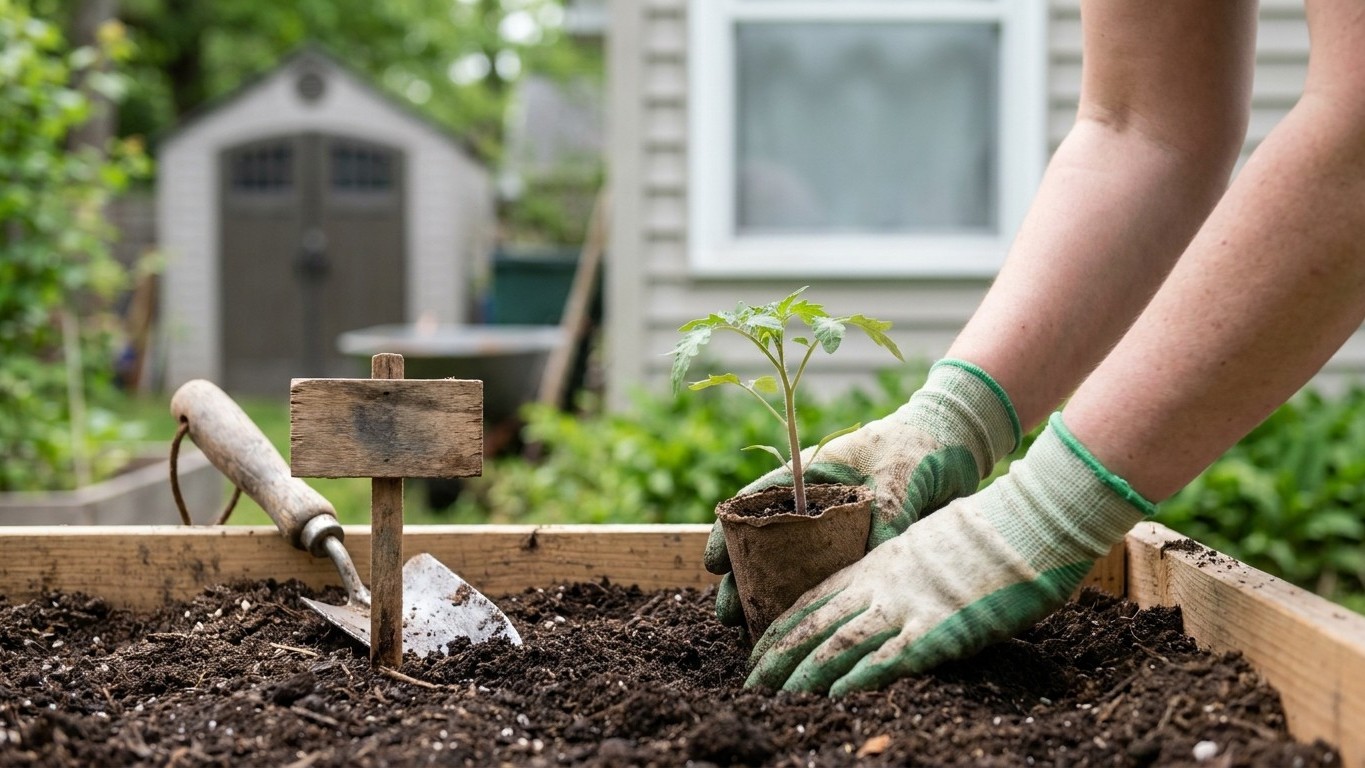

Wilmington’s last frost, not some national rule of thumb, is what actually sets your tomato date here. Most planting charts assume one clean line — after the last frost, go. Delaware doesn’t hand you a line; it hands you a range, April 3 to 14, and a state split across zones 7a to 8a where coastal ground warms weeks ahead of inland fields. That gap is the whole story: mid to late April works near Wilmington, later if you’re not.
What this comes down to in Delaware

Your safe-to-transplant window for tomatoes in Delaware runs from mid April to late April, calculated from the last spring frost at Wilmington, which NOAA’s 1991-2020 climate normals put at April 3 to April 14. Tomatoes are killed outright by frost, so the transplant date has to fall after that window closes, with room for soil to warm and for a stray late cold snap to pass. The reference point is Wilmington, not the state: gardens further inland or on higher ground see frost linger later into spring and arrive earlier in fall.
USDA’s Plant Hardiness Zone Map places Delaware across zones 7a to 8a, a range wide enough that a gardener near the coast and one well inland are working with different growing seasons even though they share a state line. The zone number describes winter minimum temperatures, not frost dates, so use it to judge whether a perennial survives winter, not to time a tomato transplant.
On the fall end, NOAA’s 1991-2020 normals put Wilmington’s first fall frost at October 26 to November 7. That gives a growing season, bookended by two ranges rather than two dates, of roughly six and a half months at the reference station. Every cultivar’s days-to-maturity figure has to fit inside that stretch, counted from the transplant date rather than from seed. For a rundown of which tomatoes actually make that cut here, check the arithmetic in Tomato Varieties That Ripen in Time in Delaware before you commit a bed to a slow-maturing cultivar.
Working it out for your own garden
If you’ve already read the basics in growing tomatoes in Delaware, this section turns those basics into an actual date for your own calendar. The method outlasts any single date printed here: take the last spring frost range for your area, add the time your soil needs to warm and settle, and that gives your transplant window. Then take the cultivar’s days-to-maturity figure, printed on the seed packet and counted from the transplant date, and add it to the transplant window to find your first-harvest range. Finally check that range, plus the rest of the harvest period, against the first fall frost range for your area. If the two don’t overlap with room to spare, the variety doesn’t finish reliably where you garden.
Running the numbers on two cultivars
Take Sun Gold, a 57-day indeterminate cherry tomato. Transplanted in the mid April to late April window that Delaware’s frost dates allow, it should set its first ripe fruit in late June. Counting forward to Wilmington’s first fall frost, October 26 to November 7 per NOAA’s normals, leaves roughly 124 days of margin, plenty of room for a long cherry-tomato harvest with weeks to spare even in a year that turns cold early.
Now take Amish Paste, an 85-day indeterminate paste tomato, the slowest cultivar worth counting here. The same transplant window puts its first ripe fruit in late July. That still leaves about 96 days of margin before the earliest fall frost date at Wilmington, so it clears the season with room to spare. The margin shrinks as days-to-maturity climbs, though, and a cultivar needing much more than 85 days from transplant, or a garden that sees frost arrive at the early end of the range, starts to cut that cushion thin.
| Cultivar | Days from transplant | Transplant window | First ripe | Margin before frost |
|---|---|---|---|---|
| Sun Gold | 57 | mid April to late April | late June | 124 days |
| Cherokee Purple | 72 | mid April to late April | early July | 109 days |
| Amish Paste | 85 | mid April to late April | late July | 96 days |
Seed started indoors needs its own countdown too. Most tomato seed is started roughly six to eight weeks before the transplant date, so for a mid April to late April transplant, indoor sowing falls in late February to early March. That’s a rule of thumb from the seed packet, not a Delaware-specific figure, so check the packet for the cultivar you’ve actually got.
What changes across the state
Wilmington’s frost dates sit at the northern end of Delaware, near where New Castle County rises out of the coastal plain toward the Piedmont. Move south into Kent and Sussex counties and the land flattens and drops closer to sea level, with the Delaware Bay and the Atlantic close enough to moderate temperature swings. Large bodies of water hold heat into fall and release it slowly, so coastal and near-bay gardens often see their first fall frost later than the Wilmington figure suggests, while spring warm-up can lag behind inland spots for the same reason.
Inland, cold air behaves differently. It’s dense and sinks, so low-lying fields and valley bottoms collect it on still nights and frost there even when the forecast for the wider region reads several degrees warmer. A garden in a hollow or at the bottom of a slope should expect frost dates on the harsher side of any regional range, both later in spring and earlier in fall.
Urban heat matters too. Wilmington’s weather station sits near buildings, pavement and other heat-retaining surfaces that keep the immediate area a degree or two warmer overnight than the surrounding countryside. That’s part of why the NOAA figures for Wilmington read as a best case for the rest of the state rather than a typical one: a rural garden twenty miles out, with none of that stored heat, commonly sees its last spring frost run later and its first fall frost run earlier than the airport station records, sometimes by a week or more.
The mistakes this state punishes

The most common mistake is trusting a warm stretch in late March or early April instead of the actual frost window. Delaware regularly throws a run of 70-degree days weeks before the last frost clears, and gardeners who plant into that warmth risk losing the whole flat when a cold night follows. Wait for the frost window to close, not for warm weather to arrive: the two don’t move together.
The second mistake is picking a variety on flavor or size alone without checking how it lines up against the growing season. A cultivar with a very long days-to-maturity figure eats into the cushion between first ripe fruit and the first fall frost, and a wet, cool spring that delays transplanting by even a week or two can turn a comfortable margin into a tight one. Run the arithmetic for any cultivar you’re considering against Wilmington’s frost dates before committing a whole bed to it.
The third is ignoring the pest calendar and treating every problem as a disease or a nutrient issue. Delaware’s tomato-growing season brings specific pests at fairly predictable points, and misdiagnosing damage wastes time a fast-moving pest doesn’t give back. Tomato Pests in Delaware: Which Ones Actually Show Up Here covers what to watch for and when.
The fourth is skipping hardening off. A transplant grown indoors or bought from a greenhouse needs several days outside in filtered light and rising exposure before it goes into open ground, even after the frost window has passed. Skipping that step in Delaware’s variable spring wind and sun often sets plants back as badly as a light frost would.
Checking this against your county
Every figure above comes from one weather station near Wilmington, and it’s a starting point, not a promise for wherever you actually garden. Call or check the website of your county’s extension office for observations closer to home, and lean on the University of Delaware Cooperative Extension for guidance beyond what a single frost record can tell you: the extension service’s site lists office contacts by county.
If you’ve gardened the same plot for a few seasons, your own notes on when frost actually hit beat any station average. Local, repeated observation outranks a regional normal every time the two disagree.
Common questions
Can I get away with planting tomatoes in Delaware in March?
Almost certainly not outdoors without protection. NOAA’s normals put Wilmington’s last spring frost as late as April 14 in some years, and a March transplant sits well inside that risk window. Cold-hardy crops tolerate March in Delaware. Tomatoes don’t.
What happens if I miss the mid to late April window entirely?
You can still transplant into May and get a full crop from most cultivars on the list here, since even the slowest ones carry close to 100 days of margin before the first fall frost at Wilmington. You’ll just push first ripe fruit later into summer, and a very late transplant paired with a very long-season cultivar is where that margin starts to matter.
Do I count days-to-maturity from when I sow the seed or when I set out the plant?
From the transplant date, not the seed. Catalog figures for tomatoes assume you’re starting the clock the day the plant goes into the ground outdoors, not the day you sowed it indoors weeks earlier.
Can row cover or a wall-o-water let me plant earlier than the frost window?
Some season-extension tools buy a few degrees of protection on a light frost night, but they don’t make a hard freeze safe for a tomato transplant. Treat any early planting under cover as a gamble against Wilmington’s frost probabilities, not a way around them, and keep the cover ready to close up fast if temperatures drop.
Some gardeners also time this by the Moon: when to plant tomatoes by the moon, as almanac tradition rather than fact.