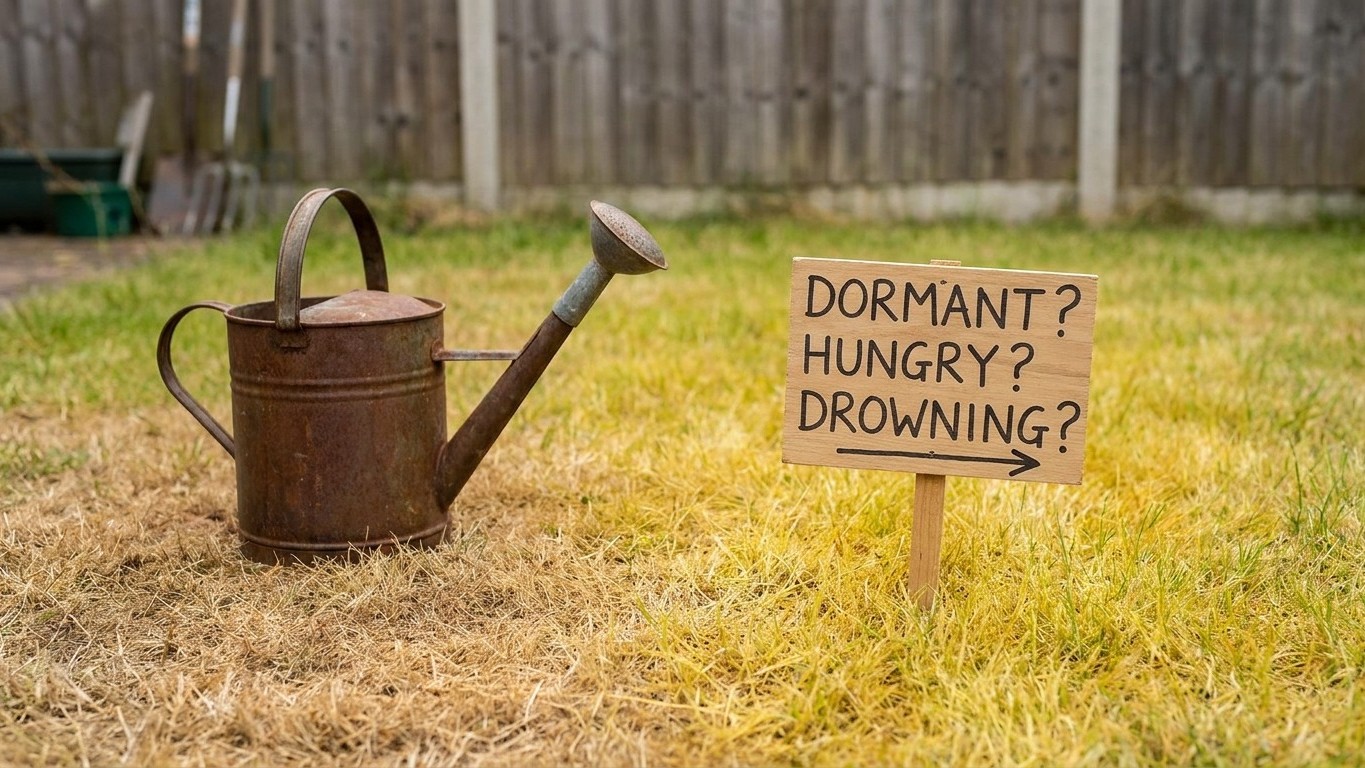

A yellow lawn is almost always one of three things: it is hungry, it is drowning, or it has simply gone dormant for the season and is not dead at all. The pattern on the ground tells you which. Before doing anything else, pull a handful of the yellow grass and check whether the roots hold or lift away in your hand, since that single test separates a feeding or watering problem from something living underground.
What you are looking at

Start with the shape of the yellow area, because the shape is usually the diagnosis before you touch a single blade. Nitrogen hunger tends to show up as a uniform pale yellow-green wash across the whole lawn or across one whole zone, often starting at the oldest leaf blades and creeping upward. There is no sharp edge to it. It fades into green gradually, the way a bruise fades, rather than stopping at a line.
Drowning looks different. It shows up in low spots, compacted paths, or areas next to a downspout where water actually collects, and the edges are often irregular but distinct, following the contour of the ground rather than a lawn zone. The grass there may feel soft or spongy underfoot, and the yellow often shades toward a darker, almost olive tone before it browns off, rather than the bright pale yellow of a nitrogen shortage.
Dormancy has its own signature
Dormancy in warm-season lawns, bermudagrass, zoysiagrass, centipedegrass and St. Augustinegrass among them, turns the entire lawn a uniform straw-brown, evenly, all at once, with no patches at all. That evenness is the tell. A lawn going dormant does not skip some areas and hit others the way a drainage problem or a pest does. It happens everywhere at the same time, because the whole plant is shutting down top growth in response to the season, not reacting to a local condition in the soil.
A perfect circle of yellow, by contrast, usually points to something localized and man-made: a buried object, a fuel spill, a dog’s favorite spot. A straight line almost always means a mower, an edger, or a herbicide sprayer passed along that exact path. Keep those two shapes in mind, because neither one is what this page is about, but both get mistaken for it constantly.
What it is not
The three real look-alikes worth ruling out are grub damage, dog urine spots, and a fungal disease. Each has a tell that takes less time to check than it took to read this sentence.
- Grub damage: the turf lifts like a loose carpet when you tug it, because the roots have been eaten away underneath.
- Dog urine spots: a small dead center ringed by a border of unusually dark, lush green, the nitrogen overload effect around the edge of the burn.
- Fungal disease: patches with a distinct ring or smoke-colored margin, often appearing after a stretch of humid, warm weather rather than after a dry spell.
If the roots hold firm when you pull on the grass, grubs are not the cause, and you can stop looking underground. If there is no dark green ring at the edge, it is not a urine spot. If the weather has been dry rather than humid, a fungal disease becomes far less likely, since most turf fungi need sustained moisture to establish. That leaves the three real candidates: too little nitrogen, too much water sitting in the root zone, or the grass doing exactly what it is supposed to do for the season. For a fuller rundown of the pest and disease look-alikes and how to rule each one out, A Lawn That Will Not Grow: Working Through the Four Causes walks through them in more depth than fits here.
What actually causes it
Cool-season grasses, fine fescue, Kentucky bluegrass, perennial ryegrass, rough bluegrass and tall fescue among them, yellow for a different reason than warm-season grasses do, and at a different time of year, so it matters which group you are looking at before you assume a cause.
Hunger, in cool-season lawns
Nitrogen moves through the plant to wherever new growth is happening, and when supply runs short the plant pulls it back out of the oldest leaves first, which is why the lower, older blades yellow before the new growth at the tip does. Clemson Cooperative Extension’s HGIC 1201, Fertilizing Lawns, ties the correct feeding schedule to the specific grass species and the season rather than to a single calendar date, because a fescue lawn and a bermudagrass lawn are not hungry at the same time of year. The yellowing itself does not appear the day the nitrogen runs low. It shows up once the plant has already been drawing down its own reserves for a stretch, which is why a lawn that looked fine a few weeks ago can look uniformly pale now with nothing obvious having changed.
Drowning, in either group
Roots need oxygen from air pockets in the soil, and saturated or compacted soil closes those pockets off. The roots suffocate first, quietly, underground, and only afterward does the top of the plant show it, turning yellow and then brown as the damaged root system stops being able to move water and nutrients up. That lag is why drowning damage often looks worse a week or two after the rain has already stopped and the ground looks dry again on the surface. The cause and the symptom are separated in time, which is the single biggest reason people misdiagnose it as drought and water the lawn again, making the underlying compaction problem worse.
Dormancy, in warm-season lawns
Warm-season species stop producing chlorophyll in the blades and pull growth back to the roots and crown as the season turns, and the straw color you see is simply what the plant looks like with no green pigment active in the leaf. Clemson’s species-specific maintenance calendars, HGIC 1215 through HGIC 1219, cover centipedegrass, bermudagrass, zoysiagrass, St. Augustinegrass and tall fescue on their own separate schedules, because each one enters and leaves dormancy on its own timeline. None of that dormancy is damage. It is the plant’s normal seasonal behavior, and mowing height plays no role in triggering it.
Fixing it
The fix depends entirely on which of the three you are dealing with, and doing the wrong one, watering a nitrogen-starved lawn or feeding a drowning one, makes the actual problem worse.
- If the grass yellowed uniformly with no wet spots and no lifted turf, feed it according to the species schedule in Clemson Cooperative Extension’s HGIC 1201, and water the fertilizer in so it reaches the root zone rather than sitting on the surface.
- If the yellow is concentrated in low spots or compacted areas, stop watering that zone immediately, and get air back into the soil with a core aerator, either rented or hired, before adding anything else.
- If the color is even across the whole lawn and the grass is a warm-season species going into or coming out of its normal season, do nothing at all beyond keeping foot traffic light.
The hungry lawn is the cheapest and fastest fix. One correctly timed feeding, followed by regular watering, usually shows visible improvement within a couple of mowing cycles. The drowning lawn costs more in time than money. Aeration breaks up the compaction that is choking the roots, but the roots still need weeks to recover their function once oxygen is available again, and pushing water back onto that soil before it drains resets the clock. The dormant lawn costs nothing and needs nothing. Fertilizer will not wake a dormant warm-season grass early, and in some cases pushes new growth right before conditions turn against it, which is a worse outcome than the brown color you started with. Patience is the actual treatment here, not a product.
Keeping it from coming back
Almost every recurring yellow lawn traces back to one habit: mowing height that does not match the grass species growing there. Cutting a shade-tolerant species too short removes the leaf area it needs to keep the root system fed, and cutting a low-growing species too tall shades out its own crown. Clemson Cooperative Extension’s HGIC 1214, Selecting a Lawn Grass, lists the mowing range each species tolerates, and matching your mower deck to that range is the single change that prevents the most repeat yellowing.
| Grass | Season | Mow height | Drought tolerance |
|---|---|---|---|
| Fine Fescue | Cool | 2.5 to 3.5 in | Good |
| Kentucky Bluegrass | Cool | 2 to 3 in | Fair |
| Perennial Ryegrass | Cool | 2 to 3 in | Fair |
| Rough Bluegrass | Cool | 2 to 3 in | Poor |
| Tall Fescue | Cool | 2.5 to 3.5 in | Fair |
| Bahiagrass | Warm | 3 to 4 in | Excellent |
| Bermudagrass | Warm | 0.75 to 1.5 in | Excellent |
| Carpetgrass | Warm | 1 to 2 in | Very poor |
| Centipedegrass | Warm | 1.5 to 2 in | Fair |
| Seashore Paspalum | Warm | 1 to 1.5 in | Fair to good |
| St. Augustinegrass | Warm | 2.5 to 4 in | Good |
| Zoysiagrass | Warm | 0.75 to 2 in | Good |
Watering habit matters almost as much. A lawn watered lightly and often keeps roots shallow and near the surface, which makes it more likely to both starve for nitrogen, since shallow roots cannot reach deeper reserves, and to drown, since the same shallow zone saturates fastest after rain. Watering less often but more deeply per session encourages roots down into the profile where both problems are less likely. Feeding on the species-specific schedule in HGIC 1201, rather than on a fixed date circled on the calendar, keeps a cool-season and a warm-season lawn each fed when they can actually use it. If the lawn also carries thin, mossy patches in the shaded or compacted corners rather than yellow ones, that is a separate signal worth reading on its own, covered in Moss in a Lawn: What It Tells You About the Soil Underneath. For the wider set of issues a lawn can run into beyond color, the Lawn Problems section is the place to start.
Common questions
How long does it take for a yellow lawn to green back up after feeding?
Most cool-season lawns show visible improvement within a couple of mowing cycles once nitrogen is applied and watered in. A lawn that shows no change after several weeks likely has a different cause, such as compaction or a root problem, rather than a simple feeding gap.
Can I just water more if I am not sure whether it is hunger or drowning?
No. Extra water on a lawn that is already saturated is the single most common way people turn a recoverable drowning problem into a dead one. Check the low spots and compacted areas for softness before adding any water at all.
My warm-season lawn is yellow in some spots and brown in others, is that still dormancy?
Probably not. True dormancy is even across the whole lawn. Patchy color within a lawn that is otherwise dormant usually points to a separate localized issue, such as a wet spot or a dead area under a former object, layered on top of the normal seasonal color.
Will mowing a yellow lawn make it worse?
Mowing at the correct height for that species does not hurt a hungry or dormant lawn. Mowing a drowning, waterlogged lawn does hurt it, both because wet turf tears rather than cuts cleanly and because the mower’s weight adds more compaction to soil that is already too dense for the roots.