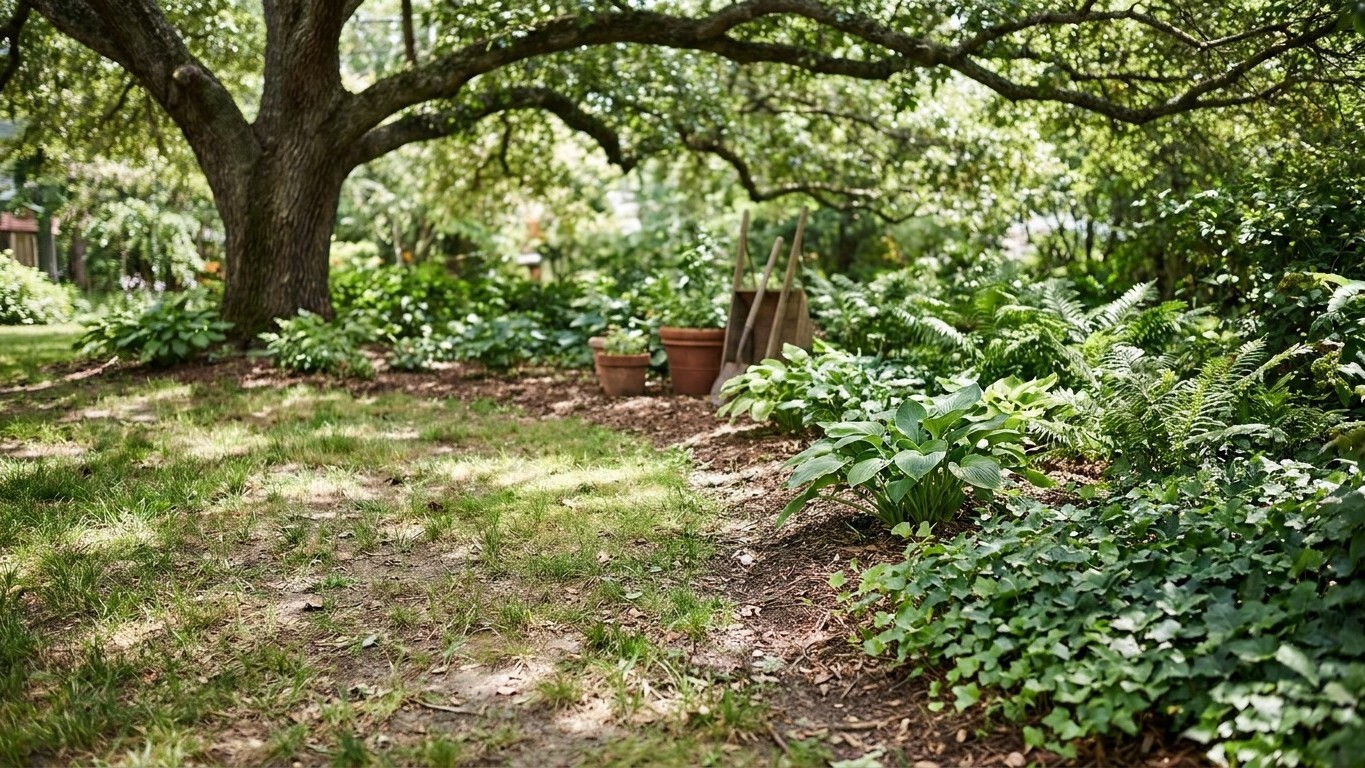

The grass under your tree isn’t dying, it’s losing two fights at once: not enough light to feed itself, and roots from the tree stealing the water and nutrients before its own roots can reach them. That’s why it thins out gradually starting near the drip line and gets worse toward the trunk, no matter how much you feed it. Before you do anything else, walk over to the mower and raise the deck to the top of the height range for your grass, because taller blades catch more of the little light that’s actually reaching the ground.
What you are looking at

Thin turf under trees usually starts at the drip line, the ring on the ground below the outer edge of the branches, and gets worse as you move toward the trunk. The transition is gradual, not sharp. You will not find a clean edge the way you would with a fungal patch. Grass blades in the thinning zone often look pale green to yellowish and grow long and thin between mowings, a response called etiolation, where the plant stretches for whatever light it can find instead of filling in wide.
Under a single mature tree, the pattern is roughly circular, wider on the side that gets the least sun through the day. Under a row or a windbreak, the dead zone runs in a strip along the shaded side, following the sun’s path rather than the tree trunks themselves. Bare soil at the base of the trunk, within a foot or two, is often just root crowding and mower avoidance rather than shade at all.
Density thins gradually over a season or two rather than collapsing overnight. If you see a sudden dead patch with a hard, well-defined edge appearing within days, that is a different problem, and shade is not the driver.
What it is not
Grub damage looks similar at a glance, thin and patchy, but it is not tied to tree canopy at all and it fails a simple test. Grab a handful of the thinning grass and tug. If it lifts free like a loose piece of carpet with no roots attached, you are looking at grub feeding, not shade stress. Shade-thinned grass under a tree holds its roots even when the top growth is sparse.
Dog spots and fertilizer burn show up as a ring of dark green, lush growth around a dead center, an effect of concentrated nitrogen. Shade thinning has no dark green halo. The grass simply gets thinner and paler the closer it sits to the trunk, with no ring pattern at all.
A perfectly circular patch with a sharply defined brown edge, especially one that shows up fast in warm, humid weather, points to a fungal disease rather than tree competition. Fungal patches also occur out in the open lawn, away from any canopy, which shade thinning never does. If you are also finding small fruiting bodies pushing up through the thin turf, that is usually decaying wood or root debris underground rather than a lawn disease, and it is worth reading about separately in Mushrooms in a Lawn: What They Are Feeding On.
Foot traffic wear looks like thinning too, but it follows a straight or curved path, a line to the mailbox, a shortcut across the yard, rather than the shape of a canopy overhead. If the thin area is a path shape and does not correspond to where the sun is blocked, traffic is the cause, not the tree.
What actually causes it
Two competitions happening at once
Under a tree, grass is losing on two fronts. The canopy cuts the light available for photosynthesis, and the tree’s root system, which is denser and more efficient than turf roots, pulls water and nutrients out of the same soil volume before the grass can use them. Species differ enormously in how well they tolerate the light side of that competition. Clemson’s HGIC 1214 rates Fine Fescue, Rough Bluegrass, St. Augustinegrass and Zoysiagrass as excellent in shade, while Kentucky Bluegrass, Perennial Ryegrass, Tall Fescue and Centipedegrass sit in the fair to good range, and Bermudagrass, Bahiagrass and Carpetgrass are poor to very poor in shade regardless of how well they otherwise handle drought or wear.
Timing matters for reading the damage correctly. A deciduous tree’s canopy closes in over a period of weeks each spring, so a lawn that looked fine in early spring can visibly thin by midsummer as the leaf canopy fills in overhead, well after the cause has already acted. By the time you notice the grass is sparse, the tree has already been shading it for a month or more. That lag is why shade thinning is easy to mistake for a sudden problem when it is really a slow decline that became visible late.
Mowing height compounds the light problem. Grass mowed short has less leaf surface to capture what light does get through, so a shaded lawn cut at the low end of its range thins faster than the same species cut at the high end. This is one of the few places where the fix is entirely in the reader’s control, independent of the tree itself.
Fixing it
Match the species to the shade before you do anything else
If the current lawn is a species with a poor shade rating, no amount of fertilizer or watering will make it thick under a full canopy. The fix is switching to a species suited to the light you actually have. The table below pulls the shade-relevant options from Clemson HGIC 1214 and Penn State Extension’s lawn establishment guidance.
| Species | Season | Mowing height | Shade tolerance | Drought tolerance |
|---|---|---|---|---|
| Fine Fescue | Cool | 2.5–3.5 in | Excellent | Good |
| Rough Bluegrass | Cool | 2–3 in | Excellent | Poor |
| Tall Fescue | Cool | 2.5–3.5 in | Good | Fair |
| Kentucky Bluegrass | Cool | 2–3 in | Fair | Fair |
| Perennial Ryegrass | Cool | 2–3 in | Fair | Fair |
| St. Augustinegrass | Warm | 2.5–4 in | Excellent | Good |
| Zoysiagrass | Warm | 0.75–2 in | Excellent | Good |
| Centipedegrass | Warm | 1.5–2 in | Fair | Fair |
| Seashore Paspalum | Warm | 1–1.5 in | Poor to fair | Fair to good |
| Bahiagrass | Warm | 3–4 in | Poor | Excellent |
| Bermudagrass | Warm | 0.75–1.5 in | Very poor | Excellent |
| Carpetgrass | Warm | 1–2 in | Fair | Very poor |
Where the existing lawn is Bermudagrass or Bahiagrass under a heavy canopy, no reseeding schedule will fix it, since both rate poor to very poor for shade regardless of care. In a cool-season lawn already growing Fine Fescue or Tall Fescue under trees, the better move is overseeding into the existing thin turf rather than starting over, since those species already tolerate the light level, and thinning there usually traces back to mowing height or soil compaction rather than the wrong species.
Once the species is right, raise the mower to the top of its published range and leave it there for the shaded section even if the rest of the lawn is cut shorter. Skip nitrogen increases as a first response. Extra feeding pushes top growth the plant cannot support on reduced light, which can weaken it further rather than thicken it. Clemson’s HGIC 1201 fertilizing guidance and HGIC 1205 mowing guidance are the references to check before changing either input.
If the canopy is dense enough that even Fine Fescue or Zoysiagrass stays thin, that patch of ground may not be able to support turf at all, and mulch or a shade-tolerant ground cover is a more realistic outcome than another year of reseeding.
Keeping it from coming back
The habit most worth changing under trees is mowing height, not watering or feeding schedule. A shaded lawn mowed at the low end of its range never fully recovers between cuts, because it has less leaf area to rebuild what light it gets. Keep the shaded section at the top of the range listed above year-round, not just during the thinning months.
Watch foot traffic in the shaded zone as closely as the mowing height. Grass already weakened by low light has little reserve left to recover from being walked on, so a path that would barely mark a sunny, thick lawn can turn into bare soil under a tree within a season. Route foot traffic around the drip line where possible.
Thin, weakened turf under trees is also the easiest place in the yard for weeds to move in, since bare or sparse ground gives them room to establish without competition. If that has already happened, A Lawn Taken Over by Weeds: Where to Start covers the sequence for taking the lawn back before you reseed. For the broader picture of how this fits with everything else going on in the yard, Lawn Problems is the starting point.
Common questions
Will grass ever grow thick under a big shade tree?
Rarely as thick as it grows in full sun, even with the right species. Fine Fescue, St. Augustinegrass and Zoysiagrass rate excellent for shade tolerance per Clemson HGIC 1214 and Penn State Extension, but excellent under partial shade still means thinner than the same grass in the open.
Should I prune the tree to fix the grass?
Thinning the lower canopy to let more light through helps, but it is a tree-care decision, not a lawn one, and the right amount to remove depends on the species and the tree’s health. Check with a certified arborist before removing branches for this purpose.
Is it worth reseeding every fall if the tree just shades it out again?
If the species is already shade-tolerant and the mowing height is right, thinning usually traces back to compaction, root competition for water, or foot traffic rather than the species failing outright, so fix those first. If the species is a poor shade performer like Bermudagrass, reseeding into the same spot every year without switching species is money spent on a losing match.
Can I just let it go bare and put down mulch instead?
Under a dense enough canopy, that is often the more realistic outcome than fighting for turf. A ring of mulch or a shade-tolerant ground cover out to the drip line also protects the tree’s roots from mower and trimmer damage, which is a common source of trunk injury near the base.