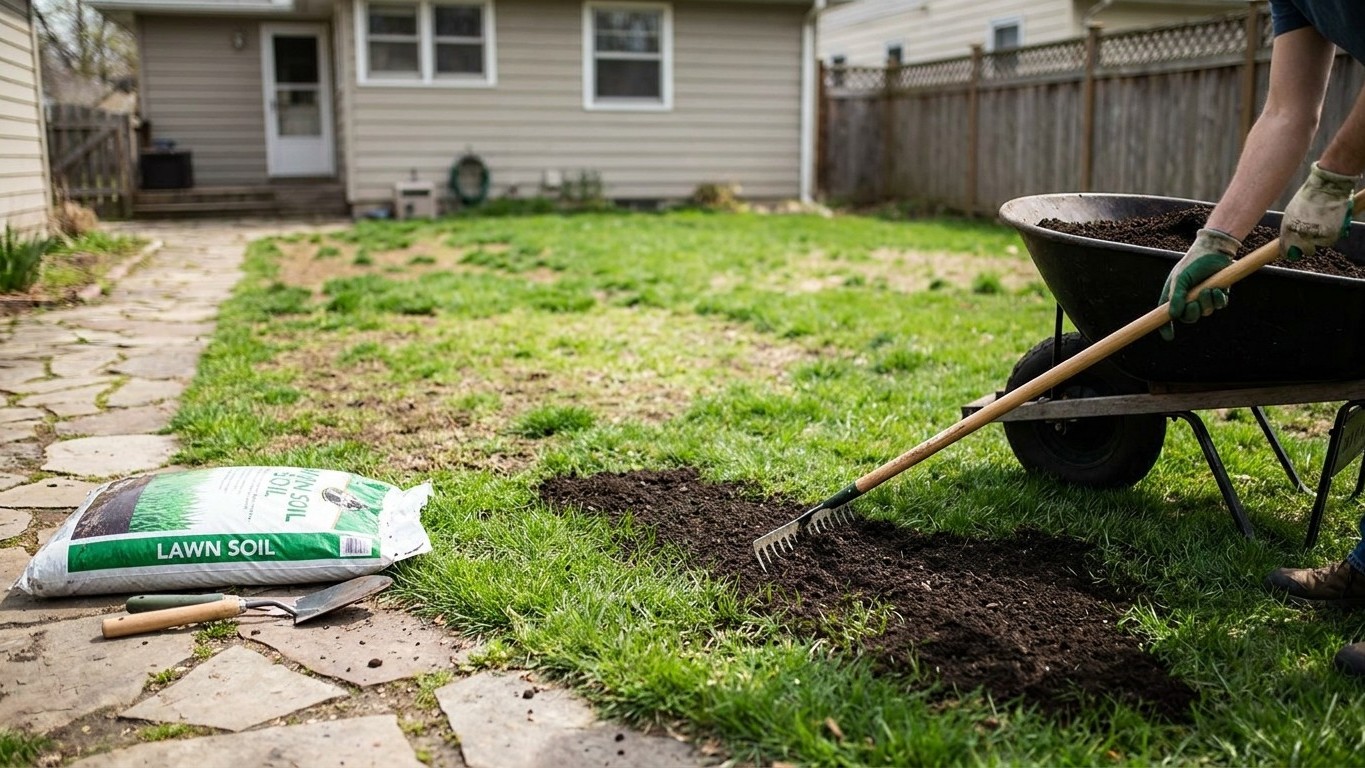

An uneven lawn is a soil problem wearing a grass costume. The turf just shows you what’s happening underneath it: low spots come from decomposing roots, buried debris or freeze-thaw heaving, and high spots come from old fill, a thick thatch layer or a mower set too high in one pass and too low in the next. Before you touch a rake or a bag of soil, walk the yard after a rain and mark where water stands, because the fix for a drainage problem is not the fix for a settling one.
What you are looking at

Uneven ground announces itself in a handful of shapes, and each shape points to a different cause. A shallow, saucer-like dip a few feet across, with soft edges that blend into the surrounding grass, usually sits over a spot where a stump, root ball or construction debris was buried and has since rotted down. A long, narrow trench that runs in a straight line across the yard, often on the shortest path between the house and the street, is settling over a utility trench or an old drain line rather than a random low spot.
Small, evenly scattered mounds an inch or two high and spaced a foot or so apart are usually earthworm castings or ant mounds rather than a grading problem, and they flatten under a few mowing passes on their own. A single dome-shaped high spot, especially near the edge of a bed or a former garden path, often marks fill soil that was never compacted before sod went down over it.
The single most useful clue is whether the low spot holds water. Walk the yard the day after a soaking rain and mark, with a flag or a stick, every place where water is still standing or the ground squelches underfoot. A depression that holds water for more than a day is a drainage problem first, and topdressing it without addressing where the water goes just buys another season of the same puddle. A dip that drains within a few hours but still catches a mower deck or an ankle is a straightforward fill-and-level job.
Color is a secondary clue, not the first one. A dip in full sun that stays greener and lusher than the rest of the lawn is collecting extra water and nutrients, while a high spot that browns out first in a dry spell is losing moisture faster because there is simply less soil depth over the roots.
What it is not
A soft, springy patch that gives underfoot like a mattress is not a grading problem, even though it can look like one at a glance. Grubs feeding on grass roots loosen the turf from the soil below, and a lawn with a grub problem lifts like a loose carpet when you tug on it. Grade problems do not do this. The sod holds fast to the soil because the roots are intact; the ground underneath has simply moved.
Raised, snaking ridges rather than flat dips are usually mole or vole tunnels, not soil settling, and they run in continuous lines rather than sitting as an isolated saucer. Push a finger into the ridge. A tunnel is hollow underneath, while a true high spot is solid soil all the way down.
A dead circle with a green, lush ring around its edge and a browned-out or bare center is a classic sign of a concentrated nitrogen dose, most often from a dog, and it has nothing to do with soil level at all. That pattern is worth reading up on separately, since the fix is completely different: see Dog Urine Spots: Why the Ring Is Green and the Middle Is Dead.
An irregular patch where the grass thins and something else, usually crabgrass or clover, fills the gap is a weed problem that has moved into a lawn already under stress, often because a dip collects water and drowns the turf first. If the low ground in your yard is also the weediest ground, treat the weeds and the grade as two separate jobs: A Lawn Taken Over by Weeds: Where to Start covers the first one.
The thirty-second test that separates all of these from a true grading problem is simple: grab a handful of grass at the edge of the suspect area and pull. If it lifts with little resistance, the problem is below the surface, not the surface itself, and you’re looking at a pest or a disease rather than settled soil.
What actually causes it
Almost every low spot is soil that has lost volume underground, and almost every high spot is soil, thatch or debris that has gained it. The mechanism is slow, which is why the dip you’re looking at this spring may trace back to something that was buried or damaged well before you noticed it.
Settling and heaving
Buried organic matter, whether it’s a ground-down stump, old sod that was tilled under instead of removed, or leftover construction scraps, decomposes underground and loses volume as it breaks down, and the soil and turf above sink to fill the gap left behind. In regions with real winter freezing, repeated freeze-thaw cycles heave soil upward each time it freezes and settle it back down unevenly as it thaws, which is why cool-season lawns often develop a rolling, wavy surface over several winters rather than a single clean dip.
Thatch, mowing height and wear
High spots have a different story. A thick thatch layer, the mat of dead stems and roots that builds up between the soil and the green blades, raises the surface a section at a time rather than across the whole lawn evenly, and it holds enough water to stay springy underfoot. A mower set too low for the grass on a high spot scalps the crown there faster than anywhere else in the yard, because there’s simply less blade height to spare. That matters most on species with the least room to begin with: bermudagrass is mowed at just 0.75 to 1.5 inches and zoysiagrass as low as 0.75 inches according to Clemson Cooperative Extension’s HGIC 1214, so a high spot on either lawn gets scalped by a deck setting that would barely touch a tall fescue lawn mowed at its full 2.5 to 3.5 inches.
Wear ruts, the shallow trench that forms along a regular foot path or a mower’s wheel line, are a fourth pattern. Repeated compaction crushes air pockets out of the soil, and compacted soil takes up less space than loose soil, which is why a daily path worn into the same stretch of lawn over a season carves a visible track.
Fixing it
Confirm drainage before you fill in anything. If a low spot held standing water for more than a day during the water test, regrade or add drainage first, because topdressing over a spot that can’t shed water just delays the same puddle by one season. If it drained within hours, you’re dealing with a straightforward fill.
- Water test: mark every spot where water still stands a full day after rain.
- Shallow dip: topdress in thin layers, letting grass grow through between coats.
- Deep or sunken patch: cut a turf flap, add soil beneath it, fold the turf back and tamp.
- High spot from thatch: dethatch rather than mow it lower.
Topdressing a shallow dip
For a dip you can smooth out rather than dig up, spread a mix of screened topsoil and sand thin enough that grass tips still show through, water it in, and let the lawn grow through that layer before adding a second thin coat if the dip is still visible. Burying the crowns under one thick pour smothers the grass instead of leveling around it, and a lawn treated that way can take far longer to recover, if it recovers at all.
Rebuilding a deep or sunken patch
For a genuinely sunken area, cut a flap of turf on three sides and fold it back like a page, add and firm soil underneath to the level you want, then fold the turf back down and tamp it into place. This keeps the existing sod and its root system intact instead of starting over from bare seed.
High spots caused by thatch respond to dethatching, not to mowing lower. Pulling the thatch layer out with a dethatching rake, or a rented power rake for a larger lawn, drops the surface back down without scalping the crowns the way a lower mower setting would.
Matching the reseed to the site
Bare patches left after any of this need reseeding, and the species you choose should match the site, not just the bag on the shelf. In a shaded low spot in a cool-season lawn, for example, fine fescue tolerates shade well at a 2.5 to 3.5 inch mow, while Kentucky bluegrass, mowed at 2 to 3 inches, holds up better to foot traffic but rates only fair for both shade and drought, per Penn State Extension. In warm-season regions, St. Augustinegrass handles shade well at a 2.5 to 4 inch mow, while bermudagrass needs full sun and a much lower 0.75 to 1.5 inch mow but tolerates wear excellently, according to Clemson Cooperative Extension’s HGIC 1214.
| Grass | Season | Mow height | Shade | Drought | Wear |
|---|---|---|---|---|---|
| Fine Fescue | Cool | 2.5–3.5 in | Excellent | Good | Poor |
| Kentucky Bluegrass | Cool | 2–3 in | Fair | Fair | Good |
| Tall Fescue | Cool | 2.5–3.5 in | Good | Fair | Fair |
| St. Augustinegrass | Warm | 2.5–4 in | Excellent | Good | Fair |
| Bermudagrass | Warm | 0.75–1.5 in | Very poor | Excellent | Excellent |
| Zoysiagrass | Warm | 0.75–2 in | Excellent | Good | Very good |
Cool-season figures from Penn State Extension’s Lawn Establishment guidance; warm-season figures from Clemson Cooperative Extension’s HGIC 1214, Selecting a Lawn Grass.
Keeping it from coming back
Most repeat unevenness traces back to one habit: mowing too low for the species growing in that spot. Cutting height determines root depth, and a lawn kept at the top of its recommended range grows deeper roots that resist both compaction and the drought stress that shrinks and cracks dry soil. A tall fescue lawn mowed at its full 3.5 inches, rather than scalped down near 2 inches, holds a more even surface through a dry summer than the same lawn cut short.
Watering habits matter almost as much. Frequent, shallow watering keeps roots near the surface, and shallow-rooted turf is exactly the kind of turf that heaves and settles unevenly with each freeze-thaw cycle or dry spell. Watering less often but more deeply encourages roots to follow the water down, which firms and stabilizes the soil structure they’re growing in.
Fertilizing on the schedule for your grass type, rather than by a fixed calendar date, helps too. Clemson Cooperative Extension’s HGIC 1201 fertilizing guidance and the species-specific maintenance calendars, HGIC 1215 through 1219, time nitrogen applications to when each grass is actively building root mass rather than soft top growth, and a lawn fed at the wrong point in its cycle puts energy into leaf instead of the roots that keep the surface stable.
If the unevenness came back after you’d already leveled and reseeded once, treat the whole lawn as a maintenance problem rather than repeating the same patch job. The broader Lawn Problems section covers the watering and feeding basics that keep new low spots from forming in the first place, and it’s worth working through before buying another bag of topsoil.
Common questions
Can I just fill low spots with bagged garden topsoil?
You can, but screened topsoil or a topsoil-sand blend spreads and settles more evenly than bagged garden soil, which often contains clumps of compost or bark that leave lumps under the new grass. A finer, screened material also lets you spread thinner layers, which matters more than the type of bag it came in.
How long before a leveled spot blends in with the rest of the lawn?
Expect a full growing season before a topdressed area looks fully blended, and longer if the work was done while the grass was dormant rather than actively growing. Patience matters more than a second or third coat applied too soon.
Is a lawn roller a good way to flatten small bumps?
Rolling flattens the grass blades but does nothing to fix what’s underneath, and a heavy roller compacts the soil further, which works against root growth rather than for it. It’s a cosmetic fix at best and can make drainage worse on a lawn that’s already prone to holding water.
My lawn is only bumpy along the fence line. Why just there?
A straight-line pattern almost always means something was dug and refilled along that path, most often a utility line, an old fence post trench or an irrigation run. Dig a small test hole where the bump is worst before assuming it’s the same cause as the rounded dips elsewhere in the yard.