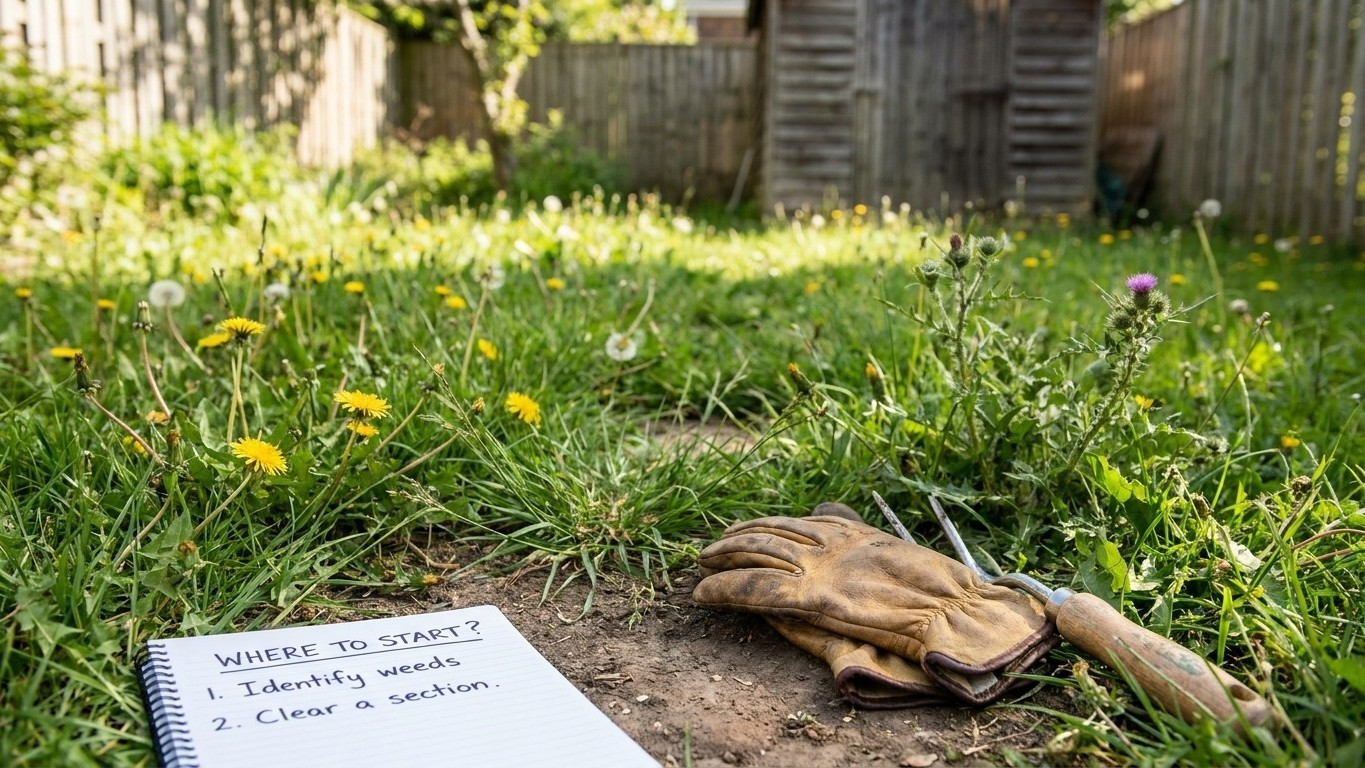

A lawn taken over by weeds is usually a mowing or watering habit working against the grass, not an outside invasion. Cool-season turf like tall fescue needs a mowing height of 2.5 to 3.5 inches, and Kentucky bluegrass needs 2 to 3 inches, according to Clemson Cooperative Extension’s HGIC 1214 fact sheet on selecting a lawn grass. Cut shorter than that for a season and the canopy opens enough for weed seed to germinate in the gaps. Measure your mower deck against the range for the grass you actually have before doing anything else.
What you are looking at

A weedy lawn rarely shows up as one clean problem. Look at the whole yard first, not one bad-looking corner. Weeds that are scattered evenly across the entire lawn, mixed in blade by blade with the turf, usually mean the grass itself has thinned overall and lost the competition everywhere at once. Weeds that show up as dense patches in specific spots, especially along paths, under trees, or near the edge of a driveway, point to a local stress in that one area rather than a lawn-wide failure.
Reading the edge
The border between weed and turf matters as much as the weeds themselves. A ragged, irregular edge that blends gradually into thicker grass usually means competition, the turf is losing ground slowly as weeds fill bare spots left by mowing or drought stress. A sharp, straight edge, especially one that follows a fence line, a walkway, or the reach of a sprinkler head, points to something mechanical: a watering pattern that misses that strip, or a mower that scalps it on turns. The shape of the boundary is often more diagnostic than the weed species growing inside it.
Color is a second clue. Weeds like clover and chickweed often look a brighter, more saturated green than the surrounding turf because they are actively growing while the grass around them is stressed or dormant. If the weedy patches are also a different texture, coarser or finer-bladed than the lawn around them, that is a strong sign you are looking at weed encroachment and not just discolored turf. If the whole lawn has gone one uniform tan or straw color with weeds as the only green left standing, that is a different situation, closer to widespread turf failure than a patch of weeds, and it’s covered separately in Brown Patches in a Lawn: Reading the Shape to Find the Cause.
What it is not
Not every rough-looking lawn is a weed problem. Grub damage can look like thinning turf that then fills in with weeds, but the test is fast: grab a handful of the thin turf and pull. If it lifts away like a loose piece of carpet, with no root resistance, that is grub damage, not a weed issue, and the weeds you see are opportunists filling in behind the real cause. If the grass resists and the roots hold, look elsewhere.
A second look-alike is compacted soil. Compaction thins turf in high-traffic strips, along mower turning points, and near gates, and weeds like plantain and knotweed move into those exact same strips because they tolerate hard soil better than lawn grass does. The two problems often sit right on top of each other. A screwdriver pushed into the soil tells you which one you are dealing with, and the full test is laid out in Compacted Lawn Soil: The Screwdriver Test and What Follows.
A third possibility, and the one most often mistaken for a weed problem, is simple dormancy. Cool-season grass under heat stress and warm-season grass in the shoulder seasons can both go tan or gray-brown while weeds keep growing green through it. Brown is not dead. Before you treat anything, separate the parts of the lawn that are dormant grass from the parts that are actual weed cover, because the fix for each is completely different.
What actually causes it
Mowing height and timing
The single most common driver is mowing lower than the grass species tolerates. HGIC’s fact sheet on mowing lawns (HGIC 1205) sets the working principle: cutting height controls how much leaf surface is left to shade the soil surface, and shaded soil is harder for weed seed to germinate in. Fine fescue and tall fescue both need 2.5 to 3.5 inches, per Penn State Extension’s lawn establishment guidance and Clemson’s HGIC 1214, while a warm-season lawn of bermudagrass is meant to run much lower, 0.75 to 1.5 inches, because it spreads by stolons rather than depending on leaf shade the same way. Mow a bermudagrass lawn at fescue height, or a fescue lawn at bermudagrass height, and weeds get an opening either way.
Damage from a mowing mistake does not show up the day you make it. A scalped lawn in early summer often does not look weedy until four to six weeks later, once weed seed already in the soil has had time to germinate and establish in the open canopy. That lag is why the weed problem you’re looking at today was very likely set up by a mowing pass from a month or more ago, not by anything happening this week.
Watering depth and nitrogen timing
Shallow, frequent watering trains grass roots to stay near the surface, which weakens the turf’s ability to compete for water and nutrients against deep-rooted weeds like dandelion. Fertilizing at the wrong time compounds it. HGIC 1201, Clemson’s fact sheet on fertilizing lawns, ties nitrogen timing to the grass’s active growth period, feeding a cool-season lawn in summer heat or a warm-season lawn while it is still dormant pushes weeds instead of turf, because the weeds are often the only thing actively growing when the fertilizer hits the soil.
Fixing it
First, separate weeds from dormancy
Do not spray or dig anything until you have confirmed which parts of the lawn are actually weeds and which are stressed turf. A dormant patch that gets treated like a weed problem gets watered less and mowed shorter still, which only extends its recovery. Give any suspected dormant area two to three weeks of normal watering and mowing before deciding it needs more than patience.
Then correct the habit, not just the symptom
Once you have confirmed actual weed cover, raise the mower to the correct height for your species first, before any product goes down. Pulling weeds by hand works for scattered broadleaf types like dandelion and plantain if you get the whole taproot, and costs nothing but time. For grassy weeds like crabgrass spread through large sections of turf, hand-pulling isn’t practical, and a home grower’s realistic options narrow to a selective post-emergent herbicide labeled for lawns, most commonly formulations containing 2,4-D, MCPP, or triclopyr for broadleaf weeds. Check your state’s rules before buying anything, several active ingredients carry use restrictions that vary by state, and your state extension service’s website is the place to confirm what is currently legal to buy and apply where you live.
Overseeding thin turf after the mowing height is corrected gives the grass a real chance to close the gaps weeds were using. Timing that overseeding correctly depends on your local frost window, which is a county-level figure, not a national one, so check your own state extension service or NOAA’s climate data for your area rather than relying on a general date here.
Keeping it from coming back
The habit most worth fixing long-term is mowing height, because it is the one variable you control every single week and the one most lawns get wrong by cutting too low too often. A lawn kept at the correct height for its species shades the soil, keeps weed seed from germinating, and out-competes most broadleaf weeds without any product at all.
Matching the grass to the site
Part of the long-term fix is making sure the grass species is even right for where it’s planted. A lawn struggling in deep shade or heavy foot traffic will keep losing ground to weeds no matter how carefully you mow it, because the species itself is a poor fit for the site.
| Grass | Season type | Mow height | Shade tolerance | Drought tolerance | Wear tolerance |
|---|---|---|---|---|---|
| Fine Fescue | Cool-season | 2.5-3.5 in | Excellent | Good | Poor |
| Kentucky Bluegrass | Cool-season | 2-3 in | Fair | Fair | Good |
| Tall Fescue | Cool-season | 2.5-3.5 in | Good | Fair | Fair |
| Zoysiagrass | Warm-season | 0.75-2 in | Excellent | Good | Very good |
| St. Augustinegrass | Warm-season | 2.5-4 in | Excellent | Good | Fair |
| Bermudagrass | Warm-season | 0.75-1.5 in | Very poor | Excellent | Excellent |
All figures come from Penn State Extension’s lawn establishment guidance for the cool-season species and Clemson’s HGIC 1214 for the warm-season species. If your weedy patches are concentrated under trees, a shade-tolerant choice like fine fescue or St. Augustinegrass has a real advantage over Kentucky bluegrass or bermudagrass in that same spot. If they’re concentrated in a well-worn path, wear tolerance matters more than shade. For the maintenance calendar specific to whichever warm-season species you plant, Clemson publishes one for each: HGIC 1215 for centipedegrass, HGIC 1216 for bermudagrass, HGIC 1217 for zoysiagrass, and HGIC 1218 for St. Augustinegrass. The broader picture of how these problems connect across a season is covered in Lawn Problems.
- Mow at the correct height for your species, checked with a tape measure, not by eye
- Water deeply and less often rather than a light daily sprinkle
- Feed on the schedule tied to your grass’s active growth period, not the calendar month
- Overseed thin spots once the mowing height is already corrected
Common questions
Can I just mow the weeds off and be done with it?
Mowing knocks back top growth and stops seed heads on some weeds, but it doesn’t remove the taproot on broadleaf types like dandelion or the underground stems on grassy spreaders like nutsedge. It buys you time, it doesn’t solve the underlying competition problem.
Will a thick layer of weeds choke out my grass permanently?
Not usually. Grass that’s still alive under a weed layer generally recovers once the weeds are removed and the mowing height and watering are corrected, because the crown and roots are still intact even when the leaf blades look overwhelmed.
Is it better to reseed the whole lawn or just fix the bad patches?
Spot-treat first, whole-lawn reseeding is a bigger job and cost than most weedy lawns actually need. Reserve a full reseed for lawns where the weed cover is genuinely lawn-wide rather than concentrated in a few identifiable patches.
Do I need to identify every single weed species before I do anything?
No, but it helps to know broadleaf versus grassy weed, since that distinction decides whether hand-pulling is realistic and which herbicide category, if any, is labeled for it. Your state extension service can identify a sample if you’re unsure.