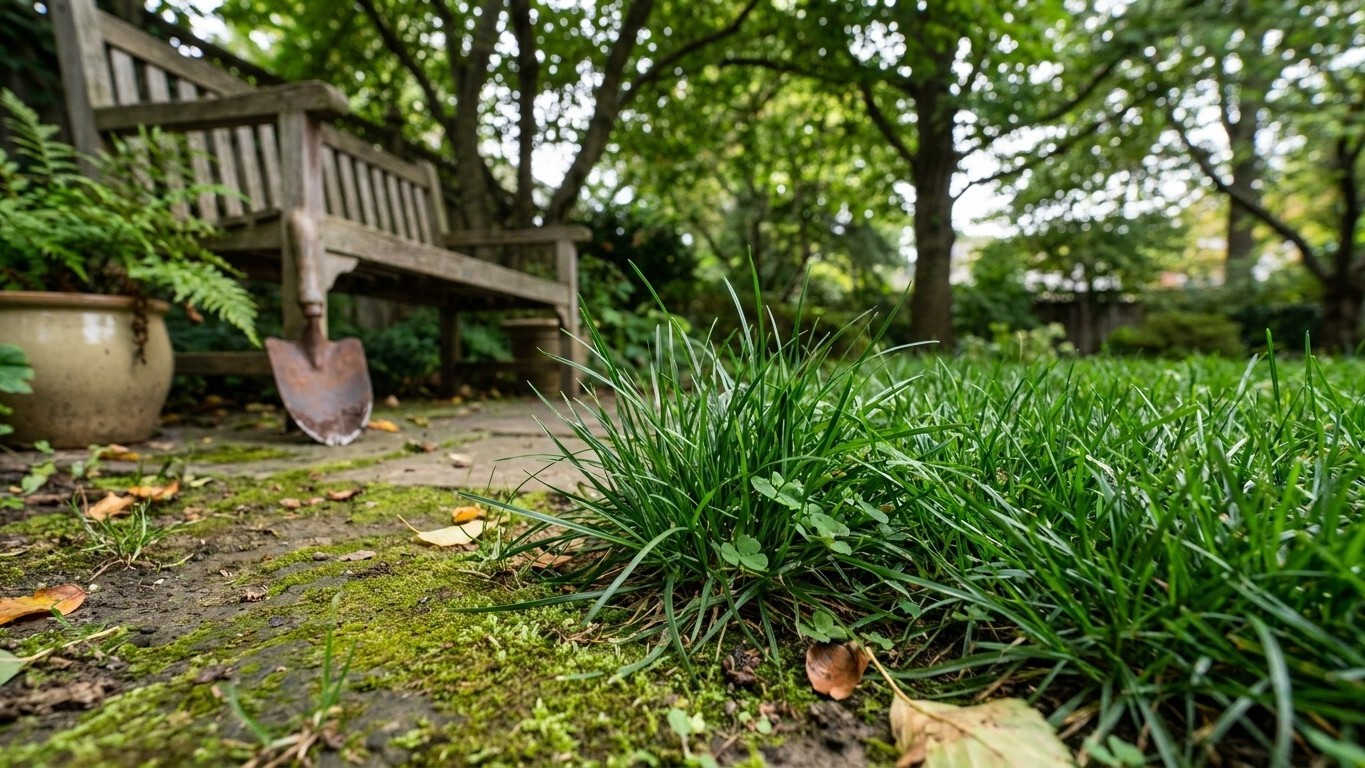

Can grass really grow under your trees, or is that bare, mossy patch just how it’s going to be? Yes, but only if what’s planted there is a species built for shade, not the same sun-loving grass covering the rest of your yard. Go look at what’s actually growing under those trees right now: if it’s the same grass as your open lawn — likely bermudagrass if you’re in the South — that’s your answer, and reseeding it again this spring won’t change a thing.
Why this matters
Shade doesn’t kill a lawn overnight. It thins the stand gradually, and by the time you notice bare soil and moss between the trees, the grass has usually been losing the fight for months. The species you chose, or inherited from a previous owner, decides that outcome long before mowing habits or fertilizer schedules do. A wear-tolerant, sun-loving grass planted under a mature oak will look fine in April and be gone by August, and most people spend that whole stretch blaming water or fertilizer instead of light.
The cost isn’t just appearance. Thin turf under trees erodes faster in rain, lets weed seed in, and competes worse against tree roots for the water and nutrients that are already limited in that spot. Reseeding a shaded area with the same unsuited species, year after year, is money spent on a result that was decided the day you picked the seed bag. Matching the species to the light level is the one decision that determines whether anything you do afterward matters.
This is also why shaded lawns get written off as impossible. Most of the time the actual problem is a mismatch: Kentucky Bluegrass or Bermudagrass planted where Fine Fescue or St. Augustinegrass belonged. Sun-loving grasses aren’t broken by shade slowly out of neglect. They’re simply working with less light than their biology needs, and every mowing and fertilizing decision after that is trying to compensate for a problem that started at planting.
When to do it
Timing depends on which growing season the grass follows, and that split runs in opposite directions. Cool-season grasses, which includes every species Penn State Extension rates for shade tolerance, such as Fine Fescues, Kentucky Bluegrass, Perennial Ryegrass, and Rough Bluegrass, grow most actively in spring and fall and go semi-dormant in summer heat. Warm-season grasses, the group covered by Clemson’s HGIC 1214, including St. Augustinegrass, Zoysiagrass, Centipedegrass, Bahiagrass, Bermudagrass, Carpetgrass, and Seashore Paspalum, do the opposite: they grow through the warm months and go dormant and brown over winter.
That means seeding or plugging a shaded lawn on the wrong calendar wastes the planting, regardless of species choice. Cool-season grasses establish while they’re actively growing, in their spring and fall growth windows; warm-season grasses establish during their summer growth window. Planting cool-season fescue seed in the middle of summer, or trying to plug Zoysiagrass into cold soil, puts new roots into a season when that grass isn’t built to grow.
The exact weeks vary by region and by year. HGIC publishes species-specific maintenance calendars for the warm-season grasses it covers, including HGIC 1215 for Centipedegrass, HGIC 1216 for Bermudagrass, HGIC 1217 for Zoysiagrass, HGIC 1218 for St. Augustinegrass, and HGIC 1219 for Tall Fescue, and those are worth checking against your own extension office’s local calendar before you buy seed or sod. If you’re not sure your current lawn care routine even has the basics down, that’s worth sorting out first, since a shade fix layered onto an unmowed, unwatered lawn won’t hold.
How to do it

Match the species to what the site can actually support
Start with the ratings, not the seed bag on the shelf. The table below pulls the shade, drought, and wear tolerance for every species covered by Penn State Extension and Clemson’s HGIC 1214, alongside the mowing height each one needs to perform at that rating.
| Species | Season | Mowing height | Shade tolerance | Drought tolerance | Wear tolerance |
|---|---|---|---|---|---|
| Fine Fescues | Cool | 2.5–3.5 in | Excellent | Good | Poor |
| Rough Bluegrass | Cool | 2–3 in | Excellent | Poor | Poor |
| Tall Fescue | Cool | 2.5–3.5 in | Good | Fair | Fair |
| Kentucky Bluegrass | Cool | 2–3 in | Fair | Fair | Good |
| Perennial Ryegrass | Cool | 2–3 in | Fair | Fair | Good |
| St. Augustinegrass | Warm | 2.5–4 in | Excellent | Good | Fair |
| Zoysiagrass | Warm | 0.75–2 in | Excellent | Good | Very good |
| Centipedegrass | Warm | 1.5–2 in | Fair | Fair | Poor |
| Carpetgrass | Warm | 1–2 in | Fair | Very poor | Poor |
| Seashore Paspalum | Warm | 1–1.5 in | Poor to fair | Fair to good | Good |
| Bahiagrass | Warm | 3–4 in | Poor | Excellent | Good |
| Bermudagrass | Warm | 0.75–1.5 in | Very poor | Excellent | Excellent |
For a lawn with real tree canopy, that table narrows the field fast. Cool-season yards should be looking at Fine Fescues or, where some wear tolerance still matters, Tall Fescue, both rated by Penn State Extension and Clemson’s HGIC 1214 respectively. Warm-season yards should be looking at St. Augustinegrass or Zoysiagrass. Everything else on that list is a sun grass first, and shade tolerance was never the trait it was bred or selected for.
Mow to the top of the range, not the bottom
In shade, leaf surface is what the plant has to work with to catch the limited light reaching it, so mowing at the highest height listed for that species (per HGIC 1205 mowing guidance and Penn State’s establishment figures) gives it more of that surface to work with. Cutting a shaded fescue lawn down to 2 inches instead of letting it sit at 3 to 3.5 inches removes exactly the leaf area the plant needs most in that spot. The same logic applies to a shaded Zoysiagrass lawn: staying near the top of its 0.75 to 2 inch range costs nothing in a full-sun section of the same yard and helps meaningfully in the shaded one.
Beyond mowing height, this is also where a lot of the standard lawn care checklist needs adjusting for the shaded section specifically, since blanket fertilizer and watering schedules written for full sun don’t transfer cleanly.
What goes wrong
The species mismatch shows up in weeks, not days
Plant a sun-loving species like Bermudagrass or Bahiagrass in real shade and the first few weeks can look fine, especially if the soil is still moist from establishment. The tell comes later: thinning starts at the point farthest from any direct sun, then spreads, and by the time bare soil is visible the stand has usually been losing density for a month or more. Catch it at the thinning stage, not the bare-soil stage, and a species swap is still a reasonable fix rather than a full renovation.
Mowing too short compounds the shade problem
Cutting a shaded lawn at the low end of its range, or worse, below the range listed for that species, removes leaf area the plant needs to photosynthesize in already-limited light. This shows up as a slow thinning that looks identical to the species-mismatch problem, which is why it’s worth checking mower height before assuming the grass itself is wrong for the site.
Brown doesn’t mean dead
Both cool-season and warm-season grasses go dormant on their own schedule, cool-season types browning in summer heat stress and warm-season types browning over winter, and dormant turf recovers on its own once conditions turn back in its favor. A shaded lawn that browns in step with the rest of the yard is going dormant normally. A shaded lawn that browns and stays thin while the sunny parts of the same yard green back up is the one with an actual shade problem.
Tree roots take the water first
Grass and tree roots draw from the same soil moisture, and mature trees generally win that competition. A shaded lawn that wilts faster than the rest of the yard between waterings often needs a different watering approach for that section specifically, which is worth working through in more detail on watering a lawn, rather than simply watering the whole yard on one schedule and assuming the shaded strip is getting enough.
How this changes across the country
Cool-season growers and warm-season growers are solving different problems, even though both call it “shade.” In Pennsylvania, Penn State Extension’s ratings put Fine Fescues at excellent shade tolerance and Kentucky Bluegrass at only fair, which is why a shaded cool-season lawn in the Northeast or Upper Midwest tends toward a fescue blend rather than straight bluegrass. The species doing the work in a Northern shaded lawn and a Southern one are almost never the same plant.
In South Carolina and across the rest of the warm-season belt, Clemson’s HGIC 1214 rates St. Augustinegrass and Zoysiagrass excellent in shade, while Bermudagrass, the default choice for full-sun Southern lawns because of its excellent drought and wear tolerance, drops to very poor. That’s a wider gap than any cool-season comparison in the table above, which is part of why a shaded Southern lawn planted in Bermudagrass out of habit tends to fail harder and faster than a shaded Northern lawn planted in Kentucky Bluegrass.
The transition zone, the band running roughly from the southern Plains across to the mid-Atlantic, doesn’t get a clean answer from either list. Summers there are too hot for reliable cool-season performance and winters too cold for the warm-season species to hold up well, which is part of why Tall Fescue, rated good for shade by Clemson’s HGIC 1214, ends up doing the heavy lifting in that band more than any single warm-season option does. It isn’t the best shade performer on the table, but among species that also survive the region’s summer heat, it’s the one with a shade rating worth building around.
Whatever the region, the shaded section of a lawn is also usually the section with the least defined edge against a bed or tree ring, since thin turf blurs into mulch faster than dense turf does. Cleaning that line up, covered in more depth on edging a lawn, does more for how a shaded area reads visually than another round of seed will.
Common questions
Can I just overseed my existing lawn with a shade mix and skip changing anything else?
Overseeding with a shade-tolerant species like Fine Fescue can thicken a thinning area, but it won’t hold if the site only gets an hour or two of direct light a day or if tree roots are pulling most of the available water first. Check the actual light level and root competition before assuming seed alone fixes it.
How much shade is too much for any grass to handle?
None of the species in the ratings above are rated for full, all-day shade, only for reduced light compared to open sun. Areas under dense evergreen canopy or up against a north-facing wall with no direct sun at all are generally past what turfgrass can sustain, and groundcover or mulch is usually the more realistic answer there.
Why did my shaded lawn look fine last year and thin out this year?
Tree canopies get denser every year as branches fill in, so a spot that had partial sun three seasons ago can be in near-full shade now without anything else in the yard changing. If the lawn was doing fine and has declined gradually, canopy growth is a more likely explanation than a sudden lawn care mistake.
Is it worth limbing up a tree instead of switching grass species?
Raising the canopy by removing lower limbs can add enough morning or afternoon direct sun to matter, and it’s often cheaper than a full reseed. It works best paired with a shade-rated species rather than as a substitute for choosing one, since even improved light rarely gets a shaded spot up to full-sun conditions.