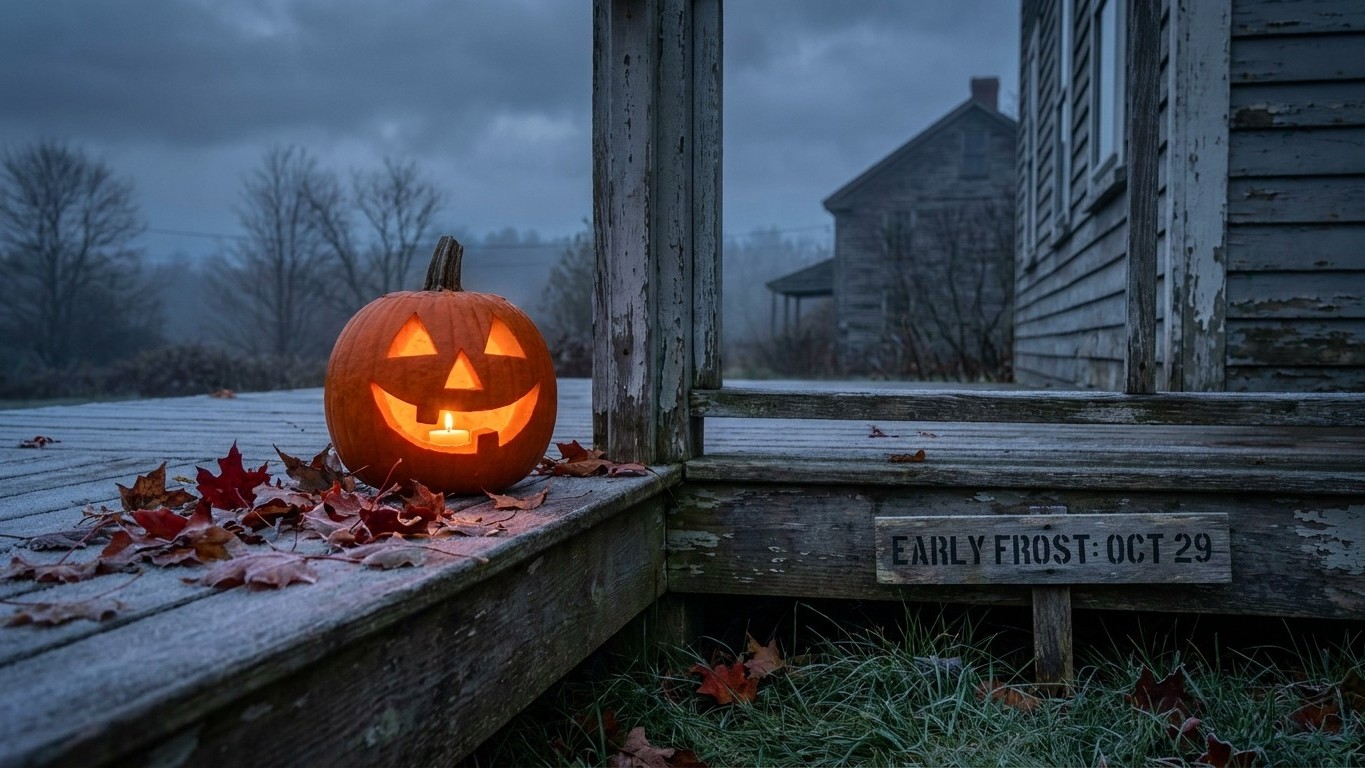

Providence’s mean first fall frost lands somewhere between October 24 and November 3, a stretch that straddles Halloween rather than falling safely before or after it. That means a pumpkin left out on a Rhode Island porch through the end of October is gambling on weather that could go either way. The safe play: carve close to the holiday itself, not weeks ahead of it.
The short answer

Rhode Island’s carving window is tight, and it’s tight because of timing, not because pumpkins here are especially fragile. NOAA’s 1991-2020 climate normals put the mean first fall frost for the Providence area somewhere in the range of October 24 to November 3. Halloween sits right in the middle of that span. Some years the frost arrives a week before trick-or-treaters hit the sidewalks. Other years it holds off until early November, giving pumpkins an extra few days of grace.
What that means practically: don’t treat late October as a safe zone for an already-carved pumpkin sitting outside. If you’re aiming for a jack-o’-lantern glowing on the porch October 31, the smartest approach is to carve within a few days of that date, not at the start of the month. Think of it as a window of roughly zero to seven days before Halloween, not a fixed date you can circle on the calendar. A pumpkin carved on October 15 in Rhode Island is exposed to potential frost for over two weeks before it even does its job.
The word “around” matters here. NOAA’s frost date is a mean, built from three decades of weather records, not a guarantee tied to a specific year. Some autumns skew warmer and push the first freeze into November. Others bring an early cold snap in mid-October that catches gardeners off guard. Rhode Island’s coastal geography, especially near Narragansett Bay, tends to moderate temperatures slightly compared with inland spots in the same state, so a pumpkin on a shoreline porch in Newport County may have a little more breathing room than one in a colder pocket of Providence County or up near the Massachusetts border.
None of this changes the core strategy. Buy your pumpkin early if you want, but hold off on the knife until the week of Halloween. A whole, uncarved pumpkin tolerates a light frost far better than one that’s been hollowed out and exposed to the air. Once you cut into it, the clock on freshness starts running, and Rhode Island’s late-October weather doesn’t leave much slack.
Frost or heat: which one gets it here
The cold end
Rhode Island’s carving season lives under the shadow of frost, not heat. The state’s coldest month, typically January, has a mean daily minimum temperature around 22.1 F according to NOAA climate normals for the Providence reference station. That’s well below freezing, and it tells you something important about the character of a Rhode Island winter: cold arrives decisively once it gets going. Late October isn’t January, but the same weather pattern that eventually pushes temperatures into the 20s starts flirting with 32 F well before Halloween, which is exactly why the frost date matters so much for pumpkin timing.
A whole pumpkin stores best between 45-50 F according to University of Illinois Extension guidance. Compare that to a Rhode Island night once the first frost arrives: outdoor air can easily fall into the 20s or low 30s, especially away from the coast. That’s colder than the ideal storage range, and a hard freeze can damage the pumpkin’s flesh, leading to soft spots and faster decay even before you’ve made your first cut.
The warm end
Heat is not the risk here. Unlike pumpkin growers in warmer southern states, where late-October temperatures can still climb into the 70s or 80s and push pumpkins above that 45-50 F storage band into premature softening, Rhode Island’s late-fall air is almost never too warm for a pumpkin sitting outside. If anything, a mild, sunny October afternoon here might nudge a porch pumpkin a few degrees above the ideal range for an hour or two, but it’s nowhere near the sustained heat that causes problems farther south.
So the answer for Rhode Island is clear: cold is the threat, not heat. Plan around frost timing, not around keeping a pumpkin cool enough.
Where to keep it until you carve
Finding a spot in a Rhode Island home that holds steady in the 45-50 F range and stays dark takes a little thought, since most living spaces run warmer and most outdoor spots run colder once frost season sets in. Here’s where to look:
- An unheated garage or attached shed. These spaces typically track closer to outdoor temperatures than the house interior, but they buffer against direct frost exposure, especially if the pumpkin sits away from an exterior wall or garage door.
- A cool basement corner. Basements in older Rhode Island homes, common throughout Providence and Kent County, often run naturally cooler than the rest of the house and stay out of direct sunlight, both useful for slowing ripening.
- A three-season porch, closed off from heated rooms. If it’s shielded from full sun and not attached to a heating vent, this can land close to the target range on milder fall days, though it needs monitoring once temperatures swing toward freezing.
- Away from the kitchen counter or any fruit bowl. Ripening produce, apples especially, gives off ethylene gas that accelerates a pumpkin’s aging. Keep it well clear of apples, potatoes, or tomatoes, even if that means sacrificing convenience.
- Out of direct sun regardless of location. Sunlight through a window can heat a spot well beyond 50 F even on a cold day, undermining an otherwise good storage location.
Wherever you choose, handle the pumpkin by its base, never by the stem. That 1 to 2 inch stub isn’t a handle, it’s a seal protecting the top of the pumpkin from decay. Once it snaps off, that exposed spot becomes the first place rot sets in, regardless of how well you’ve managed temperature.
Checking this against your own county
The frost window and cold-month figures here come from the Providence reference station, and Rhode Island is small but not uniform. Inland spots and areas away from the coast, particularly in Washington County or northern Providence County, tend to see frost arrive earlier than the coastal average, sometimes by a week or more, while sheltered coastal pockets near the bay can lag behind it.
For a reading tailored to your specific town, the University of Rhode Island Cooperative Extension is the right resource. Their staff can speak to local frost patterns, soil conditions, and seasonal timing questions specific to your county, which matters more than a statewide average when you’re deciding exactly which week to bring out the carving knife.
Common questions
How long does a carved pumpkin actually last?
No university extension publishes a specific shelf life for a carved pumpkin, and there’s no verified preservation protocol, despite what you might see suggested elsewhere online. What’s actually known: choose a firm pumpkin with an intact stem, keep it whole for as long as possible, and carve close to the day you plan to display it. That’s the guidance grounded in research; anything more specific isn’t.
Can I buy my pumpkin weeks before Halloween in Rhode Island?
Yes, as long as you keep it whole and uncarved. A whole pumpkin stored between 45-50 F can last three to six months per University of Illinois Extension. The clock only really starts once you cut into it, so buying early and carving late is the better strategy here.
Will a light frost ruin my pumpkin before I carve it?
A whole pumpkin left outside through a brief, light frost may show some surface effects, but real damage tends to come from a hard freeze or repeated exposure. Since Rhode Island’s frost date genuinely straddles Halloween, moving the pumpkin indoors or into a garage once nighttime temperatures approach freezing is the safer call.
What should I look for at the pumpkin patch to get the best result?
University of Illinois Extension recommends choosing a pumpkin with 1 to 2 inches of stem remaining, free of blemishes or soft spots, and heavy for its size. Shape doesn’t matter for quality. Avoid pumpkins with a broken or missing stem, since that exposed spot is where spoilage typically begins first.