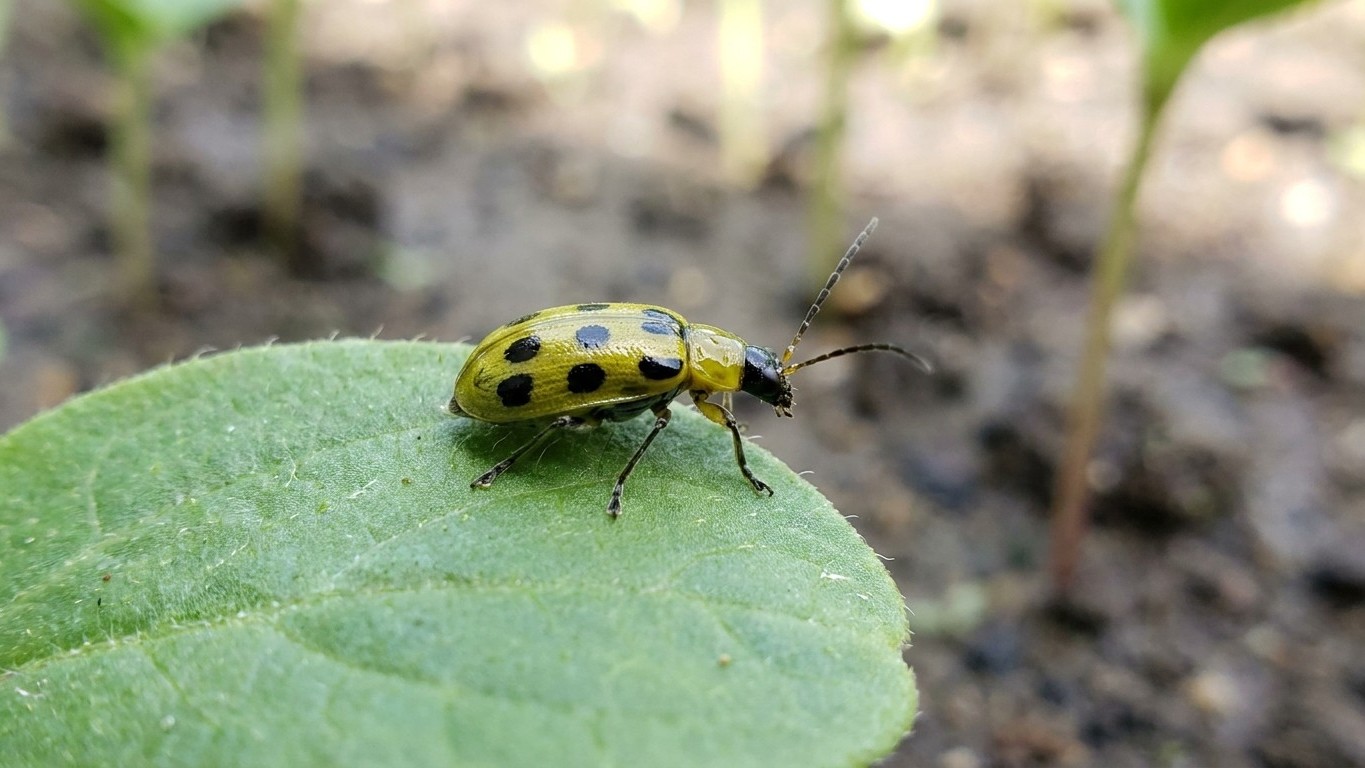

The spotted cucumber beetle turns up in Iowa gardens right around late May, just as squash and cucumber seedlings push their first true leaves out of the soil. That timing is the whole problem. Young cucurbit plants have almost no defense against a hungry beetle, and this particular pest carries something far worse than a chewed leaf: a bacterial disease that can kill a healthy vine in a matter of days.
What the Spotted Cucumber Beetle Looks Like and Eats

At about a quarter-inch long, the adult beetle is easy to overlook until you know what you’re looking for. The body is a soft yellow-green, almost the color of a ripe honeydew, with twelve black spots arranged across the wing covers. A close cousin, the striped cucumber beetle, gets confused with it constantly, but the striped version has bold lengthwise bands instead of dots. Both belong to the same family as the corn rootworm, and that relationship matters more than it sounds.
Adults aren’t picky eaters. Cucumbers, squash, melons, and pumpkins top the list, but they’ll also chew on bean leaves, corn silk, tomato fruit, and even garden flowers like asters and dahlias when cucurbits aren’t available yet. Iowa State University Extension entomologists list this beetle among the state’s most common early-season vegetable garden pests, right alongside flea beetles.
A few field marks help separate it from lookalikes:
- Yellow-green body with exactly twelve black spots, six per wing cover
- Black head and black antennae, noticeably longer than the striped cucumber beetle’s
- Slightly larger and more oval-shaped than most other leaf beetles found on garden vegetables
- Larvae live underground, thin and cream-colored, feeding on roots rather than leaves
When It Shows Up in Iowa
Adult beetles overwinter in Iowa, tucking themselves under leaf litter, in fence rows, or in the thatch of unmowed grass at the edge of fields. Some years, warm southerly winds also carry in beetles that overwintered farther south, adding to the local population once temperatures climb. Either way, the beetles become active once soil temperatures hold steady above roughly 65 degrees Fahrenheit, which in most of the state lines up with mid to late May.
That first wave of activity is the dangerous one. Beetles emerge hungry and immediately seek out the youngest, most tender cucurbit seedlings available, often before a home gardener has even finished planting the rest of the vegetable bed. A second, smaller population bump tends to show up in July and August as a new generation of adults emerges from eggs laid earlier in the season near plant roots.
Southern and eastern counties in Iowa, where soils warm faster and growing seasons run a bit longer, typically see beetle activity a week or two ahead of the northern third of the state. Gardeners near Des Moines or Iowa City should start scouting seedlings by the third week of May; those farther north around Mason City or Spencer usually have until early June before beetle pressure builds.
Why This Beetle Causes More Damage Than It Should
Chewed leaves alone rarely kill a healthy plant. The real threat is what the beetle carries in its gut. Spotted and striped cucumber beetles both transmit Erwinia tracheiphila, the bacterium behind bacterial wilt, a disease that clogs a plant’s vascular system so thoroughly that entire vines collapse almost overnight. A cucumber plant that looked fine yesterday can be lying flat and yellowed by tomorrow afternoon.
The giveaway is a sticky, stringy sap that oozes out when you slice through a wilted stem near the base. Squeeze the cut ends together and pull them apart slowly. If thin threads of sap stretch between them, bacterial wilt is almost certainly the cause, not drought stress or root rot. Cucumbers and muskmelons are highly susceptible; squash and pumpkins tend to tolerate the disease better, and watermelon is rarely affected at all.
Cucumber mosaic virus is the second complication. Beetles that feed on an infected plant can pick up the virus and spread it to healthy neighbors, causing mottled, distorted leaves and stunted fruit. Unlike bacterial wilt, this one doesn’t kill outright, but it tanks yield for the rest of the season.
There’s also an underground angle gardeners often miss. Larvae feed on plant roots, including corn roots, which is exactly why this species sits in the same genus as the western and northern corn rootworm. Home gardens rotating sweet corn near squash beds can end up feeding two beetle problems at once without realizing the two are connected.
What Actually Stops the Spotted Cucumber Beetle
Timing beats almost every other tactic here. Because the worst damage happens to young seedlings during that first emergence wave, protecting plants for just the first three to four weeks after they sprout cuts losses dramatically.
Physical barriers and timing tricks
Floating row covers, the lightweight spun fabric sold at most garden centers, work well when installed right at planting and sealed tightly along the edges with soil or landscape staples. The catch: covers need to come off once flowers open, since cucurbits rely on bees and other pollinators for fruit set, and a sealed cover blocks them out too. Some Iowa growers get around this by delaying planting until early June, letting seedlings skip that early beetle wave entirely, though this pushes back harvest by a couple weeks.
Trap cropping is another option worth considering for larger garden plots. Blue Hubbard squash is intensely attractive to cucumber beetles, more so than most cucumbers or melons. Planting a small border of it around the main crop, then treating just that border with insecticide or removing beetles by hand, concentrates the problem in one manageable spot instead of spreading it across the whole bed.
Direct control once beetles are present
Kaolin clay sprays, marketed under various organic garden product lines, coat leaves in a fine white film that beetles find unappealing to feed on and difficult to lay eggs near. It’s not glamorous, but reapplication after rain keeps it working through the season.
For heavier infestations, insecticides containing spinosad or pyrethrin offer control while remaining acceptable for organic gardening under most certification standards, though timing applications for early morning or evening reduces harm to pollinators visiting open flowers. Carbaryl and permethrin work faster against established populations but carry higher risk to bees, so they’re better reserved for pre-flowering plants or applied strictly after sunset when pollinators aren’t active.
Yellow sticky traps placed near seedlings help with monitoring more than actual population control, but they’re a cheap way to know exactly when beetles arrive in a given year rather than guessing based on the calendar.
Fall cleanup matters more than most gardeners assume. Since adults overwinter in leaf litter and garden debris, clearing cucurbit vines and surrounding weeds after harvest, rather than leaving them to break down over winter, removes a chunk of the local overwintering population before it ever gets the chance to emerge again next May.