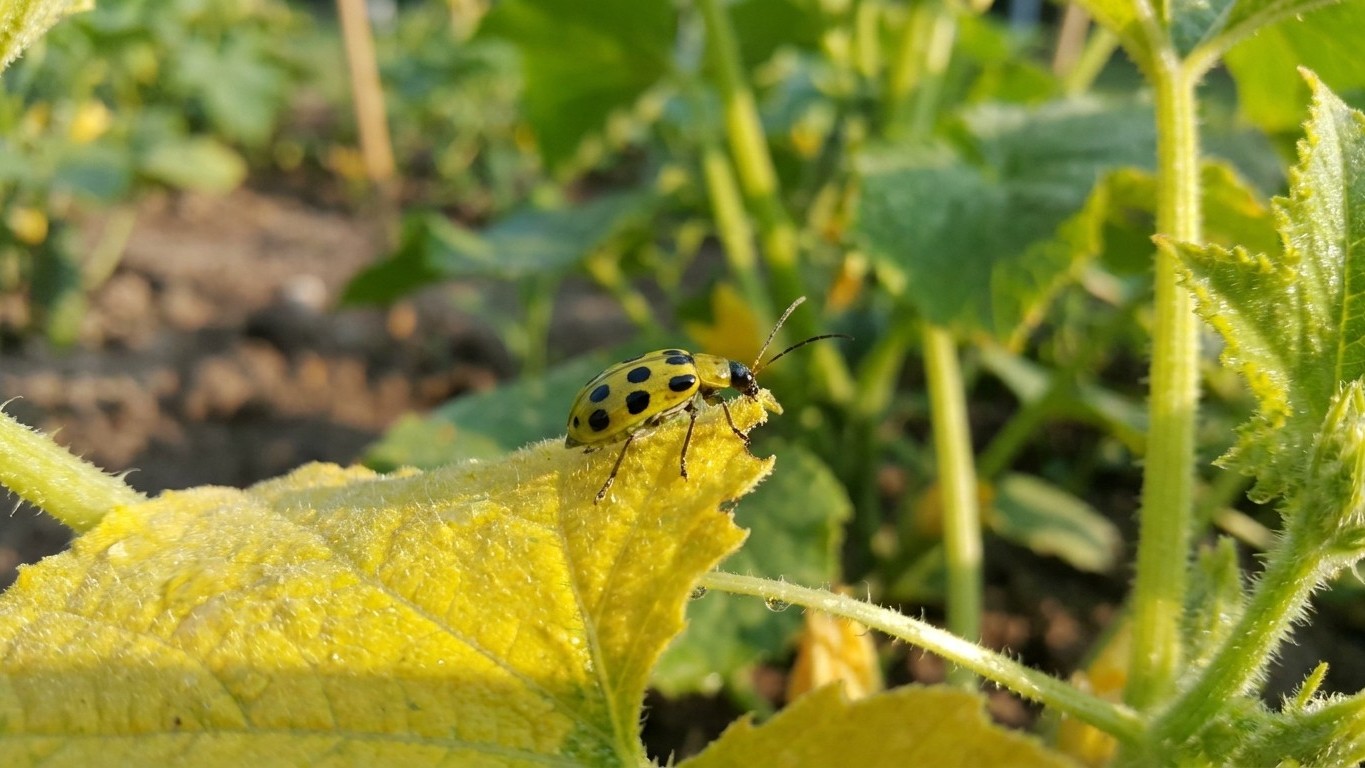

Spotted cucumber beetles start showing up in Kansas gardens as soon as soil temperatures climb into the 60s, usually mid-to-late April in the southern part of the state and closer to early May farther north. They stick around through October, running through two or sometimes three generations before frost shuts them down. The beetles themselves are fairly easy to knock back with row covers and timely spraying, but the real threat is what their larvae do underground and what bacteria the adults can carry onto your squash and cucumber vines.
Identifying the Spotted Cucumber Beetle in Kansas Gardens

The adult is about a quarter-inch long, yellow-green, with twelve black spots arranged in three rows down its wing covers. Its head and legs are black, and it has a habit of dropping off leaves the moment you get close, which is often the first clue you’re dealing with this species rather than the striped cucumber beetle. That look-alike, common in the same fields, has three solid black stripes instead of spots and tends to stick tighter to cucurbit plants.
Spotted cucumber beetles are less picky eaters. They’ll feed on cucumbers, squash, melons, and pumpkins, but they also chew on bean leaves, corn seedlings, soybeans, and the petals of dozens of garden flowers. That broader appetite is one reason Kansas growers sometimes find the beetle in a bean patch or a stand of young corn with no cucurbits anywhere nearby.
The larval stage looks nothing like the adult. It’s a slender, cream-colored worm with a brown head, living entirely underground where it feeds on roots. In corn, this same larva goes by a different name entirely: the southern corn rootworm.
The Kansas Season: When Adults Emerge and Peak
Adults overwinter in leaf litter, fencerows, and undisturbed grassy edges around fields and gardens. Unlike some beetles that spend winter as eggs or pupae, spotted cucumber beetles ride out the cold as adults, which lets them get moving fast once temperatures rise. Kansas State University entomologists track first emergence tied to soil warming rather than a fixed calendar date, which is why a warm March followed by a mild April can push activity two or three weeks earlier than usual.
First-generation adults lay eggs at the base of host plants through May and June. Those eggs hatch into root-feeding larvae over roughly two to three weeks, then pupate in the soil before emerging as a second wave of adults in July and August. A third, smaller generation is possible in southern Kansas during a long, warm fall, though it’s inconsistent and depends heavily on late-season weather.
Peak adult pressure on cucurbit crops in most of Kansas lands in June, right as seedlings are establishing true leaves, and again in late July through August when melons and winter squash are setting fruit. Gardeners who transplant early, before mid-May, sometimes dodge the worst of the first wave simply because their plants are past the vulnerable seedling stage before beetle numbers spike.
Why This Beetle Does More Damage Than It Looks
A handful of beetles chewing holes in a squash leaf rarely kills a plant. The bigger problems come from two directions that don’t get enough attention.
Root Damage from Larvae
Southern corn rootworm larvae feed on corn roots and can also attack the roots of beans, peanuts, and cucurbit seedlings. In field corn, root pruning leads to lodging, weakened plants, and yield loss, particularly in fields with heavy clay soil that holds moisture, since larvae thrive in damp conditions. Home gardeners growing sweet corn in raised beds or heavy soil sometimes see stunted, yellowing stalks that get blamed on nutrient deficiency when root feeding is the actual cause.
Bacterial Wilt Transmission
Cucumber beetles, both striped and spotted, can carry the bacterium Erwinia tracheiphila, which causes bacterial wilt in cucumbers and muskmelons. The striped species is the more efficient carrier and the one most commonly blamed for wilt outbreaks, but spotted cucumber beetles feeding on the same wounds can still spread the pathogen. Once a vine wilts from this bacteria, there’s no cure, plants collapse within one to two weeks, and the only real recourse is pulling and discarding infected vines before the disease spreads through drip lines of feeding damage to neighboring plants.
Squash and pumpkin varieties tend to show more tolerance to bacterial wilt than cucumbers and cantaloupe, which is worth knowing when deciding where to concentrate protective measures in a mixed vegetable garden.
What Actually Stops the Spotted Cucumber Beetle
Control works best when it targets timing rather than relying on a single tactic. Kansas growers who combine two or three of the following methods report the fewest losses.
Timing and Cultural Controls
Delaying planting until late May, when possible for warm-season crops, lets seedlings skip the peak of first-generation adult activity. Crop rotation matters too: moving cucurbits away from where corn or beans grew the previous year reduces the larval population already established in that soil. Clearing garden debris and mowing grassy field edges in fall removes overwintering sites, since adults tuck into exactly that kind of cover to survive winter.
Physical Barriers
Floating row covers placed over seedlings immediately after planting or transplanting block adults from reaching young plants during the most vulnerable stage. Covers need to come off once flowering starts, though, since cucurbits require pollinator access to set fruit. That timing gap, roughly three to five weeks depending on the crop, is when scouting matters most.
Trap Crops and Scouting
Some Kansas growers plant a small block of an attractive squash variety, like Blue Hubbard, at the edge of the garden a week or two before the main crop goes in. Beetles concentrate on the trap crop, which can then be treated or removed, reducing pressure on the main planting. Whether or not a trap crop is used, checking the undersides of leaves and the base of stems twice a week during May and June catches infestations before larvae have a chance to establish in the soil.
Insecticide Timing
When beetle counts justify treatment, generally more than one beetle per plant on seedlings, insecticides labeled for cucumber beetles work best applied in early morning or evening when beetles are actively feeding and pollinators are less active. Rotating between different active ingredients helps slow resistance, and treatments should stop once fruit begins forming unless the product label specifically allows for continued use through harvest. Systemic soil-applied products at planting can protect seedlings through the riskiest early weeks without repeated foliar spraying.
Resistant and tolerant cucurbit varieties exist for bacterial wilt susceptibility, and choosing them reduces the consequences of beetle feeding even when beetle numbers can’t be fully controlled. That’s often the most practical long-term move for home gardens that can’t rely on the intensive scouting schedules used in commercial fields.
One detail that surprises a lot of first-time vegetable growers in Kansas: spotted cucumber beetle numbers often spike hardest not on cucumbers themselves but on winter squash and pumpkin blossoms in late summer, since the beetles are drawn to pollen and the large, open flowers of these plants make an easy landing spot. Checking blossoms directly, not just leaves, during August scouting catches populations that leaf-only inspections miss entirely.
Related guides
- Spotted cucumber beetle in Colorado: When It Shows Up and What Stops It
- Spotted cucumber beetle in Kentucky: When It Shows Up and What Stops It
- Spotted cucumber beetle in Michigan: When It Shows Up and What Stops It
- Harlequin bug in Kansas
- Spotted cucumber beetle in Ontario: When It Shows Up and What Stops It