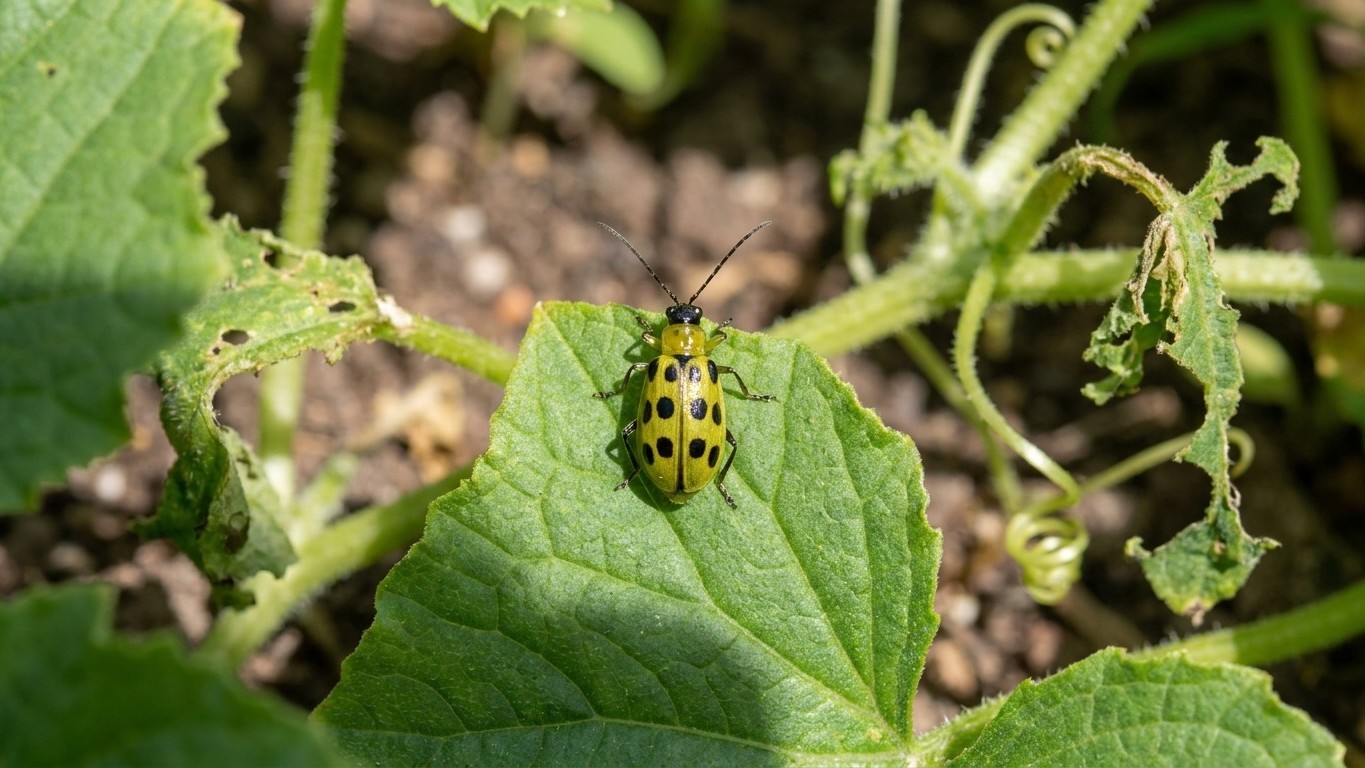

Spotted cucumber beetles start turning up in Colorado gardens in late May at lower elevations and can persist into September, with the heaviest pressure hitting cucurbit crops during July and August. They don’t survive Colorado winters on their own, so every population you see is either flying in from warmer states to the south or hatching from eggs laid earlier that same season. Stopping them means combining row covers, timed planting, and targeted treatments rather than reaching for one single fix.
Identifying the Spotted cucumber beetle in Colorado Gardens

The adult beetle is about a quarter-inch long, with a yellow-green body and twelve black spots arranged in three rows across its wing covers. Some gardeners confuse it with the western spotted cucumber beetle or with ladybugs at a glance, but the elongated, boxy shape and the black head and antennae give it away. Flip one over and you’ll notice it moves fast when disturbed, dropping into foliage or flying off rather than playing dead the way some other leaf beetles do.
The larval stage looks nothing like the adult. Cucumber beetle larvae are thin, white to cream-colored worms with a dark head, living underground and feeding on roots. In Colorado, gardeners rarely spot the larvae directly since they stay buried near the root zone of squash, corn, and beans, but their damage shows up as stunted, wilting plants that don’t respond to extra watering.
When Spotted Cucumber Beetles Show Up in Colorado
Timing depends heavily on elevation and region. Along the Front Range and in the lower Arkansas Valley, where soil warms faster and the growing season stretches longer, adult beetles can appear as early as mid-to-late May once nighttime temperatures stay reliably above 50 degrees. In the Western Slope’s fruit and vegetable growing areas, arrival often lags by two to three weeks. At higher elevations above 7,000 feet, populations tend to stay lighter overall, since the beetle’s biology favors warmer, longer seasons.
Unlike pests that overwinter as eggs or pupae buried in Colorado soil, the spotted cucumber beetle mostly survives winter in southern states and migrates north on warm air currents as spring progresses. This matters for timing your defenses: a hard freeze doesn’t wipe out next year’s population the way it might for a locally overwintering insect. What you’re managing is a fresh wave of arrivals each season, plus any generations that hatch and mature locally once beetles establish themselves in a garden bed.
A second wave often follows in August, when the first generation’s offspring mature. This is the point where many Colorado gardeners get caught off guard, thinking the pest pressure from June has passed, only to see numbers climb again right as squash and melon plants are setting fruit.
What Damage Looks Like Before It Gets Serious
Adult beetles chew irregular holes in leaves, scar the surface of fruit, and feed directly on flowers, which can reduce pollination and fruit set on cucumbers, squash, melons, and pumpkins. Seedlings take the worst hit. A cucumber or squash plant with only two or three true leaves can be defoliated fast enough to die outright, while a mature plant usually shrugs off moderate feeding.
The bigger threat isn’t the chewing, it’s what the beetle carries. Spotted cucumber beetles can transmit Erwinia tracheiphila, the bacterium behind cucurbit bacterial wilt, and certain mosaic viruses, moving pathogens from plant to plant as they feed. A vine that suddenly wilts from the tip inward on a hot afternoon, even with plenty of soil moisture, is showing a classic bacterial wilt symptom rather than simple drought stress. Once a plant is infected this way, there’s no cure. Removing and destroying the vine is the only way to stop the spread to nearby plants.
Underground, larvae feeding on roots of corn, beans, and squash weaken the plant’s ability to take up water and nutrients. Corn seedlings hit hard by root feeding can lodge, meaning they fall over in wind or rain because the root system can’t hold them upright anymore.
What Stops Spotted Cucumber Beetles in Colorado
No single tactic handles this pest on its own. The beetles fly in from outside the garden repeatedly through the season, so a strategy built entirely around one spring treatment tends to fail by midsummer.
Physical barriers and timing
Floating row covers over young cucurbit seedlings block the earliest wave of adults from reaching the most vulnerable growth stage. The covers need to come off once flowering starts, though, since cucumbers, squash, and melons need pollinators to set fruit. Delaying planting by even a week or two, so seedlings emerge after the first spring flight has passed its peak, can meaningfully reduce early damage in Front Range gardens where that first wave tends to arrive predictably in late May.
Yellow sticky traps placed at plant height give a rough early-warning system. Beetles are drawn to yellow, and a jump in trap counts is usually the first sign that a spray or barrier adjustment is needed before damage becomes visible.
Cultural controls that reduce populations over time
Crop rotation matters more for the larval stage than the adult stage, since larvae develop in soil near host plant roots. Moving cucurbits to a different bed each year, rather than replanting squash in the same spot, interrupts the cycle for any locally developing generation. Removing crop debris and old vines at the end of the season eliminates overwintering shelter for any beetles that might otherwise survive a mild Colorado winter in a protected microclimate, such as against a south-facing foundation wall.
Trap cropping, planting a small block of an attractive squash variety a short distance from the main crop, can pull beetles away from the plants you actually want to protect. Some Colorado growers also report that interplanting cucurbits with strong-smelling companions like radish or nasturtium reduces the beetle’s ability to locate host plants by scent, though results vary by garden and aren’t guaranteed.
Direct treatment when populations spike
For active infestations, kaolin clay sprays coat leaves and fruit with a fine barrier that discourages feeding without harming pollinators, making it a solid choice once flowers open. Insecticidal soap and neem oil work on contact against adults but need reapplication after rain or irrigation, and they’re most effective when beetle numbers are still moderate rather than after a full outbreak.
Pyrethrin-based products offer faster knockdown for heavier infestations but should be applied in the early morning or evening when bees and other pollinators are least active, since pyrethrins are toxic to beneficial insects as well as pests. Beneficial nematodes applied to soil can target the larval stage before it damages roots, an option worth considering for gardeners who’ve had recurring root-feeding problems in the same bed year after year.
Whatever product you choose, read and follow the label directions exactly. The U.S. Environmental Protection Agency maintains guidance on safe pesticide use for home gardeners at epa.gov, and label instructions are legally binding, not just suggestions.
Regional Notes for Colorado Growers
Elevation changes the math on this pest more than most Colorado gardeners expect. A community garden plot in Denver at roughly 5,280 feet will see beetle pressure weeks before a mountain-town garden at 8,000 feet, if that higher garden sees meaningful pressure at all. Growers in the San Luis Valley and other high-altitude agricultural areas often report the spotted cucumber beetle as a minor nuisance compared to Front Range and Western Slope farms, simply because the shorter, cooler season limits how many generations can build up locally.
Irrigation practices play a role too. Colorado’s dry climate means many cucurbit growers rely on drip irrigation or furrow irrigation rather than overhead sprinklers, and that dry canopy actually works in the gardener’s favor. Wet foliage from overhead watering can favor the bacterial wilt pathogen once beetles have introduced it, so keeping leaves dry when possible adds a small but real layer of protection on top of insect control.
Colorado State University Extension offices across the state track regional pest pressure and can offer county-specific guidance, since a garden in Mesa County faces a different beetle timeline than one in Weld County. Reaching out to the local extension office before the season peaks is often more useful than any general calendar, since they track real conditions on the ground rather than statewide averages. General information is available through Colorado State University Extension.
One detail that surprises a lot of gardeners: adult beetles overwintering in mild pockets, like against heated greenhouse foundations or in mulch piles near south-facing walls, have occasionally been documented surviving a Front Range winter. It’s rare, and it’s not the main source of pressure most years, but it explains why a handful of beetles sometimes show up in April, well before the main migratory wave from the south would normally arrive.
Related guides
- Spotted cucumber beetle in Kansas: When It Shows Up and What Stops It
- Spotted cucumber beetle in New Mexico: When It Shows Up and What Stops It
- Spotted cucumber beetle in Indiana: When It Shows Up and What Stops It
- Spotted cucumber beetle in Iowa: When It Shows Up and What Stops It
- Spotted cucumber beetle in New Jersey: When It Shows Up and What Stops It