
A transplant sheared off at the soil line the week after planting is cutworm damage, not a mystery disease, and by the time you spot the flat stem the worm is long gone. Spraying then does nothing — the damage window already closed. Same story with flea beetles: wait for the peppered leaves before covering seedlings and you’ve missed the point where a row cover would’ve mattered. In Kentucky, tomato pests move on a calendar tied to frost dates, and acting a week late costs the whole plant.
What this comes down to in Kentucky

The pests that actually matter here are the ones tied to how long the season runs, not some exotic newcomer working its way north. Louisville’s frost-free window, from NOAA’s 1991-2020 last spring freeze date of March 24 to April 4 through its first fall freeze date of November 2 to November 12, gives most of these insects enough calendar to complete two or three generations before the plants come out for the year. The pests that show up earliest track your transplant date, and the ones that show up latest track your first frost. That sequence is the same across the state even where the exact dates shift.
Flea Beetles
Flea beetles hit as soon as transplants go in, usually within the early to mid-April window most Kentucky gardens use for tomatoes. Adults are tiny, shiny black, and jump when disturbed, leaving leaves peppered with small round holes. Established plants shrug this off, but seedlings can be stunted if damage is heavy. A floating row cover over young transplants keeps beetles off until the plants toughen up.
Cutworms
Cutworms work the same early weeks but from the soil instead of the air. The caterpillars are dull gray-brown, curl into a C-shape when disturbed, and feed at night, chewing clean through a transplant’s stem at the soil line. A plant that was upright yesterday and lies toppled over this morning, stem severed, is a cutworm sign. A cardboard or foil collar pushed an inch into the soil around each stem stops them.
Aphids
Aphids build up through late spring on the undersides of leaves and on new growth, forming dense clusters of soft-bodied insects in green, yellow, or black. Light numbers barely dent a healthy plant. Heavy infestations curl leaves, stunt growth, and leave behind a sticky residue that draws sooty mold. A strong jet of water or insecticidal soap knocks populations down before they spread further.
Colorado Potato Beetle
Colorado potato beetles show up as soon as nightshade-family foliage is available, which in most Kentucky gardens means as soon as tomatoes, and any nearby potatoes, are up. The adult is yellow-orange with ten black stripes down its back, and the humped orange larvae, marked with rows of black spots, do the heavier damage, stripping leaves down to the ribs. Hand-picking both stages works well in a small planting, since this beetle overwinters in garden soil and returns to the same bed year after year.
Tomato Hornworm
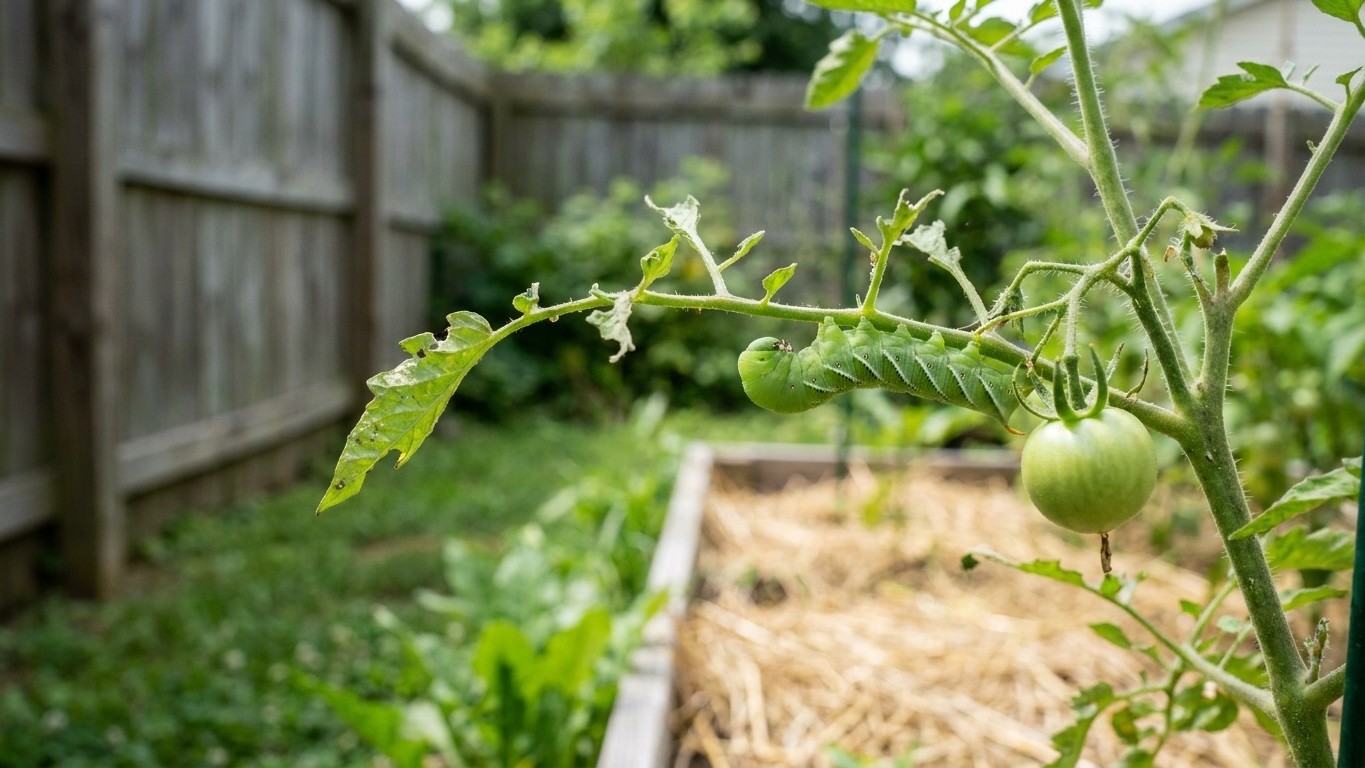
Hornworms turn up in mid to late summer, once plants are full-sized and setting fruit. The caterpillar is large, green, striped in pale diagonal lines, with a horn at the tail end, and can strip a branch of foliage in a couple of days. It’s easy to miss until the damage is done, since the color matches the foliage almost exactly. Dark green droppings on the leaves below a stripped branch are usually the first clue, well before anyone spots the caterpillar itself.
Stink Bugs
Stink bugs move in as fruit starts to ripen, piercing the skin to feed and leaving pale or cloudy spots that turn corky just under the surface. Adults are shield-shaped, brown mottled or green, about 5/8 inch long, with smaller, rounder nymphs marked in red or orange. Damage is often invisible until you slice into a fruit that looked fine on the outside.
Tomato Fruitworm
Tomato fruitworm, the same species known as corn earworm, arrives late in the season and bores directly into the fruit, usually near the stem end, leaving an entry hole that lets in rot. The caterpillar ranges from green to brown to pink with faint stripes running its length. Once a worm is inside the fruit there’s nothing left to spray for it. Picking off and destroying affected fruit, and keeping an eye on plants near any nearby corn, keeps the numbers from building.
Working it out for your own garden
Matching symptom to pest
Start with where the damage shows up, leaves, stems, or fruit, then with when it shows up relative to your transplant date. A stem severed at ground level in the first two or three weeks after setting plants out, the window covered in detail on Tomato Planting Dates in Kentucky: Counting Back From Your Frost Window, is almost always a cutworm. Shot holes in young leaves during that same stretch point to flea beetles. Anything chewing on the fruit itself rather than the foliage only shows up after fruit set, which narrows the suspects to stink bugs or tomato fruitworm.
| Pest | Where damage shows | Typical timing | Quick ID clue |
|---|---|---|---|
| Flea beetles | Leaves | Right after transplant | Tiny, shiny, jumps when touched |
| Cutworms | Stem base | First 2-3 weeks after transplant | Plant toppled, stem cut clean through |
| Aphids | Leaf undersides, new growth | Late spring onward | Dense soft-bodied clusters |
| Colorado potato beetle | Leaves | Spring into early summer | Striped adult or spotted orange larva |
| Hornworm | Whole branches of foliage | Mid to late summer | Large green caterpillar, horn at tail |
| Stink bugs | Fruit surface | Once fruit ripens | Shield-shaped body, pale corky spots on fruit |
| Tomato fruitworm | Inside the fruit | Late season | Entry hole near stem end |
If the damage is on the fruit itself and the plant otherwise looks healthy, skip the foliage pests entirely and go straight to stink bugs or fruitworm. Because Louisville’s frost-free stretch runs from NOAA’s 1991-2020 window of March 24 to April 4 through November 2 to 12, insects with short generation times, aphids and flea beetles especially, can cycle through several generations before the season ends, which is why a light aphid problem in May can be a serious one by July if it goes unchecked. Walk the rows every few days rather than waiting for obvious damage, since several of these pests do their worst work in the day or two before anyone notices them.
What changes across the state
Louisville’s frost dates are a starting point, not a state-wide rule. Kentucky runs from the Mississippi River bottomlands in the west to the Appalachian foothills in the east, and the USDA’s Plant Hardiness Zone Map puts the state across zones 6a to 7a, with the milder end concentrated in the western and central lowlands and the cooler end at higher elevation in the east.
A longer, warmer season in western Kentucky’s bottomlands gives fast-cycling pests like aphids and flea beetles more time to squeeze in an extra generation before frost, while a shorter season at higher elevation in the east compresses that same window and can cut a generation out entirely. Warmer river-bottom soils also wake overwintering pests like the Colorado potato beetle earlier in spring than the surrounding uplands, so a garden in one of those valleys should expect adults on emerging plants sooner than a garden a few hundred feet higher up nearby.
Local terrain matters too. A garden against a south-facing slope or near pavement warms earlier in spring than one in a low, shaded hollow a few miles away, and that difference alone can shift when the first flea beetles or cutworms show up by a couple of weeks. None of this changes which pests to expect, only when to expect them. The lineup covered above holds across the state. It’s the calendar for each one that shifts county to county.
The mistakes this state punishes

Fixes that actually work
The most common mistake is treating pest control as a July problem, when several of Kentucky’s worst offenders, cutworms and flea beetles among them, do their damage in the first two or three weeks after transplants go in. By the time a gardener notices stunted or toppled seedlings in June, the window for a cheap fix like a row cover or a stem collar has already closed, and replacing plants means losing weeks of growing season that can’t be made up.
Skipping crop rotation is the second one. Colorado potato beetles overwinter in the soil of whatever bed hosted nightshades the year before, tomatoes, potatoes, peppers, or eggplant, and a bed that grows a nightshade crop every single year builds up a resident population that gets worse rather than better. Moving nightshade crops to a different bed each year, even a modest rotation, breaks that cycle.
Choosing tomato cultivars with built-in resistance to nematodes or foliar disease doesn’t stop insect feeding on its own, but it does mean a plant already stressed by aphids or stink bugs isn’t also fighting a secondary infection through the wound. That’s one more reason the resistance traits listed on Tomato Varieties That Ripen in Time in Kentucky are worth checking before buying transplants.
The last mistake is spraying before identifying the pest. A broad insecticide applied for aphids also kills the predators, ladybird beetles and lacewings among them, that would otherwise keep populations in check on their own. An accurate identification matters more than a fast reaction.
Checking this against your county
Every figure above comes from the Louisville station in NOAA’s 1991-2020 climate normals, and pest timing shifts with it. A county in the far west or far east of the state can run its pest calendar a couple of weeks off what’s described here, in either direction.
Check with your local Cooperative Extension office for current pest pressure and any active outbreaks being tracked in your county, and use the University of Kentucky Cooperative Extension Service, at https://extension.ca.uky.edu/, as the starting point for county contact information and its own tomato pest guidance. That local office can tell you whether a particular pest is running heavier than usual this year, something a state-wide page like this one can’t capture.
Common questions
Will a hornworm covered in tiny white cocoons still hurt my plants?
Barely, if at all. Those cocoons are the pupal cases of a parasitic wasp that’s already killed the hornworm from the inside, so leaving it on the plant lets the next generation of wasps hatch out and go after the rest of the population.
Do I need to grow potatoes for Colorado potato beetles to be a problem?
No. Tomatoes are in the same nightshade family, and the beetle feeds on tomato foliage on its own even with no potatoes anywhere nearby, though damage on tomato leaves is usually lighter than on potato foliage.
Can I use a row cover on hornworms the same way I do on flea beetles?
Not really. Row covers only work before the plant flowers, since they have to come off once flowers open to let pollinators reach them, and hornworms don’t show up until well after that point in the season.
My tomato leaves have small holes but I never see any bugs. What is it?
Flea beetles are the usual answer, since the adults feed most actively at dawn and dusk and drop off the leaf the moment they sense movement. Check the plant with a flashlight after dark, or look for the beetles jumping when you brush a leaf during the day.