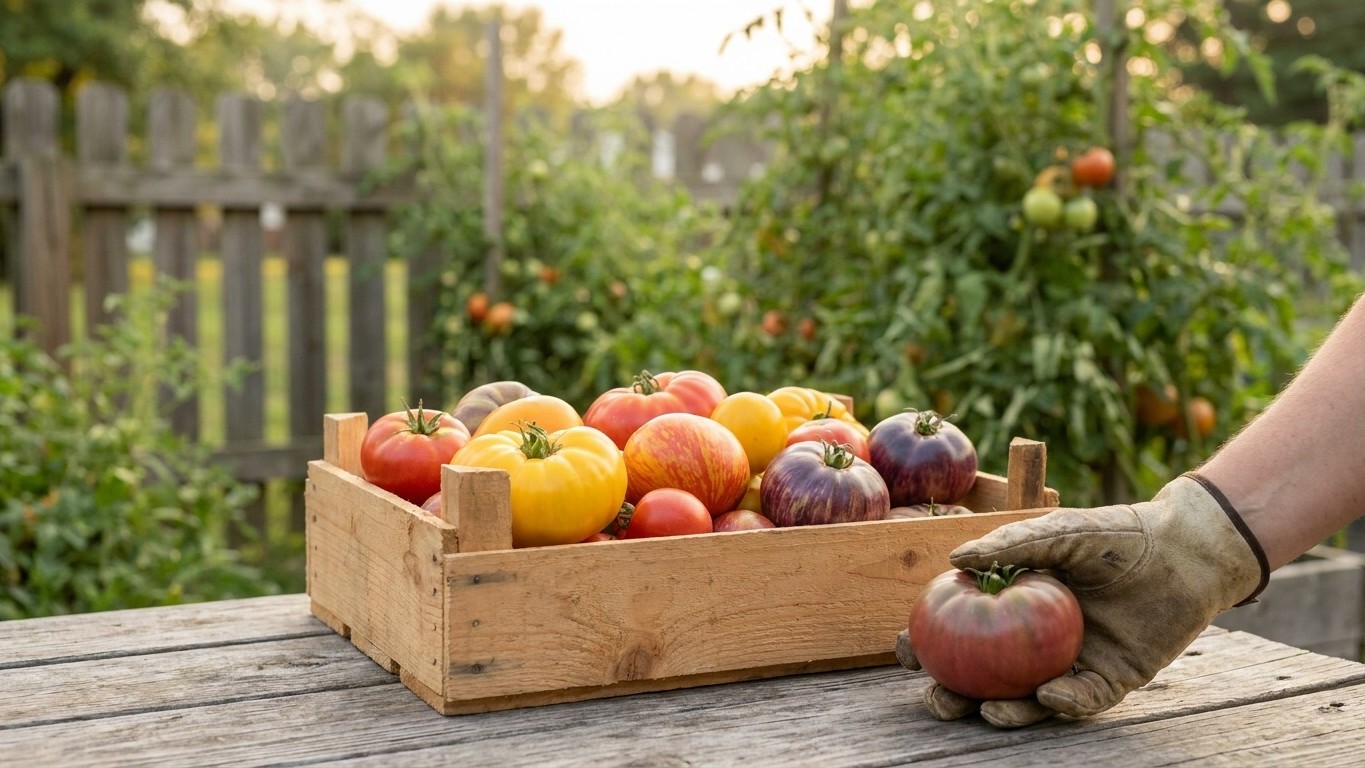

Kentucky’s growing season, measured at Louisville by NOAA’s 1991-2020 Climate Normals, runs from a last spring freeze of March 24 to April 4 to a first fall freeze of November 2 to November 12, which is roughly seven months between frosts. Every cultivar named below is calculated to finish well inside that window when set out in the early-to-mid April transplant range those dates allow. Confirm your own frost risk against your county extension office before you commit a planting date, since Louisville’s urban station runs later in spring and earlier in fall than the rural counties around it.
What this comes down to in Kentucky

Sakura tomatoes ripen in about fifty-five days, landing a first harvest by mid June and leaving a full 143 days before Louisville’s fall frost closes the season. That kind of margin isn’t luck — it’s math, and it holds for nine other cultivars too, from Sun Gold and Juliet down through Cherokee Purple and Big Beef Plus, each one clearing frost with days to spare when set out as an April transplant.
The table below lines up all ten cultivars by days to maturity, plant type, calculated first-ripe date, and the margin of days left before the Louisville-area frost window opens in fall. All figures assume a transplant set out in the early-to-mid April window.
| Cultivar | Days to Maturity | Type | First Ripe | Margin Before Frost |
|---|---|---|---|---|
| Sakura | 55 | Indeterminate | Mid June | 143 days |
| Sun Gold | 57 | Indeterminate | Mid June | 141 days |
| Supersweet 100 | 60 | Indeterminate | Mid June | 138 days |
| Juliet | 60 | Indeterminate | Mid June | 138 days |
| Jasper | 60 | Indeterminate | Mid June | 138 days |
| Amalfi | 68 | Determinate | Late June | 130 days |
| Cherokee Purple | 72 | Indeterminate | Late June | 126 days |
| Big Beef Plus | 72 | Indeterminate | Late June | 126 days |
| San Marzano II | 78 | Indeterminate | Early July | 120 days |
| Amish Paste | 85 | Indeterminate | Mid July | 113 days |
Sakura
Sakura reaches its first ripe fruit in about 55 days from transplant, the fastest cultivar on this list, producing small, glossy, deep red cherry tomatoes. Set out early to mid April, it is calculated to be picking by mid June, with about 143 days of margin before the Louisville-area frost window opens. It carries high resistance to Tobacco Mosaic Virus and to Fusarium Wilt race 1, useful on ground that has grown tomatoes before.
Sun Gold
Sun Gold matures in about 57 days and produces small, golden-orange cherry tomatoes known for their sweetness rather than their looks. It shares Sakura’s mid-June first-ripe date and about 141 days of margin, and its high resistance to Tobacco Mosaic Virus and Fusarium Wilt race 1 makes it dependable on repeat tomato ground.
Supersweet 100
Supersweet 100 needs about 60 days from transplant to its first small, red cherry fruit, carried in long, heavy clusters. It has high resistance to Verticillium Wilt and Fusarium Wilt race 1, and with about 138 days of margin before frost, a slow start from transplant shock still leaves plenty of season in hand.
Juliet
Juliet also runs about 60 days and yields small, oblong, deep red grape tomatoes that hold their shape well off the vine, useful for canning or roasting whole. Its intermediate resistance to Late Blight and Early Blight matters more in Kentucky’s humid summers than its speed does, since both diseases show up on schedule most years.
Jasper
Jasper finishes in about 60 days with small, round, red cherry fruit, and carries the strongest disease package among the fast cultivars here: high resistance to Late Blight and intermediate resistance to Early Blight. That combination makes it worth choosing over a less resistant cherry tomato in a wet summer, even though the fruit itself is unremarkable next to Sun Gold or Sakura.
Amalfi
Amalfi is a 68-day determinate plum tomato bred for sauce, with a blocky, oblong, matte red fruit that ripens on a compact bush suited to a container or a small bed. Its intermediate resistance to both Late Blight and Early Blight, plus intermediate nematode tolerance, makes it one of the better-defended paste tomatoes on this list for Kentucky’s heavy clay soils.
Cherokee Purple
Cherokee Purple takes about 72 days and produces a large, flattened, dusky pink-purple beefsteak with darker shoulders, grown for flavor rather than yield. It carries no listed disease resistance, so it depends on the calendar and on good garden hygiene, and even so it is calculated to ripen with about 126 days to spare before frost.
Big Beef Plus
Big Beef Plus matures in about 72 days into a large, smooth, bright red beefsteak, and unlike Cherokee Purple it comes with intermediate nematode tolerance and high resistance to Gray Leaf Spot and Tomato Mosaic Virus. For a gardener who wants beefsteak size without giving up disease defense, this is the trade Cherokee Purple does not offer.
San Marzano II
San Marzano II needs about 78 days to its first long, narrow, red paste fruit, the shape most associated with canned sauce. First ripe in early July from an early-to-mid April transplant, it still carries about 120 days of margin before the Louisville-area frost window, more buffer than most sauce tomatoes need in this state.
Amish Paste
Amish Paste is the slowest cultivar on this list at about 85 days, producing a medium-large, red, oxheart-shaped fruit valued for its meaty interior. Even at that pace, an early-to-mid April transplant is calculated to ripen by mid July with about 113 days left before frost, the tightest margin here but still a comfortable one on Louisville’s normals.
Working it out for your own garden
To set a transplant date without leaning on a fixed calendar day, start from NOAA’s Louisville range for the last spring freeze, March 24 to April 4, and add a week or two of buffer for the soil to warm before tomatoes go into it. That gives a transplant window of early to mid April for the area NOAA measures around Louisville, which is exactly why every cultivar above is calculated from that same window. For the full week-by-week breakdown of that calculation, see Tomato Planting Dates in Kentucky: Counting Back From Your Frost Window.
A worked example, end to end
Take San Marzano II, an indeterminate paste tomato listed at 78 days from transplant. Set out early to mid April, it gives a first-ripe range of early July. Counting forward from July to NOAA’s Louisville fall freeze range of November 2 to November 12 leaves about 120 days of margin, well more than enough room for a slow finish in a cool summer.
Amish Paste, at 85 days, is the cultivar with the least room to spare on this list. Set out in the same early-to-mid April window, it is calculated to ripen by mid July, leaving about 113 days before the Louisville frost range opens. That is still well over three months of buffer, which is the real answer to whether Kentucky’s season is long enough for a slow heirloom paste tomato: it is, as long as the transplant date holds. A transplant delayed into late May by a cold, wet spring eats into that buffer directly, and it is the delay, not the cultivar’s catalogue number, that decides whether an 85-day tomato actually finishes on time.
What changes across the state
Louisville sits in the Ohio River valley, and NOAA’s frost data for that station runs later in spring and earlier in fall than much of the surrounding countryside, a gap that NWS Louisville itself flags for rural Jefferson County. The effect grows larger the further you get from the river.
Eastern Kentucky’s higher elevation in the Appalachian foothills holds cold air longer into spring and lets it settle in earlier come fall, so a garden there should plan for its own frost window to open and close inside a narrower gap than Louisville’s. Western Kentucky’s lower, flatter ground near the Mississippi and Ohio confluence tends to warm earlier and hold heat later into fall, closer to Louisville’s numbers or slightly milder still.
USDA’s Plant Hardiness Zone Map puts the state across zones 6a to 7a, a full zone of spread between the coolest uplands and the warmest river bottoms. That spread is reason enough to treat every date in this article as a Louisville-anchored starting point, not a statewide instruction, and to shift your own transplant window earlier or later by however many days your local frost data run relative to Louisville’s.
The mistakes this state punishes

The most common mistake is setting transplants out during a warm stretch in late March without checking the soil itself, only to have a cold snap arrive inside NOAA’s own freeze-probability window and set the plants back for weeks. Tomatoes that stall from cold shock rarely catch up to their catalogue days-to-maturity number, even once the weather turns for good.
The second is picking a slow heirloom for its flavor and assuming the whole season is available for it regardless of when it actually goes in the ground. Kentucky’s frost gap is long enough for even an 85-day tomato like Amish Paste, but stacking a late transplant on top of a long-season cultivar removes the exact buffer that made the choice safe in the first place.
The third is choosing on speed alone and ignoring disease pressure. A fast cherry tomato with no listed resistance can still lose most of its crop to a wet-summer disease that a resistant cultivar like Big Beef Plus or Jasper would shrug off, so days to maturity is only half of what should decide a variety. Kentucky’s own tomato pest and disease pressure, covered in Tomato Pests in Kentucky: Which Ones Actually Show Up Here, is worth checking before you settle on a cultivar for speed alone.
Checking this against your county
Louisville’s frost dates are the only precise figures in this article, and NOAA itself notes that its urban station runs later in spring and earlier in fall than the rural counties around it, so treat every date here as a starting point rather than an instruction for your own yard. The University of Kentucky’s Cooperative Extension Service, at extension.ca.uky.edu, connects to your county’s own office, which keeps the closest thing to a local frost record for your soil and elevation. Call before you finalize a transplant date, especially if you garden outside the Louisville area.
Common questions
Are the days-to-maturity numbers on the seed packet counted from seed or from transplant?
For tomatoes, that number is almost always counted from transplant, not from the day you sow seed.
Can I grow a heirloom longer than 85 days that isn’t on this list?
Possibly, if you run the same arithmetic used above: count the catalogue days forward from an early-to-mid April transplant and compare the result to NOAA’s Louisville fall freeze range of November 2 to November 12. If the margin looks thin, treat the transplant date as fixed and do not let it slip, since a late spring is what actually eats the buffer.
Will an indeterminate variety like Cherokee Purple or Big Beef Plus keep producing until frost?
Indeterminate vines keep flowering and setting new fruit right up until frost or disease shuts them down, unlike a determinate plant such as Amalfi, which sets most of its crop in one flush and then tapers off. That is why an indeterminate cultivar’s “first ripe” date is really just the start of a harvest window, not the whole story.
What do I do if a late cold spring pushes my transplant date past mid April?
The planting calendar breakdown at Tomato Planting Dates in Kentucky: Counting Back From Your Frost Window walks through that recalculation step by step.