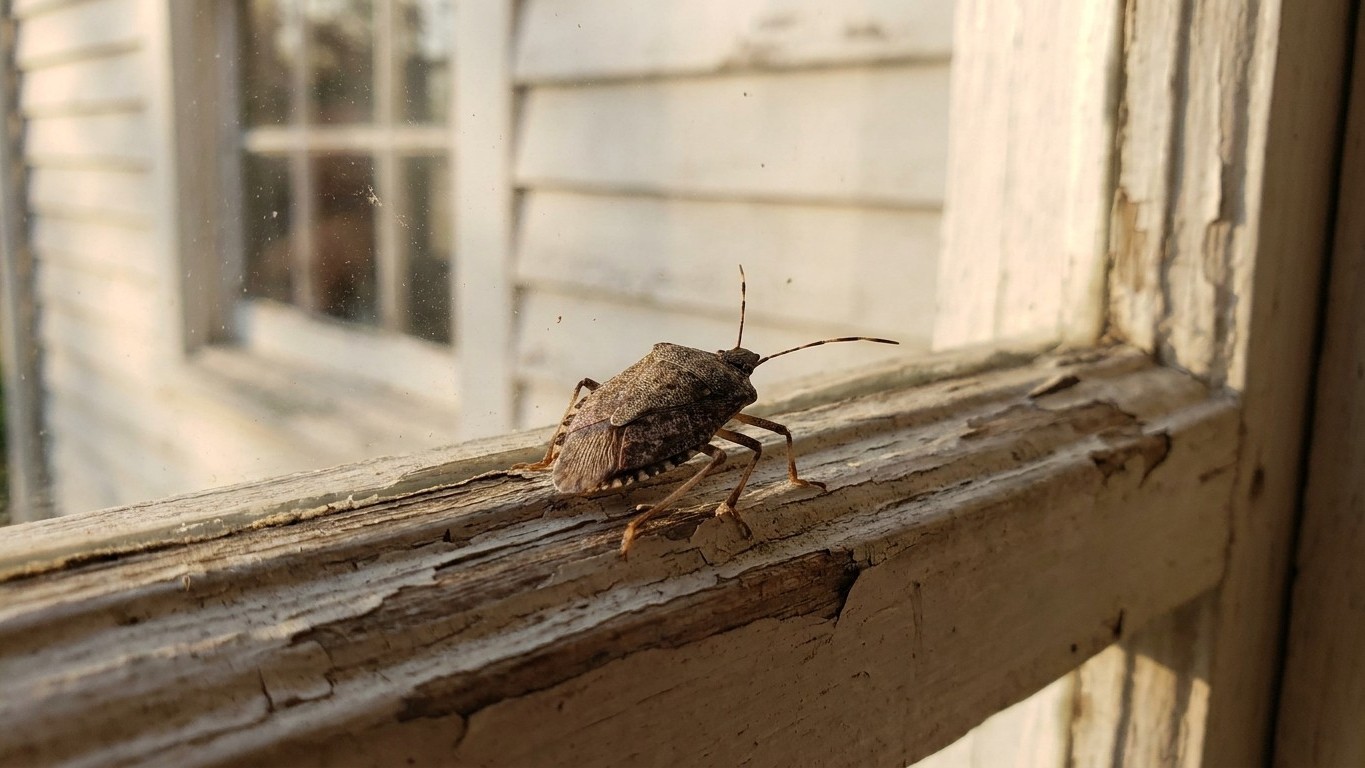

Brown marmorated stink bugs show up in Kentucky homes twice a year on a predictable schedule: a fall invasion that peaks from mid-September through late October, and a spring re-emergence in April and May once temperatures climb past the mid-60s. What stops them isn’t a single spray or trap. It’s sealing the building envelope before the fall push begins, combined with targeted outdoor management during the growing season when they’re feeding on fruit, vegetables, and field crops.
How Long Has This Bug Been in Kentucky?

Halyomorpha halys, the species’ scientific name, hitchhiked into the United States from East Asia in the late 1990s, first turning up near Allentown, Pennsylvania. It took roughly a decade to work its way into the Ohio Valley. Kentucky’s confirmed populations date back to the early 2010s, with the heaviest concentrations now found in Fayette, Jefferson, Boone, Kenton, and Campbell counties, though isolated sightings have been reported statewide as the insect continues to spread along interstate corridors and through nursery stock shipments.
Unlike native stink bug species that have kept a relatively low profile in Kentucky for generations, this Asian import has no effective natural predator here. Native parasitic wasps and birds occasionally pick off a few, but nothing keeps population growth in check the way it does back in Asia. That’s the core reason it’s become a nuisance pest in both homes and commercial agriculture across the Bluegrass State.
When It Shows Up: The Two-Season Pattern
Fall is when most Kentucky homeowners notice them. As daylight shortens and nighttime temperatures drop into the 50s, adult stink bugs abandon soybean fields, orchards, and ornamental shrubs and go looking for a place to overwinter. Houses, barns, and sheds with sun-warmed south and west-facing walls become magnets. They squeeze through gaps around window air conditioners, attic vents, chimney flashing, and utility penetrations that are barely a quarter-inch wide.
Once inside, they don’t breed. They go dormant in wall voids, attics, and unused rooms, sometimes in clusters of dozens. A warm spell in January or February can trick a few into becoming active indoors, which is why some Kentucky residents report seeing “winter” stink bugs wandering across ceilings during a January thaw.
The second wave happens in spring. Surviving adults wake up as temperatures rise, and this is when interior sightings spike again, usually April into May, as the bugs search for a way back outside to feed and lay eggs. Females can lay 20 to 30 eggs per cluster on the underside of leaves, with multiple generations possible from May through September in Kentucky’s climate, depending on how warm the summer runs.
What Kentucky Crops Are at Risk
Commercial growers in the state watch this insect closely because it’s a plant-juice feeder with a wide host range. In Kentucky, documented feeding damage includes:
- Apples and peaches, where feeding causes internal browning and corky, cat-facing scars that make fruit unmarketable
- Tomatoes and peppers in home gardens and market farms, showing cloudy or discolored spots at the feeding site
- Soybeans, one of Kentucky’s largest row crops, where pod feeding reduces seed size and yield
- Ornamental trees and shrubs like butterfly bush and catalpa, which serve as reproductive hosts even when damage isn’t the main concern
The University of Kentucky’s entomology program has tracked BMSB alongside other invasive stink bug species for years as part of broader integrated pest management outreach to the state’s fruit and soybean growers.
How to Identify It (and Not Confuse It With Look-Alikes)
Adults measure about five-eighths of an inch, roughly the size of a large ladybug stretched into a shield shape. The name comes from the mottled brown pattern across the back, but the giveaway features are the alternating light and dark bands on the antennae and the edges of the abdomen, which peek out slightly from under the wings like a scalloped trim. Nymphs look nothing like adults at first, appearing almost black and red before molting through gray-and-black stages.
Kentucky has several native stink bugs that get mistaken for this species, including the brown stink bug and the spined soldier bug (which is actually beneficial, since it preys on caterpillars). The antenna bands are the fastest field check: solid brown antennae point to a native species, while distinct white or light bands point to the marmorated invader.
What Actually Stops Them Indoors
Pesticide sprays applied after the bugs are already inside the walls do very little. The insects are tucked into insulation and framing cavities where liquid treatments rarely reach, and killing them there just leaves carcasses that attract carpet beetles later. Prevention built around exclusion works far better than reactive spraying.
Caulking gaps around window frames, door thresholds, dryer vents, and cable or pipe penetrations before mid-September closes off the main entry routes. Fine mesh screening (20-mesh or finer) over attic and soffit vents blocks a route many homeowners overlook entirely. Weatherstripping on garage doors and gaps under exterior doors matters more than people expect, since stink bugs will walk several feet along a foundation looking for the path of least resistance.
Exterior light matters too. Bright porch lights and lit windows in September and October act like a beacon during the exact weeks the bugs are searching for shelter. Swapping to yellow “bug light” bulbs or simply turning off unnecessary exterior lighting during peak migration weeks measurably cuts down how many land on siding near entry points.
For bugs that already made it indoors, a shop vacuum with a disposable bag beats swatting every time. Crushing releases the defensive odor the species is named for, an unpleasant, lingering smell some describe as similar to cilantro gone bad or rancid cashews. Emptying the vacuum bag outdoors right after use prevents the scent from settling into carpet or furniture.
Pheromone Traps and Their Real Limits
Commercial aggregation-pheromone traps are sold widely and do capture stink bugs, but research from land-grant universities monitoring BMSB populations has generally found these traps work better as a monitoring tool to track local activity than as a way to meaningfully reduce a household infestation. They tend to draw bugs toward the trap location, which can mean more insects near the house rather than fewer, so placement well away from siding and entry points is important if they’re used at all.
Outdoor Control During the Growing Season
For anyone growing tomatoes, peppers, or tree fruit in Kentucky, timing matters more than product choice. Scouting weekly starting in June, checking the undersides of leaves for the barrel-shaped egg clusters, and physically removing and destroying them prevents a generation from ever reaching adulthood. Egg masses are pale and roughly the size of a dime, laid in tight rows of 20 to 30.
Row covers protect young vegetable plants during early feeding windows, though they need to come off once flowering starts to allow pollination. Trap crops, particularly sunflowers or sorghum planted along a garden’s perimeter, can pull feeding pressure away from the main crop since BMSB shows a strong preference for certain plants over others.
When insecticide use is warranted for commercial or heavy home-garden infestations, timing sprays for early morning or evening when bugs are most active on foliage improves results, and rotating modes of action helps slow resistance development, a growing concern flagged by researchers tracking this species across the mid-Atlantic and Midwest.
The StopBMSB.org research consortium, a partnership of land-grant universities including work coordinated through USDA funding, tracks regional population data and offers updated management guidance specific to different crops and climate zones, useful for Kentucky growers comparing notes with states facing similar pressure.
Professional Treatment: When It’s Worth Calling Someone
Homes with a documented history of large fall aggregations (dozens to hundreds of bugs clustering on one wall) sometimes benefit from a perimeter treatment applied by a licensed pest control company in early September, before the migration starts. This creates a barrier on exterior siding and around foundation entry points rather than treating the interior. It’s not a permanent fix since re-treatment is typically needed each fall, but for homes on wooded lots or near orchards and soybean fields, where pressure is heaviest, it can noticeably cut down how many make it inside compared to sealing alone.
Kentucky’s stink bug population isn’t going anywhere soon. Entomologists monitoring the species across the Ohio Valley expect numbers to keep climbing gradually as it fills in the remaining counties where it hasn’t yet established a foothold, which means the September sealing routine is likely to become as much a part of fall home maintenance in Kentucky as cleaning gutters or checking the furnace.
Related guides
- Brown marmorated stink bug in Indiana: When It Shows Up and What Stops It
- Brown marmorated stink bug in Missouri: When It Shows Up and What Stops It
- Brown marmorated stink bug in Maryland: When It Shows Up and What Stops It
- Brown marmorated stink bug in Montana: When It Shows Up and What Stops It
- Brown marmorated stink bug in Quebec: When It Shows Up and What Stops It