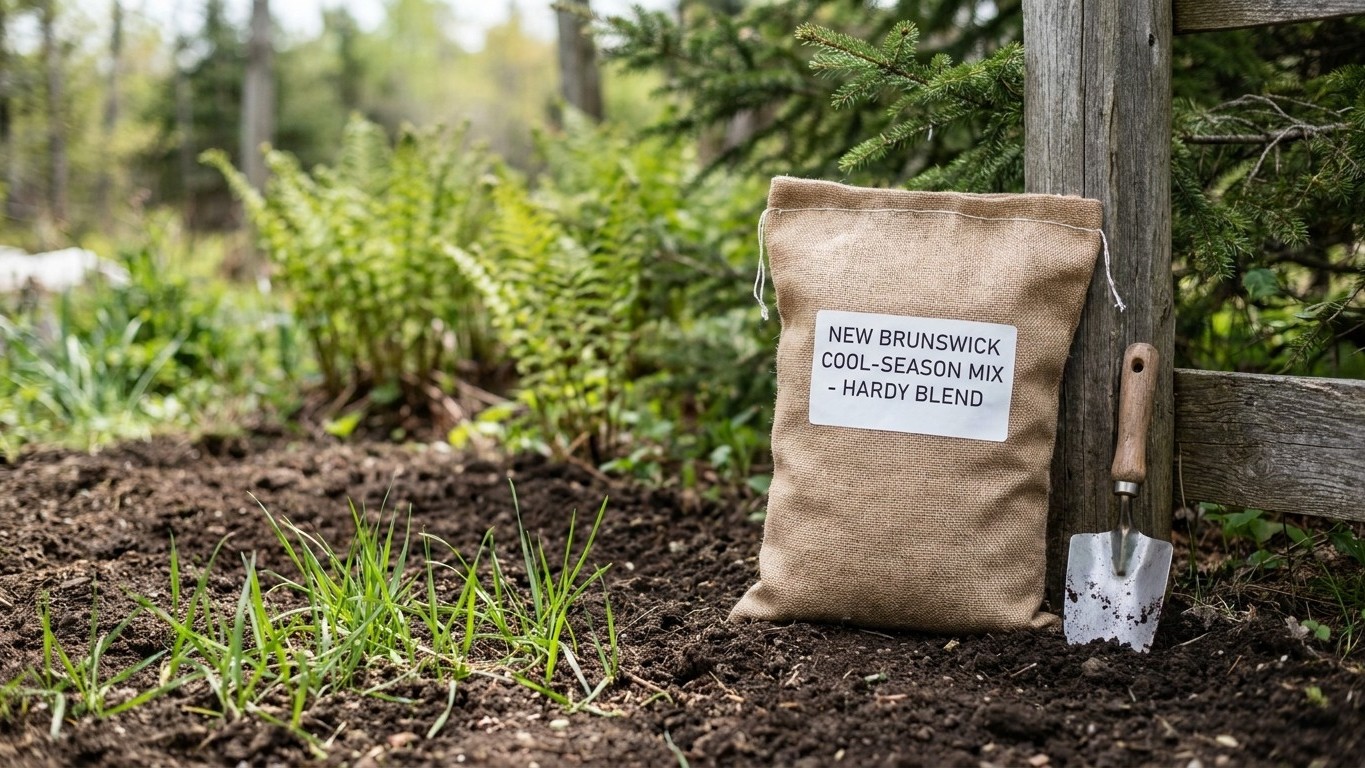

The best grass seed for a New Brunswick lawn comes from the cool-season group: Kentucky bluegrass, perennial ryegrass, fine fescues, tall fescue, and rough bluegrass, the five species Clemson Cooperative Extension (HGIC 1214) and Penn State Extension list for cool-season turf. New Brunswick falls in the cool-season zone, the classification The Homestead Post assigns from local climate normals read against Clemson’s published season tolerances. Before buying a bag, check how much sun and foot traffic the area actually gets, since that decides which of the five earns its place.
The short answer for New Brunswick
What the choice depends on
No warm-season grass belongs in a New Brunswick lawn. Species like Bermuda or Zoysia need a long hot growing season to establish and store enough energy to survive winter, and this territory doesn’t offer one. The real decision is among the cool-season species, and it comes down to what the lawn has to survive: shade from mature trees, a dry slope, a side yard that takes a beating from kids or a dog, or a low spot that stays damp into June.
Most established New Brunswick lawns run a blend rather than a single species, because no one grass covers every weakness. A typical mix pairs Kentucky bluegrass for its self-repairing sod with perennial ryegrass for fast cover and a measure of fine fescue for the shady corners. Fall seeding gives the most reliable stand, because cool-season grasses root best once the soil has stopped baking and before the ground goes cold. If you haven’t already worked through soil prep, mowing height, and the rest of the seasonal routine, that groundwork is laid out in New Brunswick Lawn Care.
Working through the year

Ranked by how much each one asks of the site and gives back, the order runs roughly Kentucky bluegrass, perennial ryegrass, tall fescue, fine fescue, and rough bluegrass as the specialist. None of them is free of a tradeoff.
Kentucky Bluegrass

This is the species most people picture as a lawn: dense, fine-bladed, and able to knit a bare patch closed on its own because it spreads by rhizome. The cost is time. It germinates slowly next to the others and needs decent sun and consistent water while it’s getting established.
Perennial Ryegrass

Ryegrass germinates fast, often before bluegrass has even broken the surface, and it holds up well to foot traffic once mature. It doesn’t spread by rhizome or stolon though, so a bare patch stays bare unless you overseed it. That’s why it’s usually the nurse grass in a blend rather than a lawn on its own.
Tall Fescue

Tall fescue roots deeper than the other four, which is what gets it through a dry stretch without browning as fast. In exchange, its blade is coarser and more visibly ribbed, so mixed with fine-textured grasses it can look patchy rather than blended. It’s also a clump former, not a spreader.
Fine Fescues

Creeping red, hard, and chewings fescue are grouped together here, and they’re the shade specialists of the group, with thread-fine blades and low fertility needs. Their weakness is wear. A path worn across a fine fescue lawn thins out fast and is slow to fill back in.
Rough Bluegrass

Rough bluegrass, or Poa trivialis, is a narrow specialist for constantly moist shade, spreading by surface stolons into a pale, glossy mat. The moment its bed dries out or gets real sun, it thins and yellows. Treat it as a patch grass for one damp shady corner, not a whole-lawn seed.
| Species | Sun/Shade | Drought tolerance | Wear tolerance | Establishment speed |
|---|---|---|---|---|
| Kentucky bluegrass | Full sun to light shade | Fair | Good (self-repairs) | Slow |
| Perennial ryegrass | Full sun | Fair | Good | Fast |
| Tall fescue | Sun to moderate shade | Good | Good | Moderate |
| Fine fescues | Shade | Fair to good | Poor | Moderate |
| Rough bluegrass | Moist shade only | Poor | Poor | Fast |
Clemson Cooperative Extension’s Tall Fescue Maintenance Calendar (HGIC 1219) lays out a seasonal rhythm that applies to every grass on this list even though the calendar itself is written for South Carolina’s climate: the heavier feedings go into cool-season turf during spring and fall, not summer, and mowing height goes up rather than down once summer heat sets in. The actual months that rhythm falls into here are different from South Carolina’s, and the New Brunswick-specific version, tied to Environment and Climate Change Canada’s Moncton normals, is worked month by month in The New Brunswick Lawn Care Calendar, Month by Month. For seeding specifically, the safest window closes around the average first fall frost, which Environment and Climate Change Canada’s 1981-2010 normals put at October 2 for the Moncton station. That’s a mean date, not a guarantee, so in roughly half of all years frost arrives later than that and in half it arrives earlier.
What changes across New Brunswick
Coast, valley, and elevation
Moncton’s proximity to that water moderates its swings somewhat compared with inland sites. Fredericton, sitting inland along the upper Saint John River valley, runs more continental, with colder winter lows and sharper seasonal swings than the coast sees.
Saint John, on the Bay of Fundy, deals with persistent fog and cooler, cloudier summers that can slow cool-season turf growth even in July. Northern New Brunswick, through Restigouche County and the Chaleur region, sits at higher elevation and further inland, and that combination means frost typically arrives earlier there than at Moncton, shortening the safe fall seeding window by real weeks, not days. A gardener in that region should treat the Moncton-based date as already late, not as a target.
The mistakes this climate punishes
Timing errors that show up months later
Seeding cool-season grass in the heat of July is the most common one. Seedlings that germinate into a hot, dry stretch dry out before their roots go deep enough, and the failure shows up almost immediately as bare, crusted soil rather than a thin green haze.
Missing the fall window in the other direction does more quiet damage. Because the average first fall frost at Moncton is only a mean, seeding too late in September gambles on an early year. Grass that hasn’t built enough root mass before the ground freezes won’t show its damage until spring, when the whole area comes back thin or doesn’t come back at all.
Cutting cool-season turf short during a summer dry spell is the third. A lawn mowed too low loses the shade its own canopy would give the soil, and it browns faster under drought stress. That browning is not death. Cool-season turf that browns from drought or heat typically greens back up once cooler, wetter weather returns, and cutting it shorter to “clean it up” while it’s stressed only slows that recovery.
Heavy nitrogen feeding late in fall is the fourth, and it’s tempting because the grass looks like it wants it. Pushing lush new growth right before the ground freezes leaves soft tissue that’s more vulnerable to snow mold under a long winter cover of snow, and the mistake doesn’t show until the snow melts.
Planting a warm-season species like Zoysia or Bermuda out of habit or a mail-order catalog is the last, and the simplest to avoid: those grasses are built for a long hot season this territory doesn’t have, and they will not survive a New Brunswick winter at all.
Checking this against your county
Before you commit to a seeding date, check current conditions and any provincial guidance through Agriculture and Agri-Food Canada at agriculture.canada.ca, which is given here because the provincial department’s own site currently blocks automated verification. Your county’s own frost pattern, not Moncton’s, is the one that decides whether seed goes down this week or next.
Common questions
Can I plant grass seed in spring instead of fall in New Brunswick?
Yes, but it’s the second choice, not the equal one. Spring-seeded cool-season grass has to compete with weed seeds that are germinating at the same time, and the soil is often still cold and slow to support root growth, so establishment tends to be patchier than a fall planting.
Why did my new grass turn brown after the first frost?
A light frost on young cool-season seedlings usually causes leaf browning without killing the plant, since the growing point sits below the soil surface. Watch for regrowth once temperatures moderate before assuming the seeding failed.
What’s the difference between rough bluegrass and Kentucky bluegrass?
They’re different species despite the shared name. Rough bluegrass, Poa trivialis, is a shallow-rooted, stolon-spreading grass that only performs in constant moisture and shade, while Kentucky bluegrass is the deeper-rooted, rhizome-spreading species suited to a full sun to light shade lawn.
Can I use a warm-season grass like Zoysia here if I pick a hardy variety?
No variety of a warm-season species is bred to survive a New Brunswick winter. These grasses need sustained heat to build the energy reserves that carry them through dormancy, and this territory’s growing season doesn’t provide it regardless of the cultivar.