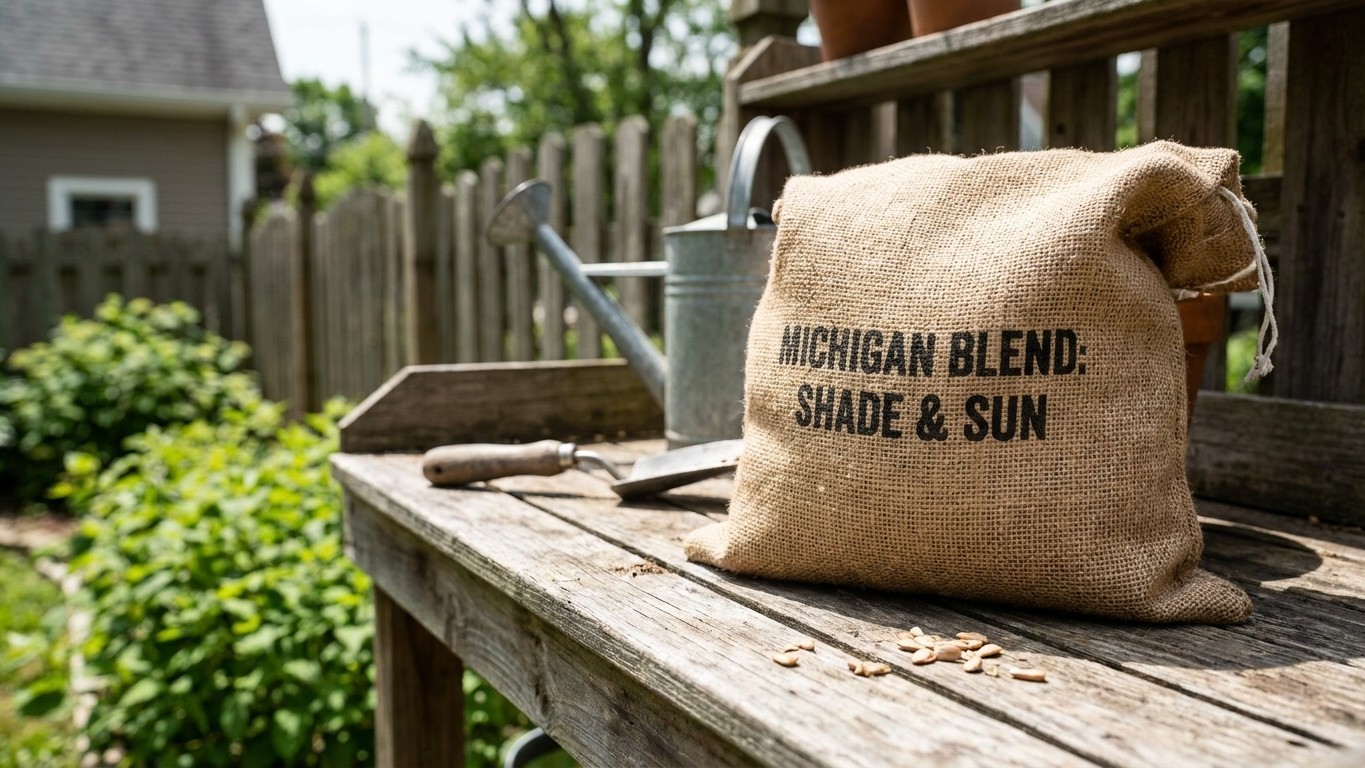

The best grass seed for a Michigan lawn is a cool-season species, not a warm-season one: Kentucky Bluegrass, Tall Fescue, Perennial Ryegrass, Fine Fescue or Rough Bluegrass, the five species Clemson Cooperative Extension (HGIC 1214) and Penn State Extension list for cool-season lawns. Near Detroit, which The Homestead Post placed in the cool-season zone using regional climate normals, any of the five will survive winter. The one that fits a given yard comes down to sun and foot traffic, so check both before buying a bag of seed.
The short answer for Michigan
Michigan winters decide your grass seed before you do: anything bred for southern heat is dead by February, which is why the choice narrows to five cool-season species — Kentucky Bluegrass, Tall Fescue, Perennial Ryegrass, Fine Fescue, or Rough Bluegrass. All five survive here, so the real question isn’t which one lives, it’s which one fits the ground you’re standing on. Walk your lawn and note how much sun it gets and how much foot traffic it takes — that’s what actually narrows the bag you buy, not the county you live in or the calendar on the wall.
What the choice depends on
Which of the five performs best depends on conditions specific to the yard, not the county it sits in:
- How much direct sun the lawn gets each day
- Whether foot traffic or pets wear down the turf
- How much irrigation or rainfall the site can count on in summer
- Whether the lawn is new or being overseeded into an existing stand
The seeding window itself is tied to the first fall frost, which MSU Extension’s Michigan Garden Calendar puts at October 6 to October 21 for zone 6a, measured near Detroit. Cool-season grass seed germinates best in the weeks ahead of that frost window, when soil is still warm but air temperatures have dropped enough to slow weed competition. Gardeners farther from Detroit should expect that window to shift, a point the next section covers.
Working through the year

Ranking the cool-season options
| Species | Sun needs | Traffic tolerance | Drought tolerance | Establishes from seed |
|---|---|---|---|---|
| Kentucky Bluegrass | Full sun | Good, self-repairs by rhizome | Fair, goes dormant in drought | Slow, several weeks to germinate |
| Tall Fescue | Full sun to light shade | Very good, deep roots | Good once established | Moderate, one to two weeks |
| Perennial Ryegrass | Full sun to light shade | Fair, no rhizomes to self-repair | Poor | Fast, under two weeks |
| Fine Fescue | Shade tolerant | Poor, thin blades wear quickly | Good, fine deep roots | Moderate |
| Rough Bluegrass | Shade, wet soil | Poor | Very poor, needs steady moisture | Moderate |
Kentucky Bluegrass tops most lists for a manicured, uniform lawn in full sun. It spreads by underground rhizomes, so nicks and bare patches fill in on their own, but it takes the longest of the five to establish from seed and needs the most consistent watering through its first summer. Tall Fescue trades some of that fine texture for toughness, with coarser blades and deep roots that handle a backyard used hard by kids or dogs. Perennial Ryegrass germinates fastest of the group, which is why it shows up in overseed mixes and erosion-control blends, but it lacks rhizomes, so it cannot repair itself the way bluegrass can. Fine Fescues are the shade specialists, holding up under trees where the other four thin out, at the cost of poor traffic tolerance. Rough Bluegrass, also called Poa trivialis, fills a narrow niche of damp, shaded ground where little else will grow, and struggles the moment that ground dries out.
The maintenance rhythm
Clemson Cooperative Extension’s Tall Fescue Maintenance Calendar (HGIC 1219) lays out a working pattern that applies to any of these cool-season grasses: mow high through the heat of summer to shade the soil and protect the roots, feed nitrogen mainly in fall when the plant is building root reserves rather than top growth, and aerate and overseed once temperatures cool. In Michigan, that fall work needs to land ahead of MSU Extension’s first-frost window of October 6 to October 21 near Detroit, since seed needs several weeks of mild soil to root before winter. Exact mowing heights and nitrogen rates vary by species and by product label, so check the bag and the calendar rather than guessing. What carries across every cool-season lawn is the sequence: feed and seed in fall, mow high and water deeply in summer, not the other way around.
What changes across Michigan
Colder ground to the north
The cool-season label above is measured near Detroit, and the rest of the state does not warm or cool at the same pace. The Upper Peninsula and the interior northern Lower Peninsula sit in a colder pocket, with a growing season that starts later in spring and closes earlier in fall than the Detroit-area window MSU Extension uses for its October 6 to October 21 frost date. A lawn seeded on that same schedule farther north risks going into cold soil before roots have time to establish.
The lake effect and low ground
Lake Michigan and Lake Huron moderate the immediate shoreline in both directions. Waterfront lawns often see a later first frost in fall than inland ground just a few miles away, because the lake releases stored summer heat slowly through autumn. That same effect can delay spring green-up on the west side of the state, where cold air moving off the lake keeps soil temperatures down longer than at inland sites.
Local topography plays a smaller but real role too. Low ground that collects cold air overnight, sometimes called a frost pocket, can see frost weeks before a slope or ridge a short distance away. None of this changes which of the five cool-season species will grow, since all five tolerate Michigan winters, but it does shift exactly when to seed, mow the last cut of the season, or put down fall nitrogen. A gardener working land away from Detroit should treat the MSU dates in this article as a starting range and adjust using their own county’s office, covered in the last section below.
The mistakes this climate punishes
Timing mistakes
Seeding cool-season grass in the heat of summer is the most common mistake we see near Detroit. Seed sown in July germinates poorly in hot soil, and any seedlings that do sprout usually burn off before their roots reach deep enough to survive August dry spells. The fix is patience: wait for the weeks ahead of MSU Extension’s October 6 to October 21 frost window, when soil is still warm enough to germinate but air temperatures have eased.
Planting a warm-season grass like Bermuda or zoysia because it is cheap or drought-tough is a mistake that shows up the following spring, not the season it is planted. Those species stay green through a Michigan summer but do not survive the winter here, so the lawn that looked fine in October is dead by April, and the whole project starts over.
Feeding and mowing mistakes
Mowing too short during a hot, dry summer is another one that shows up late. Scalping a cool-season lawn removes the leaf area the plant needs to shade its own roots and crown, and the damage does not show up as brown grass the next day. It shows up two or three weeks later as thin, patchy turf that struggles to recover even after rain returns, because the plant spent that window rebuilding leaf tissue instead of roots.
Skipping fall fertilizing in favor of a heavy spring feeding is a quieter mistake. Cool-season grasses build most of their root mass in fall, using nitrogen applied then to store energy through winter. A lawn fed hard in spring instead puts that nitrogen into leaf growth right when summer heat and drought stress are about to test the roots, leaving a thinner, shallower-rooted lawn heading into the next dry stretch. The full seasonal sequence, including where fall feeding falls relative to mowing and aeration, is laid out month by month in The Michigan Lawn Care Calendar, Month by Month.
Checking this against your county
Every figure in this article, from the frost window to the cool-season call itself, is anchored to Detroit, and Michigan runs from Lake Superior to the Ohio border. County-level data beats a statewide figure every time, and Michigan State University’s extension network keeps records on frost dates, soil types and lawn problems specific to each region. Find the office nearest a given property through MSU Extension’s outreach directory, and mention the county so the answer reflects local conditions rather than the Detroit-area baseline used here. For the groundwork that should happen before any seed goes down, including soil testing and site prep, see Michigan Lawn Care.
Common questions
Can I mix Kentucky bluegrass and tall fescue in the same bag of seed?
It is not the usual pairing. The two grow at different rates and want different mowing heights, so a heavy mix of the two tends to look patchy as one crowds the other. Bluegrass blended with perennial ryegrass, or tall fescue seeded on its own, are the more common combinations.
I missed the fall seeding window, is spring too late?
Spring seeding works but carries more risk, since young seedlings from a spring planting have to get through their first Michigan summer without the deep roots a fall-seeded lawn already has by then. If spring is the only option, expect to water more often through that first summer, and treat the next fall window as the better long-term fix.
Why does my fall-seeded lawn still look thin the next spring?
That is normal. Grass seeded in fall spends winter mostly dormant and puts on most of its thickening growth the following fall, not the spring right after planting. A thin look in April or May from a September seeding is not a sign of failure on its own.
Does a Michigan lawn need dethatching every single year?
Not automatically. Dethatching matters once a spongy layer of dead grass builds up thick enough to block water and nutrients from reaching the soil, which for most lawns takes more than one season to develop. Check by pulling back a small patch of turf and looking at the thatch layer before scheduling the job, rather than doing it on a fixed yearly habit.